


Barely half a year into his premiership, Japanese Prime Minister Shinzo Abe is provoking anger across Asia and mixed feelings in his country's key ally, the US. But will the administration of US President George W. Bush use its influence to nudge Abe away from his inflammatory behavior?
Before Abe, former prime minister Junichiro Koizumi was a mold-breaking leader, reviving Japan's economy, reforming the postal savings system and smashing the long-ruling Liberal Democratic Party's faction system. But Koizumi also legitimized a new Japanese nationalism, antagonizing China and South Korea by his annual visits to the Yasukuni shrine. If anything, Abe is even more committed to building an assertive and unapologetic Japan.
Anyone who believes that the Yasukuni controversy is an obscure historical matter that Chinese and Koreans use to badger Japan for political advantage has probably never spent much time there. The problem is not the 12 Class-A war criminals interred at the shrine; the real problem is the Yushukan Military Museum next door.
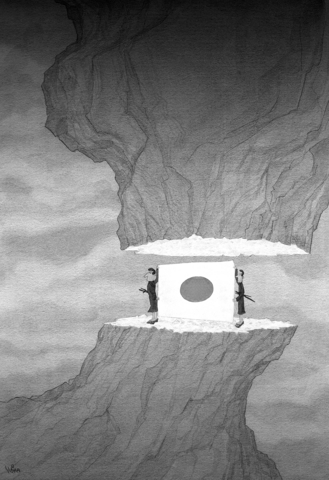
Walking past the Mitsubishi Zero, tanks, and machine guns on display in the museum, one finds a history of the Pacific War that restores "the Truth of Modern Japanese History."
It follows the nationalist narrative: Japan, a victim of the European colonial powers, sought only to protect the rest of Asia from them. Japan's colonial occupation of Korea, for example, is described as a "partnership." One looks in vain for any account of the victims of Japanese militarism in Nanjing or Manila.
One might be able to defend the museum as one viewpoint among many in a pluralist democracy. But there is no other museum in Japan that gives an alternative view of Japan's twentieth-century history. Successive Japanese governments have hidden behind the Yushukan museum's operation by a private religious organization to deny responsibility for the views expressed there.
That is an unconvincing stance. In fact, unlike Germany, Japan has never come to terms with its own responsibility for the Pacific War. Although socialist prime minister Tomiichi Murayama officially apologized to China in 1995 for the war, Japan has never had a genuine internal debate over its degree of responsibility, and has never made a determined effort to propagate an alternative account to that of Yushukan.
My exposure to the Japanese right came in the early 1990s, when I was on a couple of panels in Japan with Watanabe Soichi, who was selected by my Japanese publisher -- unbeknownst to me -- to translate my book The End of History and the Last Man into Japanese. Watanabe, a professor at Sophia University, was a collaborator of Shintaro Ishihara, the nationalist politician who wrote The Japan that Can Say No and is now the governor of Tokyo.
In the course of a couple of encounters, I heard him explain in front of large public audiences how the people of Manchuria had tears in their eyes when the occupying Kwantung Army left China, so grateful were they to Japan. According to Watanabe, the Pacific War boiled down to race, as the US was determined to keep a non-white people down. Watanabe is thus the equivalent of a Holocaust denier. But unlike his German counterparts, he easily draws large and sympathetic audiences. I am regularly sent books by Japanese writers "explaining" that the Nanjing Massacre was a big fraud.
Moreover, there have been several disturbing recent incidents in which physical intimidation has been used by nationalists against critics of Koizumi's Yasukuni visits, such as the firebombing of former prime ministerial candidate Kato Koichi's home. On the other hand, the publisher of the normally conservative Yomiuri Shimbun attacked Koizumi's Yasukuni visits and published a fascinating series of articles on responsibility for the war.
This leaves the US in a difficult position. A number of US strategists are eager to ring China with a NATO-like defensive barrier, building outward from the US-Japan Security Treaty. Since the final days of the Cold War, the US has been pushing Japan to rearm, and has officially supported a proposed revision of Article 9 of the postwar Constitution, which bans Japan from having a military or waging war.
But the US should be careful about what it wishes for. The legitimacy of the entire US military position in the Far East is built around the US exercising Japan's sovereign function of self-defense. Japan's unilateral revision of Article 9, viewed against the backdrop of its new nationalism, would isolate Japan from virtually the whole of Asia.
Revising Article 9 has long been part of Abe's agenda, but whether he pushes ahead with it will depend in large part on the kind of advice he gets from close friends in the US. Bush was unwilling to say anything about Japan's new nationalism to his "good friend Junichiro" out of gratitude for Japanese support in Iraq. Now that Japan has withdrawn its small contingent of troops, perhaps Bush will speak plainly to Abe.
Francis Fukuyama is dean of the School of Advanced International Studies, Johns Hopkins University, and chairman of The American Interest quarterly review.
Copyright: Project Syndicate/The American Interest
From the Iran war and nuclear weapons to tariffs and artificial intelligence, the agenda for this week’s Beijing summit between US President Donald Trump and Chinese President Xi Jinping (習近平) is packed. Xi would almost certainly bring up Taiwan, if only to demonstrate his inflexibility on the matter. However, no one needs to meet with Xi face-to-face to understand his stance. A visit to the National Museum of China in Beijing — in particular, the “Road to Rejuvenation” exhibition, which chronicles the rise and rule of the Chinese Communist Party — might be even more revealing. Xi took the members
A Pale View of Hills, a movie released last year, follows the story of a Japanese woman from Nagasaki who moved to Britain in the 1950s with her British husband and daughter from a previous marriage. The daughter was born at a time when memories of the US atomic bombing of Nagasaki during World War II and anxiety over the effects of nuclear radiation still haunted the community. It is a reflection on the legacy of the local and national trauma of the bombing that ended the period of Japanese militarism. A central theme of the movie is the need, at
The Chinese Nationalist Party (KMT) and the Taiwan People’s Party (TPP) on Friday used their legislative majority to push their version of a special defense budget bill to fund the purchase of US military equipment, with the combined spending capped at NT$780 billion (US$24.78 billion). The bill, which fell short of the Executive Yuan’s NT$1.25 trillion request, was passed by a 59-0 margin with 48 abstentions in the 113-seat legislature. KMT Chairwoman Cheng Li-wun (鄭麗文), who reportedly met with TPP Chairman Huang Kuo-chang (黃國昌) for a private meeting before holding a joint post-vote news conference, was said to have mobilized her
Before the Chinese Communist Party (CCP) and its People’s Liberation Army (PLA) can blockade, invade, and destroy the democracy on Taiwan, the CCP seeks to make the world an accomplice to Taiwan’s subjugation by harassing any government that confers any degree of marginal recognition, or defies the CCP’s “One China Principle” diktat that there is no free nation of Taiwan. For United States President Donald Trump’s upcoming May 14, 2026 visit to China, the CCP’s top wish has nothing to do with Trump’s ongoing dismantling of the CCP’s Axis of Evil. The CCP’s first demand is for Trump to cease US


 RSS
RSS