


"We are all Americans," wrote Le Monde on Sept. 12, 2001. And so it was with most people in the Muslim world, who were as appalled as anyone else at the carnage of the terrorist attacks on Washington and New York.
Indeed, when the US responded to the attacks, almost no one mourned the fall of the Taliban, who were universally condemned for their fanaticism.
This unanimity of opinion no longer exists, however.
In the five years since the attacks, two audiences for the so-called "war on terror" have emerged. Indeed, as the "war" progressed, the audience closest to the action began to see the emerging combat in a way that was diametrically opposed to that of the US and the West.
To the US administration, every act in the drama of the war on terror was seen as discrete and self-contained -- Afghanistan, Iraq, Palestine and Hezbollah in Lebanon.
The Bush administration, having proclaimed a war on terror, invaded and occupied countries, and yet failed to see that these events were being linked in the eyes of people in the region.
Glued to al Jazeera and other Arab satellite channels, the various battles of the "war on terror" came to be viewed as a single chain of events in a grand plot against Islam.
Worse yet, the US waved the banner of democracy as it prosecuted its wars. But hopes for democracy -- be it secular or Islamist -- for the people concerned have been buried in the rubble and carnage of Baghdad, Beirut and Kandahar.
Many Muslims understand the underlying causes of the alienation that animates Islamic radicalism and violence.
They know that the rigid dictatorships of the region have paralyzed their populations. Only those consumed by the fires of their rage seem able to melt the shackles of these authoritarian societies.
But the price of escape is a kind of deformation.
Embittered, fanatical and vengeful, those who rebel against the status quo enter the wider world seeking retaliation, not just against the regimes that deformed them, but against the West, which propped up the region's authoritarians in the interest of "stability."
Many Muslims also understand that the problem of Palestine, unsolved for three generations, goes beyond the suffering of the Palestinian people. They know that the region's dictators have used Palestine to justify their misrule and to avoid political and economic liberalization.
So when the US called for democracy, the hearts of many in the region soared with the hope that reform would come at last.
But the US, as so many times before, let them down. As people began to hope for more liberal and decent societies, the US continued to endorse the regimes that were repressing them. Washington simply could not adhere to its own democracy-promotion script.
After the ouster of the Taliban, the US turned its sights on the secular dictatorship of former president Saddam Hussein's Iraq.
Instead of encouraging reform of the Saudi-Wahhabi regime -- the system that spawned 15 of the 19 hijackers in the Sept. 11 attacks -- the average Muslim saw a US that was waging war on a regime that had nothing to do with that crime.
Many Muslims acquiesced in this deviation, viewing the invasion of Iraq as part of the passing of dictatorship and the coming of democracy.
But the bloodstained shambles of the US occupation led the US to abandon the quest for democracy.
The deeper it sank into the Iraqi quagmire, the more the US began to turn a blind eye to the region's surviving dictators, particularly those in Saudi Arabia, Syria, Egypt and Pakistan.
Indeed, the last thing the region's dictators wanted to see was a democratic Iraq.
Almost from the moment of Saddam's fall, Saudi/Wahhabi jihadis poured into Iraq almost unimpeded. Worse yet, the Muslims who supported the project to democratize Iraq widely suspect that the Sunni resistance that incited the Iraqi civil war has been financed by Saudi oil money. (Terrorism also kept Iraqi oil from becoming a serious challenger to Saudi Arabia.)
So the effort to democratize Iraq -- indeed, the entire US project to democratize the region -- has fallen under deep suspicion by even the most moderate of Muslims.
The US, they believe, only wants a democracy that suits its interests. If Palestinians freely vote for Hamas, their choice is actively opposed.
Lebanon's "Cedar Revolution," which galvanized the West in the same way as Ukraine's Orange Revolution, has been systematically undermined.
With democracy in most of the region still a long way off -- in fact perhaps a more distant prospect now than five years ago -- US Secretary of State Condoleezza Rice continues to repeat her mantra that the dead civilians of Beirut, Sidon, Tyre and Gaza represent the "birth pangs" of a new Middle East.
But until the West stops regarding dead babies as political props, we cannot understand how the Muslim world perceives all that has happened since Sept. 11, 2001.
Mai Yamani is the author of Cradle of Islam.
Copyright: Project Syndicate
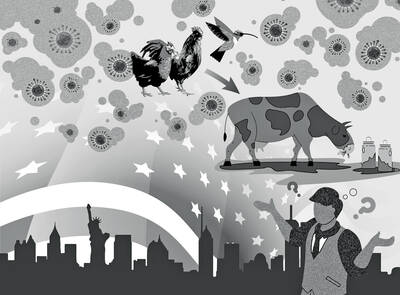
The bird flu outbreak at US dairy farms keeps finding alarming new ways to surprise scientists. Last week, the US Department of Agriculture (USDA) confirmed that H5N1 is spreading not just from birds to herds, but among cows. Meanwhile, media reports say that an unknown number of cows are asymptomatic. Although the risk to humans is still low, it is clear that far more work needs to be done to get a handle on the reach of the virus and how it is being transmitted. That would require the USDA and the Centers for Disease Control and Prevention (CDC) to get

For the incoming Administration of President-elect William Lai (賴清德), successfully deterring a Chinese Communist Party (CCP) attack or invasion of democratic Taiwan over his four-year term would be a clear victory. But it could also be a curse, because during those four years the CCP’s People’s Liberation Army (PLA) will grow far stronger. As such, increased vigilance in Washington and Taipei will be needed to ensure that already multiplying CCP threat trends don’t overwhelm Taiwan, the United States, and their democratic allies. One CCP attempt to overwhelm was announced on April 19, 2024, namely that the PLA had erred in combining major missions
On April 11, Japanese Prime Minister Fumio Kishida delivered a speech at a joint meeting of the US Congress in Washington, in which he said that “China’s current external stance and military actions present an unprecedented and the greatest strategic challenge … to the peace and stability of the international community.” Kishida emphasized Japan’s role as “the US’ closest ally.” “The international order that the US worked for generations to build is facing new challenges,” Kishida said. “I understand it is a heavy burden to carry such hopes on your shoulders,” he said. “Japan is already standing shoulder to shoulder
Former president Chiang Ching-kuo (蔣經國) used to push for reforms to protect Taiwan by adopting the “three noes” policy as well as “Taiwanization.” Later, then-president Lee Teng-hui (李登輝) wished to save the Chinese Nationalist Party (KMT) by pushing for the party’s “localization,” hoping to compete with homegrown political parties as a pro-Taiwan KMT. However, the present-day members of the KMT do not know what they are talking about, and do not heed the two former presidents’ words, so the party has suffered a third consecutive defeat in the January presidential election. Soon after gaining power with the help of the KMT’s


 RSS
RSS