


US Federal Reserve Governor Ben Bernanke has blamed net inflows of capital from the rest of the world, especially China, for a global saving glut that is driving up the US current account deficit.
Unfortunately, some commentators have echoed this seemingly plausible but outrageously silly idea.
For example, an HSBC economist in Hong Kong, Qu Hongbin (
In all events, the observations cited above reflect a belief that China must lower its domestic saving rate to fuel its economic growth and correct its trade imbalance. Doubtless, part of this argument's credibility lays in China's domestic saving rate of 46 percent of earnings.
But Bernanke and his followers confuse cause and effect in suggesting that an "excess" amount of global savings is the cause of the US' current account deficit, despite low interest rates.
As it is, their macroeconomic analysis is blind to basic economic realities. In the first instance, they are unable to unravel why savers continue to pour money into banks despite ultra-low deposit rates on offer. It turns out that the inflow of funds into banks is the result of monetary pumping by most central banks, which has generated a massive bubble inflated by excessive formation of credit and liquidity.
Bernanke's assertion is also flawed for implying that "excess" savings can damage an economy since "too much" capital can be accumulated. But capital formation is an essential element of economic growth that drives higher living standards.
As such, the implication of his argument is that there is too much growth and people are too well off for their own good. It is a little shocking that such a notion passes intellectual muster.
In all events, the conceptualization offered by Bernanke conveniently ignores the role played by the US Federal Reserve Board in causing the US trade deficit to rise while the dollar has weakened (the current account deficit of the US last year was US$668 billion, or 5.7 percent of GDP, with further rises expected).
In fact, these arguments are redolent of the warmed-over notion of John Maynard Keynes known as the "paradox of thrift." Like Keynes, Bernanke confuses the demand for money (hoarding) with savings and suggest that large cash balances reduce overall demand. But increased savings remain available in the financial system to be lent to investors.
As such, the inflows of foreign funds into the US are not savings, nor can they be fully explained by a strong domestic US capital market. Nor can it be said that the strength of the US economy is pushing up the current account deficit into record territory. If this were the case, the value of the dollar would not have recorded the general weakening trend that was reversed only recently (the US dollar is up by about 7 percent against a basket of major currencies so far this year).
The growing US current account deficit has been driven by ultra-loose monetary policy. America's central bankers have overseen an increase in the money supply (measured as M1) by 27 percent from January 2001 to last December.
As such, the accumulated dollar reserves held by central banks in countries with trade surpluses with the US reflects a type of hoarding that does not reflect increased savings. But these trade surpluses are temporary, since they eventually will be used to purchase imported goods or dollar-based assets like Maytag and Unocal.
The cheap credit policy of the Fed has created an excess supply of dollars domestically and internationally. Low interest rates in the US led to higher spending and nominal incomes, which drove up the demand for imports, causing the trade deficit to balloon. With the dollar pouring relentlessly into foreign exchange markets, the trend has been for it to depreciate against other currencies and many commodities, like oil and gold.
And so it is that this flood of cheap credit, courtesy of US central bankers, has created and kept afloat a gigantic, global Ponzi scheme. Like all pyramid schemes, there is a false sense of shared prosperity. Americans get cheap imports that hold down domestic consumer prices. And foreigners are happy, thinking that they are enjoying export-driven growth while accumulating more dollars, or paper debt mostly denominated in dollars.
Eventually, foreigners will find that their addiction to bits of green money in exchange for their own hard work is doing damage to their economies. Presumably, China will recognize this before it is too late.
But this would require that it abandon the neo-Mercantilist logic that supports the obsession with a "weak" currency to promote exports.
Artificially low interest rates have spawned a global credit bubble that has caused various "imbalances." These include a global housing boom and a trade deficit in the US that is responsible for the massive foreign exchange holdings in economies with trade surpluses. In the case of China, it has also generated an unsustainable and temporary burst of growth in its export-oriented industries. The excess liquidity is also responsible for higher asset prices, especially gold and oil.
History reveals that all "bubbles" either deflate or burst. In either case, an economic slowdown occurs that requires the liquidation of misguided investments that involve unsupported productive capacity.
It is both interesting and troubling to recount the history of Asia's export-led powerhouses. The bursting of Japan's bubble in 1989 ended a long period of high economic growth that was followed by a long period of low growth that continues to this day.
And then East Asia's "miracle" economies hit a wall in 1997 and 1998 that burst their bubbles. It should be rather clear that China is next, so the most pressing question becomes, when?
Christopher Lingle is visiting professor of economics at Universidad Francisco Marroquin in Guatemala.
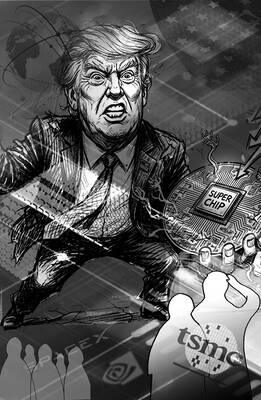
The White House’s decision to take a 9.9 percent stake in Intel Corp is looking like very shrewd business indeed. Since the government bought in at US$20.47 a share last August, the US chipmaker’s surging stock price has delivered the US a US$43 billion return. One of the reasons the investment has so far proved so sound is that the White House has made sure of it. According to The Wall Street Journal, Howard personally pushed deals on Intel’s behalf with some of the most lucrative clients imaginable. They include Nvidia Corp, the company at the heart of the AI
In a Taiwanese university classroom, a lecturer asks in English: “Can anyone give me an example from Taiwan?” Students look down. No one answers. After class, one student writes on the course platform in Mandarin: “I understood the concept, but I didn’t know how to answer in English.” That moment highlights a key issue in Taiwan’s English-medium instruction (EMI) reform: It is not just about more English-taught courses, but whether students can learn, participate and belong. EMI expansion is part of the Bilingual 2030 policy and the Ministry of Education’s BEST Program, aiming to improve English ability, support EMI teaching
A single photograph can cut through a lot of noise, but it can also be used to misrepresent the truth. At the very least, it can concentrate the mind on something that requires further investigation. On Monday last week, Ma Ying-jeou Foundation CEO Tai Hsia-ling (戴遐齡) and former National Security Council secretary-general King Pu-tsung (金溥聰) held a news conference in which they showed a photograph of former foundation CEO Hsiao Hsu-tsen (蕭旭岑), now Chinese Nationalist Party (KMT) deputy chairman. In the image Hsiao is seated next to Xiamen Taiwan Businessmen Association chairman Han Ying-huan (韓螢煥). The two men were holding
The Ministry of the Interior, working with the navy and coast guard, is organizing Taiwan’s first joint exercise simulating escort tankers carrying liquefied natural gas (LNG) and oil through a Chinese blockade. The drills simulate fuel transport along three maritime corridors leading toward Japan, the Philippines and the US. Deputy Minister of the Interior Sawyer Mars (馬士元) said that a blockade of the Taiwan Strait would amount to “almost a 100 percent blockade of the regional energy supply.” Minister of National Defense Wellington Koo said planning to counter a blockade is standard practice in Taipei. While the exercise is limited in


 RSS
RSS