


This month, China and the EU mark 30 years of official relations. During that period, changes within China, and in the nature of those relations, have been dramatic. But how will relations evolve over the next thirty years? Will China and the EU be competitors or partners?
Many challenges face both China and the EU. The first are economic. China's development in recent years has been magnificent. But speedy growth always incites turbulence, which China will have to minimize and manage. As it integrates into the world economy, it must seek to sustain growth while protecting the environment and reducing poverty and inequality. These are daunting tasks, and China cannot address them alone.
Indeed, sustainable development is a challenge for both China and Europe. After all, by far the most important factor determining whether our children and grandchildren will enjoy secure, healthy, and productive lives is whether the world's natural ecosystems survive the pressures put on them by modern civilization. A recent UN report warned that we have already entered the danger zone. Numerous land and sea ecosystems are in danger of being destroyed forever, with effects that are hard to predict.
One downside to China's rapid growth is its rising demand for energy and the increased carbon dioxide emissions that accompany it. China is quickly turning into one of the world's largest importers of oil and gas. The International Energy Agency's World Energy Outlook 2004 predicts that, between now and 2030, global demand for energy will rise by roughly 60 percent, with China and India accounting for nearly two-thirds of that increase.
Huge investments -- worth trillions of dollars -- will be needed to meet global energy requirements. The same report warns that, if we do not change our ways, worldwide carbon dioxide emissions will rise exponentially. So a new phase in international environmental cooperation is needed, with China's active contribution.
Of course, China clearly has a right -- like any country -- to seek the energy, minerals, and other resources it needs. But a lack of cooperation could result in higher-than-necessary oil and gas prices and perhaps defeat in the battle against climate change. This means that China must treat climate change and intelligent energy use as priorities in its national policies.
Beyond economics, China must reassure others that its awakening will not make the world tremble. Thus, in formulating its policies, China must also sell those policies to a global audience. Most Europeans believe that China wants to be a shaper of -- not a challenger to -- a balanced world order, a strong UN, and an effective multilateral system. But, in a global village, misperceptions can arise all too easily -- and can do great damage.
China's important role concerning North Korea's nuclear ambitions is a good example of exercising responsibility for international security and stability. The international community counts on China to pursue that role with vigor. If necessary, it must use its influence even more assertively to bring Pyongyang back to the negotiating table. Obviously, that solution must be in line with Chinese proposals and interests: a denuclearized Korean peninsula, which has the EU's support.
Opportunities exist for a constructive Chinese role elsewhere. Having concluded a ten-year energy agreement with Iran, China is in a position to support the EU's efforts to prevent nuclear proliferation, as the EU supports China's efforts concerning North Korea. This is not just about Iran, but also about the threat of a nuclear arms race across the entire Middle East. Chinese interests are served by a Middle East marked by regional cooperation. We count on China's continued support for European and US efforts in making sure that Iran's nuclear program remains limited to purely civilian purposes.
Europe and the world are also watching China's handling of domestic human rights issues. The EU welcomed the inclusion last year of the following clause in the Chinese Constitution: "The government respects and protects the human rights of the people." But it is deeds that matter. At the EU-China Summit, we discussed the Chinese government's plans for ratification of the International Covenant on Civil and Political Rights.
One subject China should address is freedom of belief. The obligation of prior registration of religious communities is discriminatory. Ratification of the International Covenant on Civil and Political Rights -- and the resulting changes in Chinese laws and practice -- would help to secure social and political stability in China, boost dialogue between China and the EU, and increase China's moral authority.
It is time to replace the old cooperation agreement between the EU and China, dating from 1985. Our relationship has evolved from a predominantly economic one into one that includes fighting terrorism, piracy and organized crime, as well as many other issues. A structured dialogue -- including the private sector, which is so intimately involved in China's development -- is needed on energy, sustainable development, and the environment. We must see environmental problems and energy scarcity for what they are: threats to mankind as a whole.
China will undoubtedly find the EU a tough negotiating partner. The EU sets all kinds of conditions for cooperation with other countries. Some issues are non-negotiable, because they are pillars of the European model that we seek to share with the world.
These include democracy and the rule of law, respect for human rights and the environment, non-proliferation of weapons of mass destruction and their means of delivery and the campaign against terrorism.
The EU's political standards are high, but the fruits of cooperation are sweet. If we tackle our common problems together, China and Europe can be instrumental in turning the twenty-first century into a century of hope.
Bernard Bot is Minister of Foreign Affairs of the Kingdom of the Netherlands.
Copyright: Project Syndicate
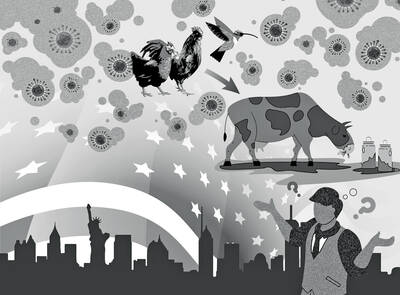
The bird flu outbreak at US dairy farms keeps finding alarming new ways to surprise scientists. Last week, the US Department of Agriculture (USDA) confirmed that H5N1 is spreading not just from birds to herds, but among cows. Meanwhile, media reports say that an unknown number of cows are asymptomatic. Although the risk to humans is still low, it is clear that far more work needs to be done to get a handle on the reach of the virus and how it is being transmitted. That would require the USDA and the Centers for Disease Control and Prevention (CDC) to get
For the incoming Administration of President-elect William Lai (賴清德), successfully deterring a Chinese Communist Party (CCP) attack or invasion of democratic Taiwan over his four-year term would be a clear victory. But it could also be a curse, because during those four years the CCP’s People’s Liberation Army (PLA) will grow far stronger. As such, increased vigilance in Washington and Taipei will be needed to ensure that already multiplying CCP threat trends don’t overwhelm Taiwan, the United States, and their democratic allies. One CCP attempt to overwhelm was announced on April 19, 2024, namely that the PLA had erred in combining major missions
On April 11, Japanese Prime Minister Fumio Kishida delivered a speech at a joint meeting of the US Congress in Washington, in which he said that “China’s current external stance and military actions present an unprecedented and the greatest strategic challenge … to the peace and stability of the international community.” Kishida emphasized Japan’s role as “the US’ closest ally.” “The international order that the US worked for generations to build is facing new challenges,” Kishida said. “I understand it is a heavy burden to carry such hopes on your shoulders,” he said. “Japan is already standing shoulder to shoulder
Former president Chiang Ching-kuo (蔣經國) used to push for reforms to protect Taiwan by adopting the “three noes” policy as well as “Taiwanization.” Later, then-president Lee Teng-hui (李登輝) wished to save the Chinese Nationalist Party (KMT) by pushing for the party’s “localization,” hoping to compete with homegrown political parties as a pro-Taiwan KMT. However, the present-day members of the KMT do not know what they are talking about, and do not heed the two former presidents’ words, so the party has suffered a third consecutive defeat in the January presidential election. Soon after gaining power with the help of the KMT’s


 RSS
RSS