


The Chinese government released a statement on the Taiwan issue after midnight on May 16. Since the statement was authorized by the government, and was issued so close to President Chen Shui-bian's (
The speech shows the carrot and the stick approach, as it included hardline principles and threats as well as flexible and pragmatic suggestions. It was not necessarily "an unprecedented severe threat to Taiwan," as the opposition camp claimed.
The statement repeatedly attacked Chen's "five noes" principle accusing him of lacking honesty and credibility, firmly insisting on the "one China" principle while refusing to tolerate Taiwan's independence. From this perspective, whether Chen would mention the "five noes" again in his speech was not a concern to Beijing anymore. Nevertheless, the statement did not mention the "one country, two systems" policy either. Although it insisted on the "one China" principle, it did not specify the concrete content of this principle. This time, Beijing's conditions for cross-strait development were not based on Taipei's acceptance of the "one China" principle. Instead, the statement simplified Chinese Vice Premier Qian Qichen's (
Among the seven suggestions in the statement, the first suggestion vacuously but positively responded to Chen's call for building a "peace and stability framework." Apart from the old issue of the opening of cross-strait links, Beijing also added the negotiation of Taiwan's international survival space and closer economic cooperation on the basis of reciprocity.
The seven suggestions were not necessarily all good for Taiwan. Still, changes such as preliminary recognition of Chen's "peace and stability framework" and the mention of Taiwan's need for international space had positive meanings. This shows that US Assistant Secretary of State James Kelly's statements that the US "continues to urge Beijing and Taipei to pursue dialogue as soon as possible through any available channels" and "the US continues to be a strong supporter of Taiwan's participation in international organizations" affected the attitudes of Chinese President Hu Jintao (
The statement was the most important message since the new leadership took control of Taiwan affairs in January, and its content varied from Jiang's eight points. The attacks on Chen's honesty and credibility, as well as the insistence on the "one China" principle, satisfied the demands of the hawks. On the other hand, the changes demonstrated the pragmatic components of China's thinking on Taiwan, showing that Hu and Wen have noted that "Taiwan recognition" has become a mainstream value, and that it's necessary to deal with the issue pragmatically. The statement was also a positive response to Kelly's words. The statement shows that although Beijing is not too optimistic about the cross-strait issue, the situation is not hopeless.
Lai I-chung directs foreign policy studies at the Taiwan Thinktank.
TRANSLATED BY EDDY CHANG
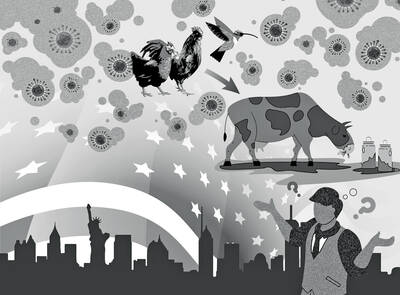
The bird flu outbreak at US dairy farms keeps finding alarming new ways to surprise scientists. Last week, the US Department of Agriculture (USDA) confirmed that H5N1 is spreading not just from birds to herds, but among cows. Meanwhile, media reports say that an unknown number of cows are asymptomatic. Although the risk to humans is still low, it is clear that far more work needs to be done to get a handle on the reach of the virus and how it is being transmitted. That would require the USDA and the Centers for Disease Control and Prevention (CDC) to get
For the incoming Administration of President-elect William Lai (賴清德), successfully deterring a Chinese Communist Party (CCP) attack or invasion of democratic Taiwan over his four-year term would be a clear victory. But it could also be a curse, because during those four years the CCP’s People’s Liberation Army (PLA) will grow far stronger. As such, increased vigilance in Washington and Taipei will be needed to ensure that already multiplying CCP threat trends don’t overwhelm Taiwan, the United States, and their democratic allies. One CCP attempt to overwhelm was announced on April 19, 2024, namely that the PLA had erred in combining major missions
On April 11, Japanese Prime Minister Fumio Kishida delivered a speech at a joint meeting of the US Congress in Washington, in which he said that “China’s current external stance and military actions present an unprecedented and the greatest strategic challenge … to the peace and stability of the international community.” Kishida emphasized Japan’s role as “the US’ closest ally.” “The international order that the US worked for generations to build is facing new challenges,” Kishida said. “I understand it is a heavy burden to carry such hopes on your shoulders,” he said. “Japan is already standing shoulder to shoulder
Former president Chiang Ching-kuo (蔣經國) used to push for reforms to protect Taiwan by adopting the “three noes” policy as well as “Taiwanization.” Later, then-president Lee Teng-hui (李登輝) wished to save the Chinese Nationalist Party (KMT) by pushing for the party’s “localization,” hoping to compete with homegrown political parties as a pro-Taiwan KMT. However, the present-day members of the KMT do not know what they are talking about, and do not heed the two former presidents’ words, so the party has suffered a third consecutive defeat in the January presidential election. Soon after gaining power with the help of the KMT’s


 RSS
RSS