


The capture of former Iraqi president Saddam Hussein marked the end of an eight-month hunt, but it also represented the start of an international controversy over how he should be tried that is likely to last much longer.
US and British officials said it would take "months, not weeks," for Saddam to be brought to trial, which they suggested would not begin before next summer.
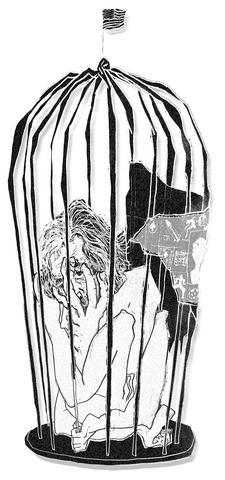
ILLUSTRATION MOUNTAIN PEOPLE
Meanwhile, he will be questioned by US-led interrogation teams hoping to wear down his resistance and find the answers to questions that have been dominating the foreign policy debate in Washington and London for the past year -- most importantly, whether he had kept any weapons of mass destruction.
Only once the US military believes it has wrung the ousted dictator dry is it likely to hand him over for trial, and then the real controversy will begin. It will pit a US administration adamantly opposed to international forms of justice, against critics in the Arab world and beyond who will seize on any evidence of a US-orchestrated "show trial." Caught in between, British Prime Minister Tony Blair's government finds itself once more trying to defend US policy while trying to influence it within the coalition.
At the center of the debate will be the war crimes tribunal launched last week by the US-appointed Iraqi governing council, just four days before Saddam's capture on a farm outside Tikrit.
An Iraqi council of judges, set up in British colonial days but disbanded by Saddam, will be re-established. The council of judges will put forward a list of potential judges and prosecutors for the Iraqi governing council to choose from.
Some of those on the list will be homegrown judges who survived in Iraq under Saddam while others are Iraqi exiles. The US-led coalition will provide legal training.
The regulations allow for foreign judges to serve as advisors or, in some instances, be sworn in. However, human rights groups expressed concern that the administration of US President George W. Bush would try to block the involvement of judges from the UN or from nations that did not support the war.
The Bush administration has not ruled out foreign involvement but its senior members are believed to be fiercely opposed to broad international involvement in a trial.
George Will, a conservative columnist whose views generally reflect those of administration hawks, wrote in the Washington Post this week: "It would be unseemly for Hussein to be tried in front of judges from, say, France, Germany and Russia, which tried mightily to prevent his removal."
Reed Brody, an expert on international prosecutions at Human Rights Watch, said: "This administration has an allergy against international institutions. It doesn't want the tribunal to look too far afield. We feel the stakes are enormous. There needs to be some international component to the procedures so it does not look like a US-dominated show trial."
Harold Koh, a former assistant secretary of state for democracy, human rights and labor under the Bill Clinton administration, argued on Monday: "The untested Iraqi judicial system has no demonstrated capacity to carry out a lengthy, complex, and expensive trial of genocide, war crimes and crimes against humanity. A full and fair trial of Saddam could potentially cost hundreds of millions."
Koh added: "Until now, Iraqi trials have lasted only days, and have commonly yielded convictions based on torture-induced confessions. Decades of Saddam's brutal rule have left few Iraqi lawyers at home or abroad with the training, skills and neutrality necessary to preside over high-profile trials that would be universally regarded as fair and effective."
In the past, Britain has supported international tribunals and the establishment of an International Criminal Court (ICC), rejected by Washington.
However, in Saddam's case, Blair has backed Bush in pushing for a purely home-grown solution. The British prime minister told parliament this week: "Of course we must make sure that there is a proper and independent and fair process. But I am quite sure that the Iraqis have the capability of doing that."
The ICC is not a feasible forum for a trial as neither the US nor Iraq are signatories and the new court has jurisdiction only over crimes committed since July last year.
The British government does not see a need for international judges to confer legitimacy, pointing out that Iraq needs to undergo a healing process similar to South Africa's homegrown truth and reconciliation commission.
Michael Posner, the head of the New York-based Lawyers Committee for Human Rights, said the Iraqi situation is quite different, as it does not at present have a democratically elected or internationally recognized government.
"I would argue that it is in the interests of the US and the UK and the Iraqis to have a trial perceived as fair around the world. It is an important test of notions of international justice," Posner said.
The death penalty is also expected to become a divisive issue.European and other nations might not send judges to take part in a process that could result in execution.
The issue puts the Blair government in an awkward position, and it insists it will raise with Washington its concerns about the possibility of the death penalty being imposed on Saddam.
But, although the British government is opposed to the death penalty, it will argue that handing sovereignty over to Iraqis means respecting their right to make their own laws.
British Foreign Secretary Jack Straw, who is opposed to the death penalty, said: "The position of the British government. ... in respect of the death penalty is very clear. We have abolished the death penalty here, we are opposed to the death penalty and its use in other countries, and we campaigned hard to try to extend the abolition of the death penalty."
He added: "However, it is an obvious reality that the death penalty exists and is used by other countries, including being actively used by two of the five permanent members of the UN, and that in the end the appropriate level of punishment is a matter for sovereign governments, and then for their courts."
The model for a tribunal held up by several authorities on international law on Monday was the hybrid system instituted under UN auspices in Sierra Leone, which mixed Sierra Leonean and international judges in a joint panel. Similar legal experiments have been tried in Kosovo, East Timor and Cambodia.
Another issue is what charges to bring against an ousted dictator who has been accused of countless crimes. Human Rights Watch has accumulated tonnes of documentation on the killing of Kurds alone.
The imprisonment and trial of Saddam in Baghdad rather than at the Hague would carry significant security risks.
The safest location in Baghdad is the international airport where all the former members of Saddam's government are being held.
The second most secure location is in his former presidential compound in Baghdad. His presence in either could result in an increase in mortar attacks -- even at the risk of him being killed -- and become the focal point for pro-Saddam demonstrations.
A gap appears to be emerging between Washington’s foreign policy elites and the broader American public on how the United States should respond to China’s rise. From my vantage working at a think tank in Washington, DC, and through regular travel around the United States, I increasingly experience two distinct discussions. This divergence — between America’s elite hawkishness and public caution — may become one of the least appreciated and most consequential external factors influencing Taiwan’s security environment in the years ahead. Within the American policy community, the dominant view of China has grown unmistakably tough. Many members of Congress, as
The Hong Kong government on Monday gazetted sweeping amendments to the implementation rules of Article 43 of its National Security Law. There was no legislative debate, no public consultation and no transition period. By the time the ink dried on the gazette, the new powers were already in force. This move effectively bypassed Hong Kong’s Legislative Council. The rules were enacted by the Hong Kong chief executive, in conjunction with the Committee for Safeguarding National Security — a body shielded from judicial review and accountable only to Beijing. What is presented as “procedural refinement” is, in substance, a shift away from
Taiwan no longer wants to merely manufacture the chips that power artificial intelligence (AI). It aims to build the software, platforms and services that run on them. Ten major AI infrastructure projects, a national cloud computing center in Tainan, the sovereign language model Trustworthy AI Dialogue Engine, five targeted industry verticals — from precision medicine to smart agriculture — and the goal of ranking among the world’s top five in computing power by 2040: The roadmap from “Silicon Island” to “Smart Island” is drawn. The question is whether the western plains, where population, industry and farmland are concentrated, have the water and
The shifting geopolitical tectonic plates of this year have placed Beijing in a profound strategic dilemma. As Chinese President Xi Jinping (習近平) prepares for a high-stakes summit with US President Donald Trump, the traditional power dynamics of the China-Japan-US triangle have been destabilized by the diplomatic success of Japanese Prime Minister Sanae Takaichi in Washington. For the Chinese leadership, the anxiety is two-fold: There is a visceral fear of being encircled by a hardened security alliance, and a secondary risk of being left in a vulnerable position by a transactional deal between Washington and Tokyo that might inadvertently empower Japan


 RSS
RSS