


Like many other concepts and phrases employed in the field of international relations, national security is a term that means different things to different people. During the Cold War, it was roughly equivalent to the term "defense," and signified the protection of a nation's territory or people against a military attack. Today, however, it has a much more extensive meaning and implies the protection of a country's political interests, economic interests, environment and public health.
According to the World Health Organization (WHO), the global community may soon confront a health crisis of biblical proportions. Avian influenza, or bird flu, has become endemic in Asia. It appears to be only a matter of time before it makes the leap to humans, and thus, human-to-human transmission. Should the WHO's predictions prove to be correct and human-to-human transmission becomes commonplace, the consequences could be catastrophic.
On Nov. 25, Klaus Stohr, a WHO influenza expert, told reporters in Bangkok that the next flu pandemic is inevitable and that it will cause the deaths of between 2 million and 7 million people. Several days later, Shigeru Omi, regional director of the WHO's Western Pacific office, suggested that this estimate was conservative. He claimed that "we are talking at least 7 million deaths, but maybe more -- 10 million, 20 million and the worst case 100 million."
Omi added, "if it happens, it will be incomparable with the SARS situation."
On Dec. 20, however, the estimated death toll was revised downward to 7 million deaths.
Whether the anticipated pandemic results in 7 million or 100 million deaths is immaterial at this juncture. Rather, the critical task that confronts the WHO is to figure out how to head off this threat to global health. To its credit, the WHO is calling for greater international cooperation, the stockpiling of anti-viral drugs, vaccine development and other public health measures. The global institution has also appealed to "some countries" to prevent delays in disclosing information about outbreaks of the flu (Chinese officials had sought initially to downplay or cover up the extent of the SARS epidemic last year). But there is one more important step that should be taken.
As part of the strategy aimed at greater cooperation, the steering committee of the WHO's World Health Assembly should call an emergency meeting and accede to Taiwan's request to participate in the organization as a "health entity" with observer status. As one of the world's major trading nations, over four million foreigners will visit Taiwan this year. Should the anticipated pandemic occur, the nation may prove to be more than a hub for trade. It will also serve as a hub for the epidemic. Taiwan's proximity to China -- a nation widely recognized as the origin of numerous strains of influenza and other infectious diseases -- only serves to exacerbate the danger.
Taiwan's exclusion from the WHO represents a serious threat both to the health of the Taiwanese people and the entire global community. As the executive board of the WHO proclaimed in 2001, "the globalization of infectious diseases is such that an outbreak in one country is potentially a threat to the whole world."
A virus originating in southern China may spread to Taiwan and onward to Japan or America in less than 24 hours.
One step the world should take to combat the anticipated outbreak of this virulent strain of influenza should be to admit Taiwan to the WHO without dithering or delay. The egregious errors of the SARS epidemic must not be repeated. The continued tolerance of what some Taiwanese officials describe as a practice of "health apartheid" constitutes a very real threat to the national security of all countries -- including China. Although Taipei's participation in the WHO may not be a panacea or a "magic bullet," it will undoubtedly help close one of the loopholes in the WHO's efforts at epidemic prevention. As such, it is a move that is long overdue.
Dennis Hickey is professor of political science at Southwest Missouri State University.
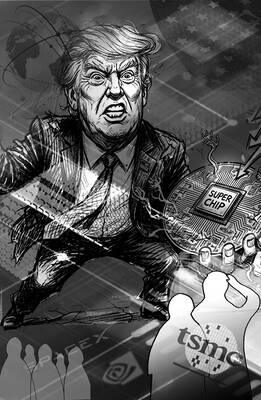
The White House’s decision to take a 9.9 percent stake in Intel Corp is looking like very shrewd business indeed. Since the government bought in at US$20.47 a share last August, the US chipmaker’s surging stock price has delivered the US a US$43 billion return. One of the reasons the investment has so far proved so sound is that the White House has made sure of it. According to The Wall Street Journal, Howard personally pushed deals on Intel’s behalf with some of the most lucrative clients imaginable. They include Nvidia Corp, the company at the heart of the AI
A single photograph can cut through a lot of noise, but it can also be used to misrepresent the truth. At the very least, it can concentrate the mind on something that requires further investigation. On Monday last week, Ma Ying-jeou Foundation CEO Tai Hsia-ling (戴遐齡) and former National Security Council secretary-general King Pu-tsung (金溥聰) held a news conference in which they showed a photograph of former foundation CEO Hsiao Hsu-tsen (蕭旭岑), now Chinese Nationalist Party (KMT) deputy chairman. In the image Hsiao is seated next to Xiamen Taiwan Businessmen Association chairman Han Ying-huan (韓螢煥). The two men were holding
I first met Professor Ray Jiing (井迎瑞) as a film and documentary student at Shih Hsin University’s (SHU) Department of Radio Television and Film in 1988. The following year, he went on to become the director of the Chinese Taipei Film Archive — forerunner of the Taiwan Film and Audiovisual Institute (TFAI). Over his eight-year tenure, Jiing rescued and restored over 200 classic Taiwanese films. In 1997, he established the Graduate Institute of Studies in Documentary and Film Archiving at Tainan National University of the Arts (TNNUA), and I joined the program in his third cohort of students. Beyond a
A recent report concerning a student who is suing his teacher posed the question in its headline: Does failing a student in two subjects constitute bullying? The college student in Chiayi County apparently sought NT$2 million (US$63,603) in state compensation, but a court dismissed the case. The first reaction of many might have been to ask: What has happened to students nowadays? Some say that teachers have lost their authority, while others say students are overindulged. Some even start reminiscing over the days when “whatever the teacher says goes.” However, the real issue might be overlooked if emotional reactions like that are the


 RSS
RSS