


The outcome of next year's presidential election is in the hands of voters between 20 and 35 years of age. While it remains unclear which candidate will come out on top in this duel between the pan-blue and pan-green camps, it is not hard to get some glimpses of the possible outcome by examining the campaign strategies adopted by the two sides and the responses of the moderate and undecided voters to their strategies thus far.
The Chinese Nationalist Party (KMT), People First Party (PFP) and the New Party have formed the pan-blue alliance, while the Democratic Progressive Party (DPP) and the Taiwan Solidarity Union (TSU) formed the so-called "nativized pan-green" alliance. Without any question, a fierce battle will be fought between these two ideologically different camps.
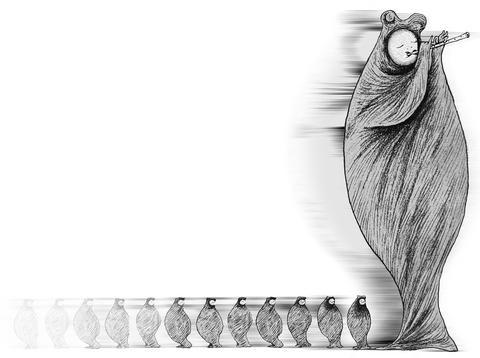
ILLUSTRATION: MOUNTAIN PEOPLE
It can even be described as a match between the "one China" ideology of the pan-blue camp on the one hand, and the "one country on each side (of the Taiwan Strait)" ideology of the pan-green alliance on the other.
The pan-blue camp's campaign strategy themes are conservatism, stability, traditional values and a strong sense of "Greater Chinese" nationalism. The pan-green camp focuses on anchoring new-found freedoms and democracy, forging national identification with Taiwan and increasing social mobility and reforms, which in general are things facilitating the end of the old era.
Key in this unprecedented and complex election will be the undecided voters in the middle who are in the prime of life. Their reactions to the campaigns of the two sides will be decisive.
In 2000, the KMT was defeated in the presidential election. The DPP's victory came entirely as a result of the split in the KMT, bringing an end to the rule of the exiled Republic of China (ROC) government in Taiwan. Power was peacefully transferred into the hands of the nativized DPP. In that election, KMT nominee Lien Chan (
For the upcoming presidential election, KMT Chairman Lien and Soong -- who became the chairman of the PFP, which he had founded -- reached a strong consensus, which is that they do not have a shot unless they join forces under the pan-blue umbrella. The disparity in the number of votes garnered by Soong and Lien in the last presidential election -- Soong lost with a slight margin behind Chen, while Lien trailed behind with an embarrassing and distant third place -- incited debates over whether the pan-blue camp should present a "Lien-Soong ticket" or "Soong-Lien ticket."
In the end, it was decided that Lien, despite an obvious lack of popular appeal, would run for the presidency, while Soong, in exchange for playing the No. 2 man, would serve as both the vice president and the premier if the ticket is elected.
After the death of former president Chiang Ching-kuo (
He became the first popularly elected president of the ROC in 1996 subsequent to constitutional amendments that made the popular election possible.
In 2000, power peacefully shifted to Lee's popularly elected successor Chen and the nativized DPP, ending the Chinese KMT's regime of more than five decades in Taiwan, and spurring on the growth of Taiwanese consciousness in the following three years. As a result, Chen can now counter the "one China" ideology of Lien and Soong with the concept of "one country on each side."
Major wake-up call
A recent event that is strengthening Chen's cause is the "Rectify Taiwan's Name" campaign endorsed by the TSU and Lee. More than 100,000 people joined the Sept. 6 march in support of the campaign, giving the pan-blue camp a major wake-up call. During the event, Lee stated that "when the Republic of China adopted its Constitution in China, Taiwan was not part of ROC territory, [since] it was a Japanese colony at the time."
The statement added realistic insight into the relationship between China and Taiwan. After all, as a result of the Chinese civil war, the Chinese Communist Party came to occupy the entire ROC territory in 1949, declaring the establishment of the People's Republic of China (PRC). The Chinese KMT escaped to Taiwan, taking with it the ROC's Constitution, and then ruled Taiwan under the name of ROC for more than five decades, when in fact the ROC had ceased to exist with the founding of the PRC.
It is against this historical backdrop that Chen decided his campaign platform for next year would be "one country on each side," which seeks to confirm once and for all the statehood and national identity of Taiwan. On the other hand, Lien's campaign platform continues to follow the line of an ambiguous "one China" principle. The contrast between the two camps in terms of their national identification has become the core of their battle.
The KMT ruled Taiwan as an alien regime for decades, using that time to build up grassroots popular support, seeking to change Taiwanese culture through the iron grip of martial law decrees, and forcibly imposing Chinese culture, thinking, language and values onto the general public.
It trampled press freedoms, made the armed forces the private fief of the party, and extended its claws into school campuses. Students, soldiers, teachers, civil servants and law-enforcement personnel were forbidden to speak Taiwanese, and everyone had to join the KMT.
Moreover, many members of the local gentry and business communities were lured into joining the KMT with political and economic interests as bait. Therefore, after the KMT declared the abolition of martial law and began to implement basic democracy in 1987, virtually all of the popularly elected government officials and lawmakers remained KMT members.
The social elite and legislative representatives who did not belong to the KMT were uniformly shun-ned as "rebels" and strongly suppressed.
In fact, before 1987 practically all activities promoting awareness of nativization issues were criminalized, punished and suppressed, often brutally, through the use of martial law, in order to give the KMT an absolute upper hand and monopoly in elections.
About 1 million or so of the mainland Chinese minority, who serve predominantly in the military, government and schools, became the small social elite of Taiwan. They thrived on political and economic interests breastfed by the KMT. The group became the publicists and protectors of this exiled government.
On the other hand, the DPP and the TSU are also rapidly uniting and mobilizing for next year's presidential campaign, making efforts to awaken a Taiwanese consciousness among the native ethnic groups.
The political struggle between the pan-green and pan-blue camps for the presidency is so ethnically divided and heated because it will have such a critical impact on the future and fate of the nation. It can be described as a national referendum on the national identity of the country. It will decide whether Taiwan is to become a vassel state -- or, worse yet, a mere province of the PRC -- or an independent sovereign country.
When Chen was elected president in 2000 and the DPP became the biggest party in the Legislative Yuan in the 2001 election, the KMT and PFP were compelled to join forces.
Together they hold more seats than the DPP, exerting great pressure on Chen and his administration and seriously weakening the presidential and executive powers. Chen was held back from making constitutional and political reforms.
In an attempt to keep Chen from excelling too much, the pan-blue alliance also refuses to live up to its promise of backing up his efforts to revive the economy. They have gone out of their way to depict and mock the government as "incapable" and "useless." Facing all these obstacles, Chen has nevertheless devoted much of his efforts to developing the country's foreign relations and military reforms, and reaching out to the masses in order to win over moderate voters.
According to a poll conducted by the TSU on July 27 regarding next year's presidential election, 39.2 percent of the general public support the pan-green alliance, while 29.5 favor the pan-blue camp.
The level of support for the DPP also surpassed that of the KMT for the first time. About 49 percent of the moderate voters will determine the outcome of the presidential election. If the levels of political stability and the cross-strait relationship, as well as economic development, are favorable, the moderate voters will be more likely to choose pan-green, and vice versa.
Since Chen took office, cross-strait tensions have not worsened, nor has the movement for a national referendum triggered any serious clashes in the US-China-Taiwan relationship. It is understood that, within the framework of this delicate relationship, any declaration of Taiwan's independence and the use of Chinese military force against Taiwan are taboo, as this would endanger peace and stability.
Chen's declaration of the political reality of "one country on each side" has neither violated the taboos nor triggered Chinese military exercises comparable to those launched by China when Lee declared the existence of a "special state-to-state relationship" in 1999. The fact that no red alert had been triggered strengthened the pan-green camp's resolve to stand by this position.
Under the circumstances, the pan-blue camp does not even dare to respond by openly embracing the "one China" principle -- which would in this case naturally mean the PRC -- or accepting the "one country, two systems" principle. Doing either would destroy the ROC, which is currently implied by the "one China" and "one country, two systems" principles.
The pan-blue alliance understands that the "one China" principle will win no moderate voters. So, instead, they sugarcoated it with the ideal of "love Taiwan" in an attempt to delude moderate voters about their position on the cross-strait relationship.
Realizing the difficulty and dilemma the pan-blue alliance faces if it openly campaigned under the "one China" principle, the TSU seized the opportunity created by the government's launch of the new passports with the word "Taiwan" on the cover to wage a campaign to rectify the nation's name. Just before Lee had another heart attack earlier this month, he had pushed for the merger of his own and Chen's supporters to jointly endorse the re-election of Chen and the campaign to rectify Taiwan's name. Lee's statement that the ROC no longer exists gave momentum to the campaign. The passionate and prevalent support for this campaign could very well push the moderate undecided voters closer to Chen.
Although the pan-blue alliance condemned Lee's statement, they have received no positive response from the moderate voters for this. However, their rage directed at Lee went a long way in fostering the unity of Chinese mainlander voters. With Chiang's daughter-in-law calling on the pan-blue camp to stand up against the name rectification campaign, these people have joined forces to oppose Taiwan's independence and to call for unification with China. The rally they held on the day after the name rectification rally drew only about 10,000 or so participants, significantly fewer than the 100,000 people who took part in the first rally.
The PRC has long ago removed the ROC from the international arena. This is a reality that the people of Taiwan had painfully come to face and realize. The more support the name rectification campaign gets, the greater the number of moderate voters who will lean towards Chen. To the moderate voters in Taiwan, "one country, two systems" no longer has any market appeal in the presidential election. This is proven by the fact that both Lien and Soong have made painstaking efforts to avoid openly debating against the concept of "one country on each side."
Nativization
The appeal of the campaign to rectify the nation's name among those who identify with Taiwan and the nativization movement is something that the pan-blue camp is badly lacking. The potential of the campaign to appeal to the moderate voters may very well shatter Lien and Soong's chances to gain the presidency.
The pan-blue camp's ability to win votes from moderate citizens is weakened by KMT Vice Chairman Vincent Siew (
The pan-blue camp's lip service and sugar coating about "loving Taiwan" was also mockingly interpreted by Lee as meaning "love Taiwan, although it isn't our country, because China is our country," further tarnishing the pan-blue alliance's ability to attract moderate voters.
Many factors have worked together to significantly reduce the interest of Taiwanese in the "one China" principle. These include the importation of SARS from China to Taiwan, efforts to enact an anti-subversion law in Hong Kong pursuant to the territory's Basic Law and the prostitution of illegal Chinese immigrants in Taiwan, among many others.
As a result, any potential uneasiness and anxiety that may have been created by Chen's "one country on each side" statement has been significantly reduced. This is definitely not favorable to the pan-blue camp.
Therefore, the strategy the pan-blue alliance is adopting to win back the presidency is to blacken and tarnish the accomplishments and credibility of the Chen administration. The KMT understands that the mobilization of party machineries can only prevent the drifting away of existing supporters, but will not go too far in terms of attracting the moderate voters.
The name-calling campaign against the DPP will only give a small minority of the more hawkish pan-blue supporters a sense of satisfaction. The moderate voters have become genuinely weary of and disinterested in political bickering.
A devastating fire in Taipei County on Aug. 31 claimed the lives of 13 people. The KMT considered this to be an invaluable opportunity to blame the government for the tragedy. However, many young voters responded negatively to its harsh criticism of the government during a press conference. This shows that the tactic no longer works with moderate voters.
On the other hand, the DPP's success in developing foreign relations, eradicating underhanded dealings and gangster activities, and pressuring the KMT to hand over its ill-gotten party assets makes it even more difficult for the KMT to win over the hearts of the moderate voters.
The biggest accomplishments of the DPP are in its milestone declaration about the existence of "one country on each side" and efforts to push for a national referendum law. These moves leave the power to decide the future of Taiwan in the hands of the Taiwanese people. They also slightly compensate for the mistakes and flaws in the DPP's policy implementation. The economic recovery and the decrease in the unemployment rate at the beginning of the third quarter of this year have further eased the effectiveness of the pan-blue camp's vicious attacks.
I have concluded that voters' lack of interest in the "one China" principle, the obstructions and threats that Taiwan faces from China, the inability of the pan-blue camp to build up an image of being supportive of a Taiwanese consciousness, and the backing of Lee will all add positively to Chen's prospects of being re-elected.
Lee Chang-kuei (
When Chinese President Xi Jinping (習近平) sits down with US President Donald Trump in Beijing on Thursday next week, Xi is unlikely to demand a dramatic public betrayal of Taiwan. He does not need to. Beijing’s preferred victory is smaller, quieter and in some ways far more dangerous: a subtle shift in American wording that appears technical, but carries major strategic meaning. The ask is simple: replace the longstanding US formulation that Washington “does not support Taiwan independence” with a harder one — that Washington “opposes” Taiwan independence. One word changes; a deterrence structure built over decades begins to shift.
Taipei is facing a severe rat infestation, and the city government is reportedly considering large-scale use of rodenticides as its primary control measure. However, this move could trigger an ecological disaster, including mass deaths of birds of prey. In the past, black kites, relatives of eagles, took more than three decades to return to the skies above the Taipei Basin. Taiwan’s black kite population was nearly wiped out by the combined effects of habitat destruction, pesticides and rodenticides. By 1992, fewer than 200 black kites remained on the island. Fortunately, thanks to more than 30 years of collective effort to preserve their remaining
After Chinese Nationalist Party (KMT) Chairwoman Cheng Li-wun (鄭麗文) met Chinese President Xi Jinping (習近平) in Beijing, most headlines referred to her as the leader of the opposition in Taiwan. Is she really, though? Being the chairwoman of the KMT does not automatically translate into being the leader of the opposition in the sense that most foreign readers would understand it. “Leader of the opposition” is a very British term. It applies to the Westminster system of parliamentary democracy, and to some extent, to other democracies. If you look at the UK right now, Conservative Party head Kemi Badenoch is
A Pale View of Hills, a movie released last year, follows the story of a Japanese woman from Nagasaki who moved to Britain in the 1950s with her British husband and daughter from a previous marriage. The daughter was born at a time when memories of the US atomic bombing of Nagasaki during World War II and anxiety over the effects of nuclear radiation still haunted the community. It is a reflection on the legacy of the local and national trauma of the bombing that ended the period of Japanese militarism. A central theme of the movie is the need, at


 RSS
RSS