


It goes by the uninspiring name “FFDR-V1004,” but Ahmet Kalyoncu is convinced his meat-cutting robot will transform the doner kebab industry, which held its first conference in Berlin last weekend.
“It’s going to change the market,” the 34-year-old Cypriot said, while crowds gathered around the machine as it sliced the meat off a huge doner kebab spit, at tremendous speed, and, as he put it, “without ever getting bored.”
The robot has a digital camera to sense the changing thickness of the meat, producing a perfect, tasty, wafer-thin slice every time. FFDR-V1004 is also phenomenally efficient, creating as many as 120 portions of kebab in an hour.
“I got the idea from my cousin who is an engineer,” said Kalyoncu, the European sales manager for the “Doner-Robotu” company, who now lives in Vienna and spent his formative years slicing kebabs in south London after school.
“It’s the first kebab robot anywhere in the world,” he said in English with a strong cockney accent.
Speed aside, the main advantage of the robot is hygiene, he said.
“Doner kebab slicers, when they are cutting the meat, get very sweaty because they are close to the grill. We take that problem out, so it’s better in the end for the customer,” he said.
But is Kalyoncu not worried his robot could put kebab shop owners out of work?
“At the end of the day, you still need people to stay there. What we’re saying is: It’s more hygienic and it’s easier. Why not just let the machine do the work?” he said.
Judging by the interest around his machine, many of Germany’s army of kebab shop owners may soon be doing exactly that.
Although many people assume the doner kebab is a Turkish delicacy, in fact the world’s first doner was sliced in Berlin in 1971.
Doner folklore has it that a Turkish immigrant in Berlin, Mahmut Aygun, first put his wafer-thin strips of meat in an open pita bread, added salad and lashings of sauce and hey presto, the doner kebab was born.
Nearly 40 years later, Germany is the snack’s undisputed home.
“There are more than 15,000 kebab shops in Germany, employing some 74,000 people,” said Tarkan Tasyumruk, president of the Association of Turkish Doner Producers in Europe (ATDID), as he opened the fair.
“Annual sales in Germany amount to 2.5 billion euros [US$3.3 billion]. That shows we are one of the biggest fast-foods in Germany,” he added to a packed audience including Turkey’s vice-consul.
ATDID figures show that every day, more than 400 tonnes of doner kebab meat is produced in Germany by about 350 firms.
“There are more producers in Germany than the rest of Europe put together,” Tasyumruk said.
The doner kebab has become at least as popular a fast-food snack in Germany as the home-grown currywurst (sausage sprinkled with curry powder) or frankfurters, driven mainly by the largest Turkish population outside Turkey.
Priced at between 2.50 and 4 euros (US$3.3 and US$5.4), an estimated 400 million doners are gobbled up every year in Germany, working out at five for every person.
“I would say we are the most successful fast food in the country,” Tasyumruk said.
At the fair, representatives of every possible facet of doner kebab making crowded into two small rooms at a conference center in central Berlin.
Firms making kebab shop clothes, grills, meat refrigerators and the shrink wrap needed to transport the enormous doners mingled with journalists from all over the world, talking doner in a mix of English, Turkish and German.
Demonstrating how important the industry is in the country, German motoring giant Mercedes-Benz and insurance group Allianz had also set up shop at the fair, keen to have a presence in such an influential market.

PROVOCATIVE: Chinese Deputy Ambassador to the UN Sun Lei accused Japan of sending military vessels to deliberately provoke tensions in the Taiwan Strait China denounced remarks by Japan and the EU about the South China Sea at a UN Security Council meeting on Monday, and accused Tokyo of provocative behavior in the Taiwan Strait and planning military expansion. Ayano Kunimitsu, a Japanese vice foreign minister, told the Council meeting on maritime security that Tokyo was seriously concerned about the situation in the East China and South China seas, and reiterated Japan’s opposition to any attempt to change the “status quo” by force, and obstruction of freedom of navigation and overflight. Stavros Lambrinidis, head of the EU delegation to the UN, also highlighted South China Sea
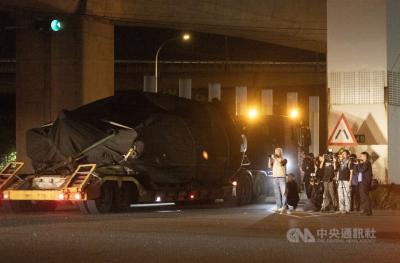
The final batch of 28 M1A2T Abrams tanks purchased from the US arrived at Taipei Port last night and were transported to the Armor Training Command in Hsinchu County’s Hukou Township (湖口), completing the military’s multi-year procurement of 108 of the tanks. Starting at 12:10am today, reporters observed more than a dozen civilian flatbed trailers departing from Taipei Port, each carrying an M1A2T tank covered with black waterproof tarps. Escorted by military vehicles, the convoy traveled via the West Coast Expressway to the Armor Training Command, with police implementing traffic control. The army operates about 1,000 tanks, including CM-11 Brave Tiger
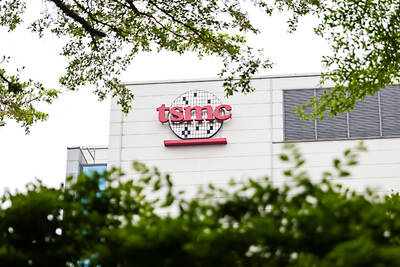
Taiwan Semiconductor Manufacturing Co (TSMC, 台積電), the world’s largest contract chipmaker, said it expects its 2-nanometer (2nm) chip capacity to grow at a compound annual rate of 70 percent from this year to 2028. The projection comes as five fabs begin volume production of 2-nanometer chips this year — two in Hsinchu and three in Kaohsiung — TSMC senior vice president and deputy cochief operating officer Cliff Hou (侯永清) said at the company’s annual technology symposium in Silicon Valley, California, last week. Output in the first year of 2-nanometer production, which began in the fourth quarter of last year, is expected to
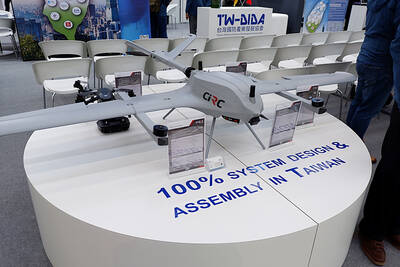
Taiwan’s drone exports surged past US$100 million in the first quarter, exceeding last year’s full-year total, with the Czech Republic emerging as the largest buyer, the Ministry of Economic Affairs said. Exports of complete drones reached US$115.85 million in the period, about 1.2 times the total recorded for all of last year, the ministry said in a report. Exports to the Czech Republic accounted for about US$100 million, far outpacing other markets. Poland, last year’s top destination, recorded about US$11.75 million in the first quarter. Taiwan’s drone exports have expanded rapidly in the past few years, with last year’s total


 RSS
RSS