


On a quiet patch of land apparently devoid of inhabitants, Krasimir Kostov’s farm is silently booming as more than 1 million snails, hiding from the sun under planks of wood, munch their way to market.
“Indeed, you cannot tell … there is a farm here. But snails do not moo,” the suntanned breeder said.
Businesses may shut by the day across Europe and Bulgarian agriculture has been declining for 20 years, but snails — a delicacy particularly popular in France and Italy — have become a dynamic niche for the EU’s poorest country.

PHOTO: REUTERS
September is harvest season and demand is outstripping supply for escargots, as the French call them (ohlyuvi in Bulgarian). The country has seized the chance to reinforce a position exporting luxury foods that are rarely consumed at home.
After France, the Balkan country is Europe’s second-largest producer of foie gras, building on duck-liver traditions dating back to the communist era.
Between 800 tonnes and 900 tonnes of snails and snail products — six times more than last year — will be exported from Bulgaria this year to please the palates of aficionados, mostly in France.
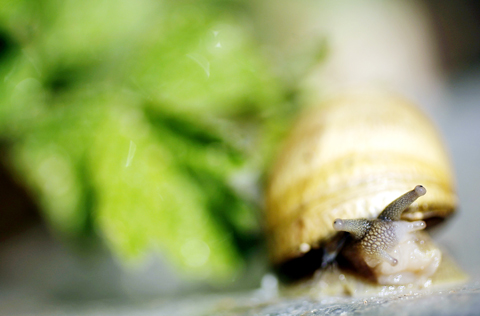
PHOTO: REUTERS
“The market is immense,” said Kostov, 45, whose farm in northern Bulgaria primarily specializes in supplying baby snails for breeding to other farms. He pulled a face when asked if he liked their flavor.
“We had quite a few orders this year, but we could not fulfill them all because our incubator is not large enough,” he said.
He will save some 60,000 snails of the Mediterranean Helix aspersa genus — one of the three major edible species — to become breeders. Each will lay about 150 eggs. The rest — about 10 tonnes or the equivalent of about 470,000 snails — will be exported.
So voracious are appetites that about 300 new farms are set to open in Bulgaria next year to add to the 50 now in operation, says the National Snail Breeding Cluster, which backs exports.
“This year we have orders from France, Germany, Austria, the Netherlands,” said Simona Mollova, consultant at the cluster.
Orders were likely to reach 1 billion baby snails this year, she said, citing demand also from Japan for fattened escargots and from Dubai for the new, orange, carotene snail.
“We have a great number of clients, but at this stage we cannot meet demand in any way,” Mollova said.
Funding from the EU, which Bulgaria joined in 2007, has also helped aid the snail business. Breeders are eligible to apply for some of the 3.2 billion euros (US$4.7 billion) promised to Sofia to 2013 under a development program.
French appetites for the gastropods — treated as exquisite delicacies since the Roman era — have withstood changing times and tastes.
“The snail market is a very traditional and stable market and ... big changes should not be expected,” said Pierre Commere, Secretary General of ADEPALE, the French association of food processing companies.
The tradition is stronger than the financial crisis, he said: Anyone who wants to make a savory treat for Christmas would try to afford snails.
A jar of snails with sauce weighing 0.4kg costs 50 euros, while high-quality gourmet packs fetch between 55 euros and 235 euros. By contrast, a kilo of the live snails Bulgaria breeds ranges from 2.5 euros to 4 euros.
France and Italy, Europe’s largest consumers, devour between 25,000 tonnes and 36,000 tonnes of snails annually, but with the population of the prized Helix pomatia in decline in the west, the industry relies mostly on east European imports.
In 2006, the species, widely known as the Burgundy snail, was included in the EU directive on wild flora and fauna conservation and their gathering in the wild was limited.
Poland and Hungary used to lead the way in snail-gathering but economic progress since they joined the EU in 2004 has turned people off the hard work, causing a shortage in France last year, according to the French Federation of Preserved Food Industries.
Countries like Bulgaria, where agriculture accounts for between 5 percent and 6 percent of GDP, welcomed the chance to fill the gap: Recession, cheap imports and low farm prices have bankrupted hundreds of farmers this year.
People who once raised pigs, cows and poultry are looking for alternatives.
“Now everybody is a snail farmer,” Kostov said.
“Two years ago people laughed when we said we were breeding snails. But last year people simply went crazy. They are calling from everywhere to inquire,” he said.
Kostov said one person can easily care for a farm with three to five 0.1 hectare parks — essentially by making sure there is enough moisture in the evenings when snails feed — but help is needed for harvest, when women and children join in from dawn to dusk.
He plans to double production from next spring and increase the area given over to snails to 1.5 hectares, two times the size of a football stadium, from 0.4 hectares now.
This year Bulgaria, which transports most of its snails to plants in Greece for processing, is also starting to export a new variety of snails whose diet includes carrots as well as the traditional white clover and specialized fodder.
“They look very ridiculous, because they are orange,” Mollova said. But they fetch 80 euros per kilo.
Besides France, she said carotene escargots were headed to a Dubai hotel, but declined to give details.
In France, Bulgaria-reared escargots are praised for their good quality. Snail-processing company Romanzini, founded in 1921, has worked with Bulgarian snails since 1991 and imports up to 50 tonnes a year.
“The product is of good quality,” said Olivier Romanzini, adding that the Bulgarian escargots are as good as the French.

GAINING STEAM: The scheme initially failed to gather much attention, with only 188 cards issued in its first year, but gained popularity amid the COVID-19 pandemic Applications for the Employment Gold Card have increased in the past few years, with the card having been issued to a total of 13,191 people from 101 countries since its introduction in 2018, the National Development Council (NDC) said yesterday. Those who have received the card have included celebrities, such as former NBA star Dwight Howard and Australian-South Korean cheerleader Dahye Lee, the NDC said. The four-in-one Employment Gold Card combines a work permit, resident visa, Alien Resident Certificate (ARC) and re-entry permit. It was first introduced in February 2018 through the Act Governing Recruitment and Employment of Foreign Professionals (外國專業人才延攬及雇用法),

RESILIENCE: Deepening bilateral cooperation would extend the peace sustained over the 45 years since the Taiwan Relations Act, Greene said Taiwan-US relations are built on deep economic ties and shared values, American Institute in Taiwan (AIT) Director Raymond Greene said yesterday, adding that strengthening supply chain security in critical industries, enhancing societal resilience through cooperation and deepening partnerships are key to ensuring peace and stability for Taiwan in the years ahead. Greene made the remarks at the National Security Youth Forum, organized by National Taiwan University’s National Security and Strategy Studies Institution in Taipei. In his address in Mandarin Chinese, Greene said the Taiwan-US relationship is built on deep economic ties and shared interests, and grows stronger through the enduring friendship between

The Ministry of Transportation and Communications yesterday said that it would redesign the written portion of the driver’s license exam to make it more rigorous. “We hope that the exam can assess drivers’ understanding of traffic rules, particularly those who take the driver’s license test for the first time. In the past, drivers only needed to cram a book of test questions to pass the written exam,” Minister of Transportation and Communications Chen Shih-kai (陳世凱) told a news conference at the Taoyuan Motor Vehicle Office. “In the future, they would not be able to pass the test unless they study traffic regulations

‘COMING MENACINGLY’: The CDC advised wearing a mask when visiting hospitals or long-term care centers, on public transportation and in crowded indoor venues Hospital visits for COVID-19 last week increased by 113 percent to 41,402, the Centers for Disease Control (CDC) said yesterday, as it encouraged people to wear a mask in three public settings to prevent infection. CDC Epidemic Intelligence Center Deputy Director Lee Chia-lin (李佳琳) said weekly hospital visits for COVID-19 have been increasing for seven consecutive weeks, and 102 severe COVID-19 cases and 19 deaths were confirmed last week, both the highest weekly numbers this year. CDC physician Lee Tsung-han (李宗翰) said the youngest person hospitalized due to the disease this year was reported last week, a one-month-old baby, who does not


 RSS
RSS