


In dueling announcements, Intel Corp and International Business Machines (IBM) Corp separately said they have solved a puzzle perplexing the semiconductor industry about how to reduce energy loss in microchip transistors as the technology shrinks to the atomic scale.
Each company said it has devised a way to replace problematic but vital materials in the transistors of computer chips that have begun leaking too much electric current as the circuitry on those chips gets smaller.
On Thursday, Intel said it made a breakthrough in transistor technology that allows it to make faster, smaller, more efficient processors.
The world's largest semiconductor maker demonstrated working models of new chips, which are made up of transistors that use metal gates rather than silicon dioxide, at an event at the company's headquarters in Santa Clara, California.
Technology experts said it is the most dramatic overhaul of transistor technology for computer chips since the 1960s and is crucial in allowing semiconductor companies to continue making ever-smaller devices that are also energy-efficient.
It also ratchets up the competition between Intel and rival chipmaker Advanced Micro Devices (AMD) Inc, which helped IBM develop the technology along with electronics makers Sony Corp and Toshiba Corp.
"It shows you the lead that Intel has today and is likely to continue to drive," said chief executive officer Paul Otellini at Thursday's event. Some of the new products will go on sale before the end of the year, he said.
Intel is altering the fundamentals of its chips in response to changing requirements in the personal computer industry. Older designs such as the Pentium resulted in chips that, while they counted quickly, required too much cooling to allow them to be used in laptops.
"They're really targeting lower power and mobility for the future," said Jim McGregor, a Scottsdale, Arizona-based analyst for In-Stat. Intel is at least six months ahead of other chip companies, he said.
Companies are feverishly trying to discover new ways to adhere to Moore's Law, the 1965 prediction by Intel co-founder Gordon Moore that the number of transistors on a chip should double about every two years.
Transistors are microscopic electronic switches which, by being switched on and off, represent the 0s or 1s that are the building block of all digital information. The silicon dioxide, or now metal gate, is used to turn them on and off.
So far, chip development has generally advanced according to that schedule, leading to the creation of faster and more powerful processors that also give off less heat and are cheaper to run.
But scientists in recent years have reported serious problems in stopping electric current from leaking out of the tiniest chip parts, threatening to halt the march of Moore's Law.
The problem is that the silicon dioxide used for more than 40 years as an insulator inside transistors has been shaved so thin that an increasing amount of current is seeping through, wasting electricity and generating unnecessary heat.
Intel and other chipmakers have been using silicon dioxide as gates since the late 1960s. The material is reaching its physical limits. Current silicon dioxide gates are as thin as five atoms, a thickness that causes leakage to the flow of electricity even when the transistor is turned off.
That leakage means that they require more power to switch them on and off, causing more heat. Some versions of Intel's 7-year old Pentium design required as much power as a small television to run something the size of a postage stamp.
Intel and IBM said they have discovered a way to replace that material with various metals in parts called the gate, which turns the transistor on and off, and the gate dielectric, an insulating layer, which helps improve transistor performance and retain more energy.
Intel's new materials will create transistors that need 30 percent less power to switch them on, while helping provide a 20 percent boost in transistor performance, the company said. The new materials will go into so-called 45 nanometer designs that will debut this year.
A nanometer is one billionth of a meter. About 400 of the new transistors would fit on the surface of a single human red blood cell, the company said.
IBM, the world's largest computer services company, did not release specifics of its project. But the company said it will begin using metal gates in transistors in some of its chips from next year, Bernie Meyerson, IBM's chief technologist, said in an interview.
"This gives the entire chip industry a new life in terms of Moore's Law, in all three of the big metrics -- performance, power consumption and transistor density," said David Lammers, director of WeSRCH.com, a social networking Web site for semiconductor enthusiasts and part of VLSI Research Inc.
"It opens the door to some pretty rapid improvements," he said.
Intel appears the farthest along in bringing a product based on the technology to market.
The Santa Clara-based company said it has created working microprocessors using the new materials that will go into mass production in the second half of this year.
Intel also said the chips will be built using its new manufacturing process that involves shrinking parts of the chips down to 45 nanometers, or billionths of a meter, from the 65-nanometer process the company uses now.
While IBM will not sell the chips by themselves, the Armonk, New York-based company said it would begin selling servers with chips using the technology next year.
Sunnyvale-based AMD said it was not disclosing when it expects to use the technology in its own chips.

The Legislative Yuan’s Finance Committee yesterday approved proposed amendments to the Amusement Tax Act (娛樂稅法) that would abolish taxes on films, cultural activities and competitive sporting events, retaining the fee only for dance halls and golf courses. The proposed changes would set the maximum tax rate for dance halls and golf courses at 50 and 20 percent respectively, with local governments authorized to suspend the levies. Article 2 of the act says that “amusement tax shall be levied on tickets sold or fees charged by amusement places, facilities or activities” in six categories: “Cinema; professional singing, story-telling, dancing, circus, magic show, acrobatics

Tainan, Taipei and New Taipei City recorded the highest fines nationwide for illegal accommodations in the first quarter of this year, with fines issued in the three cities each exceeding NT$7 million (US$220,639), Tourism Administration data showed. Among them, Taipei had the highest number of illegal short-term rental units, with 410. There were 3,280 legally registered hotels nationwide in the first quarter, down by 14 properties, or 0.43 percent, from a year earlier, likely indicating operators exiting the market, the agency said. However, the number of unregistered properties rose to 1,174, including 314 illegal hotels and 860 illegal short-term rental

INFLATION UP? The IMF said CPI would increase to 1.5 percent this year, while the DGBAS projected it would rise to 1.68 percent, with GDP per capita of US$44,181 The IMF projected Taiwan’s real GDP would grow 5.2 percent this year, up from its 2.1 percent outlook in January, despite fears of global economic disruptions sparked by the US-Iran conflict. Taiwan’s consumer price index (CPI) is projected to increase to 1.5 percent, while unemployment would be 3.4 percent, roughly in line with estimates for Asia as a whole, the international body wrote in its Global Economic Outlook Report published in the US on Monday. The figures are comparatively better than the IMF outlook for the rest of the world, which pegged real GDP growth at 3.1 percent, down from 3.3 percent
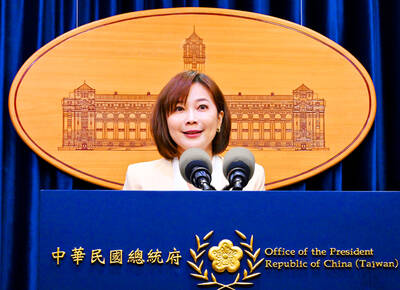
ECONOMIC COERCION: Such actions are often inconsistently applied, sometimes resumed, and sometimes just halted, the Presidential Office spokeswoman said The government backs healthy and orderly cross-strait exchanges, but such arrangements should not be made with political conditions attached and never be used as leverage for political maneuvering or partisan agendas, Presidential Office spokeswoman Karen Kuo (郭雅慧) said yesterday. Kuo made the remarks after China earlier in the day announced 10 new “incentive measures” for Taiwan, following a landmark meeting between Chinese President Xi Jinping (習近平) and Chinese Nationalist Party (KMT) Chairwoman Cheng Li-wun (鄭麗文) in Beijing on Friday. The measures, unveiled by China’s Xinhua news agency, include plans to resume individual travel by residents of Shanghai and China’s Fujian


 RSS
RSS