


Few have risen and fallen as spectacularly as Takafumi Horie, 34, the self-made Internet billionaire now on trial in Japan's courts of justice and public opinion.
At age 31, he became famous overnight for trying to wrest a baseball team from a league controlled by some of Japan's most powerful businesspeople, or, in his words, "the club of old men."
He turned his start-up, Livedoor, into a household name and built it with the kind of aggressive moves unseen in Japan. A swooning media crowned the spiky-haired, T-shirt-clad, trash-talking upstart as the living challenge to Japan's ossified establishment.
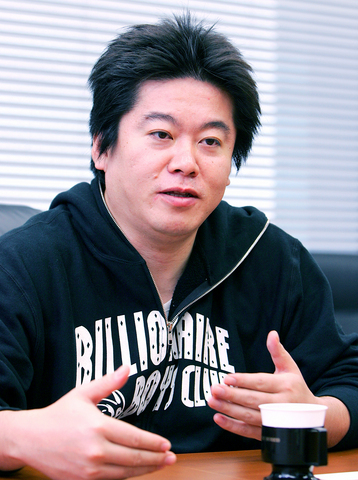
PHOTO: AP
For 18 short months, Horie defied gravity. Then early last year, the offices of Livedoor, which had built an eclectic social network site, were raided, and he was arrested on charges of securities fraud; depending on one's view of Horie, the charges amounted to just deserts or political payback.
Television networks showed his enemies gloating about his downfall, reinforcing the impression that the establishment, or some part of it, had decided to destroy Horie. He was transformed into the symbol of all that was bad about the new Japan and its supposed embrace of a ruthless, American-style capitalism.
Denounced and demonized, Horie has yet to be silenced. In a country where defendants face enormous pressure to plead guilty and criminal cases almost always result in convictions, he has fiercely proclaimed his innocence.
And though his trial has yet to end, Horie has taken the extremely unusual step of speaking out to the media, leaving nothing unsaid.
"I'm being made into a bad guy through endless leaks from the prosecution to the media," he said. "So when something's wrong, I have to state that it's wrong. Otherwise, they'll set people's image of me, and that's not good."
At the Tokyo District Court, prosecutors have demanded a four-year prison term for Horie, whom they accuse of having masterminded accounting frauds totaling more than US$40 million and other securities violations at his company.
Driven by greed, lacking a law-abiding spirit, Horie had shown no remorse and still presents a menace to society, they said.
"Isn't it a fact that you raised the value of Livedoor shares, sold them and used the profits to pursue your personal interests and desires?" one prosecutor asked early in the hearing.
"You have a twisted mind. You should repent," Horie replied.
He said Livedoor's accounting practices were on the level. He has acknowledged misreporting the source of about US$10 million, but blamed Ryoji Miyauchi, now 39, the chief financial officer.
Miyauchi, who has pleaded guilty to similar charges against him, said in court that Horie was aware of the wrongdoing. But Miyauchi wavered on this point under cross-examination.
Horie said he was caught in the cross hairs of a Japanese establishment of elite bureaucrats -- who he said do not want ordinary Japanese "to think too much" -- and powerful business executive who fear the changes he represents.
The infractions with which he is charged "are not something that typically merit a raid and arrest," he said.
Indeed, by any standard, Horie has been treated very severely by the authorities. In Japan, companies have long engaged in financial window-dressing, often in collusion with accounting firms, though regulators have cracked down on this practice in recent years.
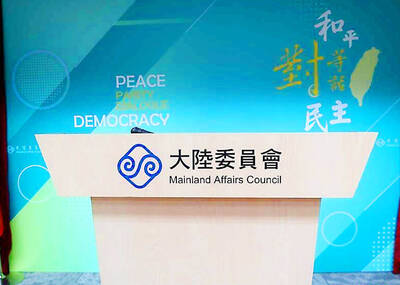
NO RECIPROCITY: Taipei has called for cross-strait group travel to resume fully, but Beijing is only allowing people from its Fujian Province to travel to Matsu, the MAC said The Mainland Affairs Council (MAC) yesterday criticized an announcement by the Chinese Ministry of Culture and Tourism that it would lift a travel ban to Taiwan only for residents of China’s Fujian Province, saying that the policy does not meet the principles of reciprocity and openness. Chinese Deputy Minister of Culture and Tourism Rao Quan (饒權) yesterday morning told a delegation of Chinese Nationalist Party (KMT) lawmakers in a meeting in Beijing that the ministry would first allow Fujian residents to visit Lienchiang County (Matsu), adding that they would be able to travel to Taiwan proper directly once express ferry

FAST RELEASE: The council lauded the developer for completing model testing in only four days and releasing a commercial version for use by academia and industry The National Science and Technology Council (NSTC) yesterday released the latest artificial intelligence (AI) language model in traditional Chinese embedded with Taiwanese cultural values. The council launched the Trustworthy AI Dialogue Engine (TAIDE) program in April last year to develop and train traditional Chinese-language models based on LLaMA, the open-source AI language model released by Meta. The program aims to tackle the information bias that is often present in international large-scale language models and take Taiwanese culture and values into consideration, it said. Llama 3-TAIDE-LX-8B-Chat-Alpha1, released yesterday, is the latest large language model in traditional Chinese. It was trained based on Meta’s Llama-3-8B

STUMPED: KMT and TPP lawmakers approved a resolution to suspend the rate hike, which the government said was unavoidable in view of rising global energy costs The Ministry of Economic Affairs yesterday said it has a mandate to raise electricity prices as planned after the legislature passed a non-binding resolution along partisan lines to freeze rates. Chinese Nationalist Party (KMT) lawmakers proposed the resolution to suspend the price hike, which passed by a 59-50 vote. The Taiwan People’s Party (TPP) voted with the KMT. Legislative Speaker Han Kuo-yu (韓國瑜) of the KMT said the resolution is a mandate for the “immediate suspension of electricity price hikes” and for the Executive Yuan to review its energy policy and propose supplementary measures. A government-organized electricity price evaluation board in March

NOVEL METHODS: The PLA has adopted new approaches and recently conducted three combat readiness drills at night which included aircraft and ships, an official said Taiwan is monitoring China’s People’s Liberation Army (PLA) exercises for changes in their size or pattern as the nation prepares for president-elect William Lai’s (賴清德) inauguration on May 20, National Security Bureau (NSB) Director-General Tsai Ming-yen (蔡明彥) said yesterday. Tsai made the comment at a meeting of the Legislative Yuan’s Foreign Affairs and National Defense Committee, in response to Democratic Progressive Party (DPP) Legislator Wang Ting-yu’s (王定宇) questions. China continues to employ a carrot-and-stick approach, in which it applies pressure with “gray zone” tactics, while attempting to entice Taiwanese with perks, Tsai said. These actions aim to help Beijing look like it has


 RSS
RSS