


Two of the world's biggest brand names, known for wooing customers around the world, are facing a credibility crisis in one of their crucial emerging markets.
This month, India's Center for Science and the Environment announced that drinks manufactured by Coca-Cola and PepsiCo contained on average more than 24 times the safe limit for pesticides, which could come from sugar, water and other ingredients.
When those reports appeared on the front pages of newspapers in India, Coke and Pepsi executives expressed confidence that they could handle the situation, but they have stumbled since.
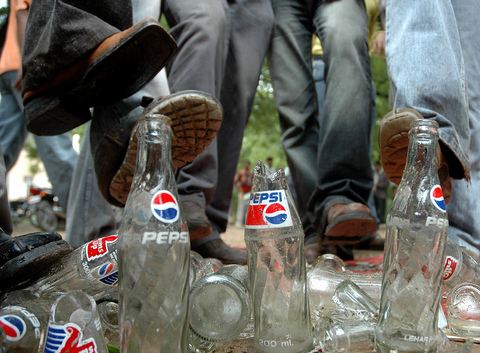
PHOTO: AP
They underestimated how quickly events would spiral into a nationwide scandal, misjudged the speed with which local politicians would seize on an Indian environmental group's report to attack their global brands, and did not respond swiftly to quell the anxieties of their customers.
Three weeks later, Coke and Pepsi are still struggling to win back the confidence of consumers. Partial bans on their products remain in a quarter of India's states, and a complex legal battle to overturn the bans is just beginning. The companies acknowledge that things have not gone smoothly.
The battle offers a cautionary tale for multinational corporations doing business in developing countries, especially one like India, where the market for soft drinks is about US$1.6 billion, with Coke holding about a 60 percent market share.
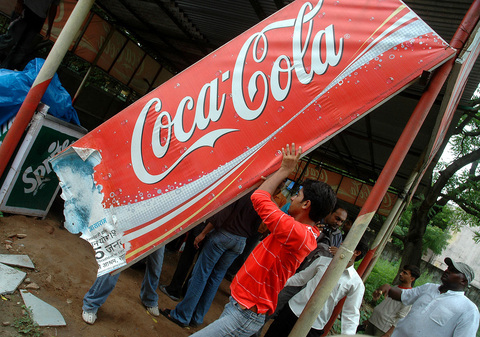
PHOTO: AP
In some ways, the immediate response from Coke and Pepsi came right out of crisis management textbooks.
The companies formed committees in India and the US, working in tandem on legal and public relations issues. They worked around the clock fashioning rebuttals. They commissioned their own laboratories to conduct tests and waited until the results came through before commenting in detail.
Their approaches backfired. Their reluctance to give details fanned consumer suspicion. They became bogged down in the technicalities of the charges instead of focusing on winning back the support of their customers.
"They got behind the curve, and now they are chasing the crisis," said Richard Levick, president and chief executive of Levick Strategic Communications, which is based in the US and specializes in advising businesses in crises.
Coke and Pepsi executives have said repeatedly that their soft drinks meet "international standards" but concede this is a difficult fight.
"We have some way to go to restore consumer confidence in our brands," said Kari Bjorhus, Coca-Cola's communications director.
Rajeev Bakshi, chairman of PepsiCo India, agreed. "Has our side of the story got across to the consumer yet? Not really. I am concerned about that."
On Tuesday, the companies got a lift with the publication of a study by India's health ministry that said the Center for Science and Environment's findings did not conclusively prove that the soft drinks contained pesticide residue.
The center, however, was skeptical. "The minister of health is clearly more concerned with industrial health -- and not people's health," it said in a statement.
At the start, both companies were unprepared, when one state after another in India announced partial bans on Coke and Pepsi products, preventing the drinks from being sold in government offices, hospitals, and schools. Politicians exploited the populist potential.
"We were a little surprised and disappointed by the bans," said Kenth Kaerhoeg, group communications director for Coca-Cola Asia, who flew in from Hong Kong to work on the situation.
Suhel Seth, a public relations expert in India and an adviser to Coca-Cola India, said Coke and Pepsi should have known better: "Fringe politicians will continue to be publicly hostile to big Western companies, regardless of how eager they are for their investment," he said.
In hindsight, Bjorhus, the Coke communications director, said she could now see how the environmental group had picked Coca-Cola as a way of attracting attention to the broader problem of pesticide contamination in Indian food products.
Sunita Narain, who heads the group, "has serious concerns about pesticides in the food chain," Bjorhus said.
"By focusing her attention on the soft drinks industry, she gets a lot of attention," she said.
Failing to anticipate the political potency of the incident, Coke and Pepsi initially hoped that the crisis would blow over and they adopted a policy of silence.
"Here people interpret silence as guilt," said Seth, the Indian public relations expert.
"You have to roll up your sleeves and get into a street fight. Coke and Pepsi didn't understand that," he said.
The companies also failed to realize how fast news travels in modern India.
"We are living in a new, very aware India," said Amit Agnihotri, a public relations analyst in Delhi.
"We have 36 news channels. People are interested in what is happening around them. Coke and Pepsi haven't understood the power of this new India," he said.
Coca-Cola eventually decided to go on the attack, though indirectly, giving detailed briefings by executives, who questioned the scientific credentials of their products' accusers.
The executives pointed reporters to Internet blogs full of entries that were uniformly pro-Coke and they handed out the phone number for the director of an organization called the Center for Sanity and Balance in Public Life.

‘A SERIOUS THREAT’: Japan has expressed grave concern over the Strait’s security over the years, which demonstrated Tokyo’s firm support for peace in the area, an official said China’s military drills around Taiwan are “incompatible” with peace and stability in the Taiwan Strait, Japanese Minister of Foreign Affairs Takeshi Iwaya said during a meeting with his Chinese counterpart Wang Yi (王毅) on Thursday. “Peace and stability across the Taiwan Strait is important for the international community, including Japan,” Iwaya told Wang during a meeting on the sidelines of the ASEAN-related Foreign Ministers’ Meetings in Kuala Lumpur. “China’s large-scale military drills around Taiwan are incompatible with this,” a statement released by the Japanese Ministry of Foreign Affairs on Thursday cited Iwaya as saying. The Foreign Ministers’ Meetings are a series of diplomatic

‘REALISTIC’ APPROACH: The ministry said all the exercises were scenario-based and unscripted to better prepare personnel for real threats and unexpected developments The army’s 21st Artillery Command conducted a short-range air defense drill in Taoyuan yesterday as part of the Han Kuang exercises, using the indigenous Sky Sword II (陸射劍二) missile system for the first time in the exercises. The armed forces have been conducting a series of live-fire and defense drills across multiple regions, simulating responses to a full-scale assault by Chinese forces, the Ministry of National Defense said. The Sky Sword II missile system was rapidly deployed and combat-ready within 15 minutes to defend Taiwan Taoyuan International Airport in a simulated attack, the ministry said. A three-person crew completed setup and

URBAN COMBAT: FIM-92 Stinger shoulder-fired missiles from the US made a rare public appearance during early-morning drills simulating an invasion of the Taipei MRT The ongoing Han Kuang military exercises entered their sixth day yesterday, simulating repelling enemy landings in Penghu County, setting up fortifications in Tainan, laying mines in waters in Kaohsiung and conducting urban combat drills in Taipei. At 5am in Penghu — part of the exercise’s first combat zone — participating units responded to a simulated rapid enemy landing on beaches, combining infantry as well as armored personnel. First Combat Zone Commander Chen Chun-yuan (陳俊源) led the combined armed troops utilizing a variety of weapons systems. Wang Keng-sheng (王鏗勝), the commander in charge of the Penghu Defense Command’s mechanized battalion, said he would give

DRILLS FOR 10 DAYS: The exercises would continue around the clock under realistic conditions taking into account all possibilities, the defense ministry said Taiwan yesterday launched its largest-ever military drills intended to guard against Chinese threats to invade, including using “gray zone” tactics deployed by China that stop just short of open warfare. This year’s 10-day live-fire Han Kuang exercises are the longest yet and follow the delivery of a range of new weaponry from tanks to uncrewed waterborne drones. The drills began with exercises to counter the actions of China Coast Guard and maritime militia ships that have been harassing Taiwanese vessels around outlying islands close to the Chinese coast, the Ministry of National Defense said. Cyberattacks and misinformation campaigns are seen by Taiwan as


 RSS
RSS