


If the Japanese want to sell cars here, they must build them here, US automakers insisted back in the fuel-shocked 1970s.
And build them they did. Detroit's brake, it turns out, was Japan's accelerator.
Last week, for the first time, Japanese auto companies said they were now selling more vehicles outside Japan than at home -- the bulk in the US. What's more, Japan's biggest automaker, Toyota, upset Ford for second place in the US market last month and reported a huge rise in profits for the quarter.
It's possible that none of this would have happened, Japanese car company officials say, had US executives, politicians and union officials not put pressure on their companies nearly 30 years ago to build factories in the US. It certainly wouldn't have happened so fast.
"You could never do that by simply shipping cars from Japan," said Dennis Cuneo, a senior vice president at Toyota Motor Manufacturing North America.
Stereotype
Beyond expanding US sales, the plants have given the Japanese companies a window into US life, creating thousands of jobs in grateful communities and blunting the stereotype of the automakers as predators interested only in sending profits back to Japan.
Detroit's strategy seemed like a good idea at the time. When they began demanding that the Japanese companies build factories in the US, the four US companies -- GM, Ford, Chrysler and American Motors -- had almost 70 percent of the domestic market. They employed nearly 800,000 people in factories that carpeted the country.
But two fuel shocks in the 1970s had given Japanese automakers nearly 30 percent of the market, up from less than 20 at the start of the decade, and Detroit was glancing more frequently in the rearview mirror.
Henry Ford II at Ford and Lee Iacocca at Chrysler led the calls for the Japanese companies to open factories or face limits on sales. Douglas Fraser, the president of the United Automobile Workers at the time, went further. Fraser, whose union was pushing measures in Congress that would have limited each Japanese company to just 200,000 sales a year, flew to Japan to confront the leaders of Toyota, Honda, Nissan and Mitsubishi.
"Invest where your market is," Fraser told them, he recalled last week. "Build cars where your consumers are."
"I not only advocated it, I yelled at them," he said with a chuckle.
Ultimately, Japan and the US agreed to voluntary limits on the imports, essentially forcing the companies to build in the US. Detroit reasoned that the limits would give it time to recoup lost ground, as the Japanese sorted through the complexities of setting up plants and pipelines of parts to supply them.
Not only did the ground remain lost, so did the unquestioning loyalty of US consumers, as Japanese companies moved in on virtually every market, from family cars to luxury models to minivans.
Despite having three decades to outwit the Japanese, GM, Ford and Chrysler find themselves in a worse situation. The big SUVs and pickups that fed profits in the 1990s and helped them briefly halt the Japanese climb are falling out of favor in the face of US$1.26-a-liter gasoline, and Detroit has failed to develop enough fuel-efficient cars to overcome its gas-guzzling image.
The US companies are stuck with heavy labor costs, especially for pensions and health care, which they say make them unable to compete with the Japanese, largely unburdened by union contracts and hefty legacy costs.
Detroit held 52 percent of the market last month, its smallest share ever. The Japanese took nearly 40 percent of the US market, their biggest.
Only now, most of the Japanese sales come from the factories that Detroit insisted they create.
Other cultures
And they are not just places to make cars. US plants have given the Japanese companies a tutorial in dealing with other cultures. Toyota is now building its Camry sedan, the US' best-selling car, in seven countries, including Vietnam and China, using ideas gleaned from Camry's base in Kentucky.
Rural towns like Georgetown, Kentucky, and East Liberty, Ohio, mere dots on the map before Toyota and Honda arrived, now boast jobs with US$25-an-hour wages that rival those at Detroit factories, helping offset some of the half-million automotive jobs Detroit lost. The factories have lifted the economies of entire states, like Indiana, which recently won a new Honda plant; Tennessee, where Nissan has two factories and will put its US headquarters; and Alabama, with four major car factories in 15 years.
With that has come influence in state capitals as well as in Washington, where the Japanese no longer face the protectionist threats that forced them to invest in the US. Now states line up to offer millions of dollars in incentives to land their plants, while US President George W. Bush, who said Detroit needed to build "relevant" products, has postponed a meeting with Detroit auto leaders three times this year.
"In an odd way," Cuneo said, "we owe Iacocca a favor for continuing to keep the pressure on."

‘NO SECURITY RISK’: The Railway Bureau reassured the public that the technicians’ activities were limited to technical guidance and did not involve sensitive systems The Railway Bureau yesterday said it had invited eight Chinese technicians to assist with an airport MRT construction project. The bureau issued the confirmation after an Internet user said Chinese nationals had entered the construction zone of Taiwan Taoyuan International Airport’s Terminal 3 project. They asked why “individuals from an enemy state” were allowed access to such a major national infrastructure project, which raised serious concerns over Taiwan’s industrial safety, sensitive systems and information security. The bureau’s Northern Region Engineering Branch Office said subcontractor Taiwan Handle Industrial Co (台灣手把工業) of the Taoyuan airport MRT’s “Contract No. CU05 Project A14 Station Civil, MEP &

A US uncrewed surface vessel (USV) encountered multiple Chinese warships during an autonomous transit of the Taiwan Strait, US defense company Seasats said in a statement on Wednesday. Seasats announced that a Lightfish USV had completed the first autonomous transit of the Taiwan Strait. Over five days, the USV traversed the entire length of the Strait while constantly monitoring surface vessel traffic, the company said. The Lightfish encountered multiple Chinese warships, one of which was a Chinese People’s Liberation Army Navy (PLAN) Type 056 corvette, it said. The Chinese vessels were operating “well within Taiwan’s exclusive economic zone without transmitting their identity via the
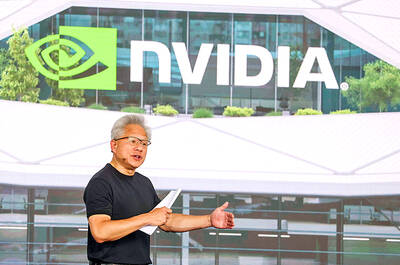
‘BOOMING’: ’ The number of partners we have here is incredible. You can see from their stock prices. They’re doing so well, they’re so happy,’ Jensen Huang said Nvidia Corp’s spending in Taiwan has ballooned to about US$150 billion a year, 10 times the US$10 billion to US$15 billion the company spent five years ago, Nvidia chief executive officer Jensen Huang (黃仁勳) said yesterday, suggesting Taiwan’s strategic importance in the global artificial intelligence (AI) supply chain. “Taiwan is the epicenter of the AI revolution. This is where the chips come, packaging comes. This is where the systems are made. This is where AI supercomputers were created,” Huang said at a meeting for the company’s employees in Beitou-Shilin Technology Park (北投士林科技園區) in Taipei, the planned site of Nvidia’s Taipei headquarters. “Taiwan
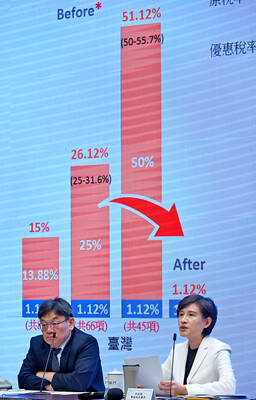
GREATER REACH? Auto parts and wood products would face tariffs of up to 15%, matching those targeting the EU, Japan and South Korea, Vice Premier said The US has announced that preferential tariff treatment for Taiwan’s non-semiconductor Section 232 goods would take effect retroactively from May 1, the Executive Yuan said yesterday. The US government yesterday posted a notice on the Federal Register’s public inspection Web site previewing tariff concessions for Taiwan under a memorandum of understanding (MOU) on Taiwan-US investment after two months of negotiations. The MOU signed on Jan. 15 stipulated three major preferential tariff arrangements: a 15 percent “reciprocal” tariff rate for Taiwan without stacking most-favored nation (MFN) rates; preferential Section 232 treatment for semiconductors and related products; and preferential Section 232 treatment for non-semiconductor


 RSS
RSS