


Amanda Congdon told viewers the last time she appeared on her popular video blog, Rocketboom: "The Internet is like a smoothly paved road, I can go anywhere I want."
She was not talking about her career, but she could have been.
In less than two years as the quirky, goofy-but-gorgeous host of a low-tech, three-minute fake newscast, "Congdon," who left Rocketboom this week in a dispute with her partner, achieved a kind of fame unique to this Internet age.

PHOTO: AP
It was the kind of fame that had little to do with money, at least until recently. For the first year Congdon made US$50 an episode. Segments were created in the one-bedroom Manhattan apartment of Congdon's partner and Rocketboom founder, Andrew Michael Baron.
It was the kind of fame that brought Congdon, 24, a guest spot -- as herself -- on CSI: Crime Scene Investigation. And representation by one of Hollywood's top agents, Ari Emanuel, the inspiration for Jeremy Piven's Emmy-nominated character on Entourage.
Most of all, it was the kind of fame -- that peculiar blogosphere kind of fame -- that made Congdon's fans feel they knew her intimately. Of the estimated 300,000 people that downloaded Rocketboom daily -- an audience larger, for example, than Connie Chung's latest cable TV show -- at least 800 had e-mailed her by Thursday afternoon, she said, and about a quarter of those contained job offers, from places as far off as Japan.
If they did not e-mail Congdon, they blogged about her. On the Web site technorati.com, which monitors tens of millions of blogs, "rocketboom" was the top search -- globally -- both Thursday and Friday (Kenneth Lay, the Enron Corp. founder who died on Wednesday, was second).
Meanwhile, on a blog Congdon set up -- appropriately named AmandaUnBoomed -- admirers piled on the good wishes.
"We love you Amanda!" wrote one, called tangerine. "Please understand: One door closes. Another opens."
"Rocketboom fans are very loyal," Congdon acknowledged on Thursday evening during an interview from her family home in rural Connecticut (she didn't want to name the town publicly).
"They're saying, `Don't worry, we'll follow you wherever you go,'" she said.
Appropriately, at least one serious offer -- from Jason Calcanis, of the AOL blogging network Weblogs, Inc -- was made on his blog.
"You're on the top of the talent pool on the Web and you should get compensated for what you've done," Calcanis wrote Congdon on calcanis.com. "You don't have a huge window of opportunity -- you need to act now."
Was Congdon surprised by such a public offer?
"That's the thing about the Internet," she said rather matter-of-factly. "It's all about being transparent."
And about being, well, KNOWN.
"I would say Amanda has a friend base, rather than a fan base," says Jeff Jarvis, author of the BuzzMachine blog, who has provided advice to Rocketboom. "You get a very personal relationship with people in this medium. It's this mass sense of knowing"
Certainly, this may have been easier for Congdon because unlike previous Internet stars like Wonkette's Ana Marie Cox, for example, she was an "on-air" personality -- a vlogger, as video bloggers are known.
Congdon was a blogosphere neophyte when she first met Baron, through an ad he had put on craiglist.com, in 2004. She was a graduate of Northwestern and an aspiring actress, who had played a coat check girl on the reality series The Restaurant.
"Andrew was looking for a blogger and an actress," Congdon says. "I wasn't a blogger. But I was a writer, and that helped."
The venture began.
Segments were highly varied. In one episode late last month, Congdon pondered the famous Diet Coke/Mentos explosions, did a quick feature on Dubai, and advised people how to avoid laptop battery fires. Two days later, it was a more serious report on a poor Botswana village.
"They created something really new and exciting," Jarvis said. "Out of nothing came a show, a franchise, a medium."
This past March, money started coming in. Rocketboom held an eBay auction of its first ads. It sold one for US$40,000, and another for US$80,000.
But Congdon, who owns 49 percent of Rocketboom to Baron's 51 percent, wanted to move to Los Angeles. She says she had a long-standing agreement with Baron that she could work from the West Coast, but that he reneged. She also says Baron demanded she serve as merely the "face" of Rocketboom, ignoring her part ownership.
Baron, for his part, says the dispute is over a number of things, not just one. He said he had been supportive of her plan to get to Los Angeles, but could not meet her demands right away. He said she was refusing to collaborate with him further, and he's coming back on Monday with an interim host.

PROVOCATIVE: Chinese Deputy Ambassador to the UN Sun Lei accused Japan of sending military vessels to deliberately provoke tensions in the Taiwan Strait China denounced remarks by Japan and the EU about the South China Sea at a UN Security Council meeting on Monday, and accused Tokyo of provocative behavior in the Taiwan Strait and planning military expansion. Ayano Kunimitsu, a Japanese vice foreign minister, told the Council meeting on maritime security that Tokyo was seriously concerned about the situation in the East China and South China seas, and reiterated Japan’s opposition to any attempt to change the “status quo” by force, and obstruction of freedom of navigation and overflight. Stavros Lambrinidis, head of the EU delegation to the UN, also highlighted South China Sea

The final batch of 28 M1A2T Abrams tanks purchased from the US arrived at Taipei Port last night and were transported to the Armor Training Command in Hsinchu County’s Hukou Township (湖口), completing the military’s multi-year procurement of 108 of the tanks. Starting at 12:10am today, reporters observed more than a dozen civilian flatbed trailers departing from Taipei Port, each carrying an M1A2T tank covered with black waterproof tarps. Escorted by military vehicles, the convoy traveled via the West Coast Expressway to the Armor Training Command, with police implementing traffic control. The army operates about 1,000 tanks, including CM-11 Brave Tiger
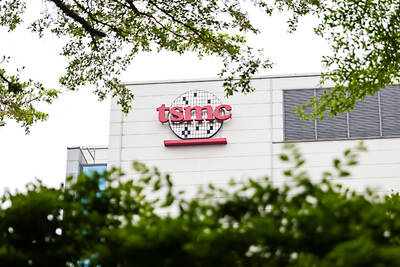
Taiwan Semiconductor Manufacturing Co (TSMC, 台積電), the world’s largest contract chipmaker, said it expects its 2-nanometer (2nm) chip capacity to grow at a compound annual rate of 70 percent from this year to 2028. The projection comes as five fabs begin volume production of 2-nanometer chips this year — two in Hsinchu and three in Kaohsiung — TSMC senior vice president and deputy cochief operating officer Cliff Hou (侯永清) said at the company’s annual technology symposium in Silicon Valley, California, last week. Output in the first year of 2-nanometer production, which began in the fourth quarter of last year, is expected to

Taiwan’s drone exports surged past US$100 million in the first quarter, exceeding last year’s full-year total, with the Czech Republic emerging as the largest buyer, the Ministry of Economic Affairs said. Exports of complete drones reached US$115.85 million in the period, about 1.2 times the total recorded for all of last year, the ministry said in a report. Exports to the Czech Republic accounted for about US$100 million, far outpacing other markets. Poland, last year’s top destination, recorded about US$11.75 million in the first quarter. Taiwan’s drone exports have expanded rapidly in the past few years, with last year’s total


 RSS
RSS