


Perhaps the biggest surprise was that no one was really surprised that the staff of the fiercely left-wing French daily Liberation accepted an offer by the scion of a capitalist dynasty to purchase a hefty portion of its stock.
The vote, taken on Thursday, was close. But in the end the survival instinct was stronger than ideology, and Edouard de Rothschild, the 47 year-old son of the banker Baron Guy de Rothschild, became the newspaper's largest shareholder.
For 20 million euros (US$26 million), Rothschild acquired 37 percent of Liberation, which was founded in 1973 by philosopher Jean-Paul Sartre and current publisher Serge July as what one writer has called "a Maoist instruction sheet."
Because it has nurtured and marketed an anti-authoritarian, anti-big business identity, the move to open itself to a capitalist heavyweight like Rothschild is deeply significant for the entire French newspaper industry.
Like almost all French dailies, Liberation has in recent years suffered from competition provided by the Internet, television and free dailies, such as the Swedish-based Metro, which has 42 daily editions in 17 countries, including France.
As a result, Liberation and other major French newspapers have suffered substantial drops in circulation and advertising revenue.
New capital
According to July, the new capital will help the paper lower prices and improve distribution, editorial and online activities.
"We judge these [improvements] indispensable to meeting the challenges of the media Big Bang," July wrote in Liberation last month when announcing the opening of negotiations with Rothschild.
Even though the deal gives Rothschild the chance to increase his share of the paper to 52 percent by 2007, he has accepted a 40 percent ceiling on his voting rights.
Nonetheless, many observers remain troubled.
"On a symbolic level, it's shocking," Pierre Defassieux of the main French journalists' union SNJ told Forbes magazine. "It just shows how difficult it's becoming to sustain an independent press in France."
Rothschild has vowed "not to interfere in the paper's editorial content." But that promise was also made by entrepreneur Serge Dassault after he purchased Socpresse, the company that owns another major French newspaper, Le Figaro, as well as other publications.
Shortly after taking control, Dassault said, "Newspapers should publish healthy ideas. And left-wing ideas are not healthy ideas."
He reportedly also told editors not to publish stories that attacked France's "commercial and industrial interests," and staff claimed that stories about his company, Dassault Aviation, were soon dropped.
Severance payments
As a result, some 10 percent of all Socpresse journalists took advantage of a contractual clause allowing them to resign because of the deal, and Socpresse was forced to pay an estimated 15 million euros (US$19.5 million) in severance payments.
Stunning as it was, the Liberation deal will not be the last -- or biggest -- shock to the French media landscape.
The daily Le Monde, widely considered one of the world's great independent newspapers, is currently in negotiations to have one of the country's most successful conglomerates, the Lagardere group, purchase 15 percent of its stock.
With circulation down some 5 percent over the last two years, Le Monde is seeking a 50 million euro infusion to help cover debts of up to 130 million euros.
When the deal with Lagardere is finally announced, perhaps later this month, France's entire media landscape will have been transformed.

‘NO SECURITY RISK’: The Railway Bureau reassured the public that the technicians’ activities were limited to technical guidance and did not involve sensitive systems The Railway Bureau yesterday said it had invited eight Chinese technicians to assist with an airport MRT construction project. The bureau issued the confirmation after an Internet user said Chinese nationals had entered the construction zone of Taiwan Taoyuan International Airport’s Terminal 3 project. They asked why “individuals from an enemy state” were allowed access to such a major national infrastructure project, which raised serious concerns over Taiwan’s industrial safety, sensitive systems and information security. The bureau’s Northern Region Engineering Branch Office said subcontractor Taiwan Handle Industrial Co (台灣手把工業) of the Taoyuan airport MRT’s “Contract No. CU05 Project A14 Station Civil, MEP &

A US uncrewed surface vessel (USV) encountered multiple Chinese warships during an autonomous transit of the Taiwan Strait, US defense company Seasats said in a statement on Wednesday. Seasats announced that a Lightfish USV had completed the first autonomous transit of the Taiwan Strait. Over five days, the USV traversed the entire length of the Strait while constantly monitoring surface vessel traffic, the company said. The Lightfish encountered multiple Chinese warships, one of which was a Chinese People’s Liberation Army Navy (PLAN) Type 056 corvette, it said. The Chinese vessels were operating “well within Taiwan’s exclusive economic zone without transmitting their identity via the
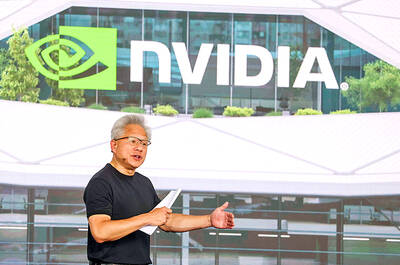
‘BOOMING’: ’ The number of partners we have here is incredible. You can see from their stock prices. They’re doing so well, they’re so happy,’ Jensen Huang said Nvidia Corp’s spending in Taiwan has ballooned to about US$150 billion a year, 10 times the US$10 billion to US$15 billion the company spent five years ago, Nvidia chief executive officer Jensen Huang (黃仁勳) said yesterday, suggesting Taiwan’s strategic importance in the global artificial intelligence (AI) supply chain. “Taiwan is the epicenter of the AI revolution. This is where the chips come, packaging comes. This is where the systems are made. This is where AI supercomputers were created,” Huang said at a meeting for the company’s employees in Beitou-Shilin Technology Park (北投士林科技園區) in Taipei, the planned site of Nvidia’s Taipei headquarters. “Taiwan
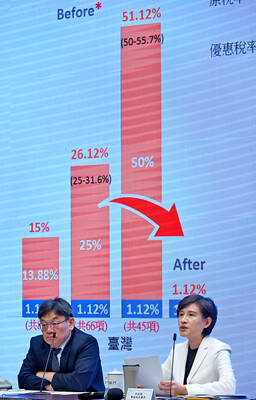
GREATER REACH? Auto parts and wood products would face tariffs of up to 15%, matching those targeting the EU, Japan and South Korea, Vice Premier said The US has announced that preferential tariff treatment for Taiwan’s non-semiconductor Section 232 goods would take effect retroactively from May 1, the Executive Yuan said yesterday. The US government yesterday posted a notice on the Federal Register’s public inspection Web site previewing tariff concessions for Taiwan under a memorandum of understanding (MOU) on Taiwan-US investment after two months of negotiations. The MOU signed on Jan. 15 stipulated three major preferential tariff arrangements: a 15 percent “reciprocal” tariff rate for Taiwan without stacking most-favored nation (MFN) rates; preferential Section 232 treatment for semiconductors and related products; and preferential Section 232 treatment for non-semiconductor


 RSS
RSS