

For many Americans, a new year means a diet, and this year there is a good chance that it's a low-carbohydrate, high-protein one. More than 10 million people are following a low-carb regimen like the Atkins diet, the Zone or the South Beach diet, according to the NPD Group, a market research company in Chicago.
Recognizing the size of the trend, nearly every part of the food industry, from manufacturers to restaurant chains, has introduced low-carb products.
"We're just seeing the leading edge of this, but low-carb is becoming ubiquitous," said Dean Rotbart, executive editor of LowCarbiz, a trade newsletter that started last July and is based in Denver. "Atkins has become something like Kleenex is to facial tissue."
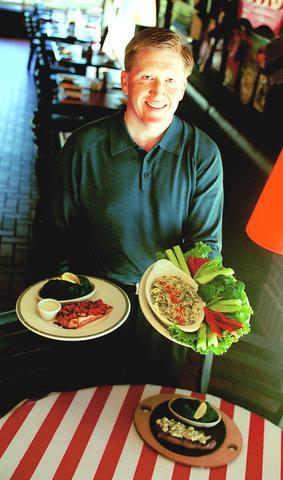
PHOTO: NY TIMES NEWS SERVICE
But marketing food that fits a certain dietary style is not without risks, and many companies now face the question of whether they are better off forming a partnership with a name-brand diet or going it alone. "There is a debate in the industry about whether you want to live and die by a diet's fortunes, or if you want to stay more generic," said John Glass, a restaurant analyst at CIBC World Markets in Boston. "Using a branded association immediately gets you more notice, but it also limits your appeal."
The high-protein crowd received an unexpected scare with the recent announcement that a cow in the US was found to have mad cow disease. Depending on the extent of the problem, diets that encourage the consumption of red meat could become less popular. Seventy percent of Americans are expressing some concern about mad cow disease, according to a survey on food safety conducted in late December by NPD, which has been tracking food trends since 1980.
"There is clearly great concern about this, but as for a change in behavior, I think that depends on how many cows get sick," said Harry Balzer, vice president of NPD. "If the bovine bonfires of Great Britain come to the US, you'll see a significant drop in meat consumption. But if it is like Canada with only one cow, I don't think it will have a major impact."
Balzer said he did not see a single infected cow as a threat to the low-carb craze. "Americans are still going to want to lose weight, and this is the hot diet," he said. "It could cause a shift in the meat component and drive people more towards poultry or pork."
TGI Friday's, owned by Carlson Restaurants Worldwide, is betting that low-carb diets will stick around. Last month, it announced a partnership with Atkins Nutritionals and began serving Atkins-approved menu items at its more than 520 American restaurants.
"We see really significant rewards in using the Atkins name because we're creating a lot of trust," said Mike Archer, executive vice president and chief operating officer of TGI Friday's. "Low-carb is on fire right now, it's the thing that everybody is talking about, and we think that it can be a considerable part of our business."
The Atkins-inspired dishes include Tuscan spinach dip, sizzling chicken with broccoli and grilled chicken Caesar salad.
Consumer research at TGI Friday's found that 19 percent of those who dine often at casual restaurants like Friday's are using the Atkins approach.
"We're trying to change perceptions of the brand," Archer said, "to show that you can go out to a TGI Friday's and have one of our indulgent items, but you also have some healthy low-carb options."
At TGI Friday's, two of the nine "Atkins-approved" menu items are made with beef. "We're continuing to monitor the situation," said Amy Freshwater, a spokeswoman for the chain. "But we have not seen any change in our guests' dining habits, and we don't anticipate that we will."
Atkins Nutritionals, the private company founded by Dr. Robert Atkins, who published his first low-carb diet book in 1972 and died last year after slipping on ice, is looking beyond its 129 grocery-store products for ways to capitalize on its widespread name recognition.
"We are looking at working with a few different channels of the restaurant industry to offer more options to our user base," said Matt Wiant, senior vice president and chief marketing officer for the company.
Rather than entering partnerships, some restaurant chains -- including P.F. Chang's China Bistro, Ruby Tuesday and KFC, part of Yum Brands -- are rolling out low-carb versions of their existing menus. Even Panera Bread, a bakery cafe chain with 550 outlets, has three low-carb breads in development.
In December, Hardee's and Carl's Jr began selling a bunless, lettuce-wrapped hamburger. The Carl's Jr. version has only 6 grams of carbohydrates, compared with 61 for a burger with a bun.
"We did look into doing a partnership, but we decided against it," said Andy Puzder, president and chief executive of CKE Restaurants in Carpinteria, California, which owns both chains.
"When you partner with these guys, it becomes a complex and expensive process. We'd rather keep prices down and keep control of our product. And it was easy for us to roll out because it wasn't a big investment. We didn't bring anything new into the restaurants," he said.
Even the beer industry has recognized a new market. In September 2002, Anheuser-Busch introduced a low-carb brew, Michelob Ultra; last month, the company said that the brand had a 2.1 percent share of supermarket beer sales. Rolling Rock, from Labatt USA, has Rock Green Light, and the Adolph Coors Co will introduce a low-carb version, Aspen Edge, in March.
But some industry analysts say they are already tired of a trend that they see as eventually going the way of the low-fat, low-salt and low-caffeine fads of the past two decades.
"Everybody is falling all over themselves," Balzer of NPD said. "But the issue here is staying power." But will low-carb diets be as important as they are now? "No way, absolutely not," he said. "It's going to follow low-fat."
Productscan Online, a firm in Naples, New York, that tracks new packaged products, says that at the peak of the low-fat diet craze, one-quarter of all manufactured food was designated as low fat. Last year low-carb products had 3.4 percent of the market. More than 600 such products were introduced last year, compared with 339 in 2002 and 47 in 1999.
"It had been percolating under the radar for most of the 1990s; then everyone jumped on the bandwagon in the past year," said Tom Vierhile, executive editor of Productscan. "These products have been selling well and there is still money to be made in low-carb, but I think it will peter out pretty quickly. I just think that this is another fad diet.
"Companies getting into the game in 2004 are going to be sorry," he added. "Trends that get hot this fast tend to go cold fast, too."
According to NPD, 27 percent of all American adults are trying some kind of diet. As of February last year 1 percent were on a low-carb diet; by August, that share had risen to 3.5 percent.
"Everyone I can think of is jumping on the bandwagon," said Glass, the CIBC analyst. "Will it last? That is the core question that everyone in the analyst community is asking."
Rotbart said sales of low-carb products exceeded US$15 billion last year.
"But at some point, you reach a ceiling," he said. "In this country, we have another year, maybe 18 months of the low-carb craze, but in the end, that is a fixed number. And one of the problems that Atkins has is that Atkins himself can no longer adjust it."
Others may be ready to fill the void created by Atkins' death.
This spring, John Wiley & Sons will release The Hamptons Diet: Lose Weight Quickly and Safely With the Doctor's Delicious Meal Plans, written by Fred Pescatore, a doctor who worked at the Atkins Center.
Some restaurant companies are in partnerships with brand-name diet plans, but not those that emphasize low carbs. Last July, Applebee's International announced a five-year partnership with Weight Watchers International.
"They are a dominant, enduring brand," John Cywinski, the chief marketing officer of Applebee's, said of Weight Watchers. "This is not a diet. This is a brand that transcends fads, age and sex. In our opinion, it will be the only enduring long-term health and weight-loss initiative."
Some people say restaurant and food companies should not be associated with any plan, even a tried-and-true one.
"If I were a national chain, I wouldn't want to be linked to one particular diet," Rotbart said. "I'd want to be flexible."
He said that he thought Friday's was making a mistake in partnering with Atkins. "The low-carb diet du jour is going to change," he said.
But executives at TGI Friday's said they had no worries that Atkins was just another trend. "There is no concern on our part at all," said Archer. "Atkins has been around for 20 years and it is continuing to build momentum," Archer said. "If this is a fad, it's the biggest fad that I've ever seen in my life."

BAVI: Taipei, New Taipei City, Taoyuan and others announced work and class closures today, with the storm expected to affect Taiwan through tomorrow The outer rain bands of Typhoon Bavi would begin affecting Taiwan today, with its storm circle reaching land this evening and its level-10 wind radius covering all of northern Taiwan by noon tomorrow, an official said yesterday. The Central Weather Administration (CWA) issued a sea warning for the storm at 2:30pm yesterday, advising of heightened danger in eastern areas and in the Bashi Channel south of Taiwan. Typhoon Bavi is expected to bring strong winds, extremely heavy rainfall and rough seas to Taiwan today and tomorrow, with the heaviest rain forecast for mountainous areas and sustained winds of up to 12 on

Typhoon Bavi was expected to have its strongest impact on Taiwan from last night through daytime today, with its storm circle forecast to reach areas from New Taipei City’s northeast coast to Yilan and Hualien counties early today, the Central Weather Administration (CWA) said yesterday. As of 6pm yesterday, the center of the typhoon was about 590km east of Taiwan’s southernmost tip at Oluanpi (鵝鑾鼻), moving northwest at 26kph, the CWA said. The storm was packing maximum sustained winds of 155kph near its center, with gusts reaching 191kph. It had a radius of 380km. A land warning, issued at 5:30am yesterday, remains in

Typhoon Bavi lashed Taiwan yesterday, injuring 113 people, prompting the evacuation of 14,605 residents and knocking out power in 234,481 households, the government said. Most of the injuries were due to people falling off motorcycles or bicycles due to strong winds and slippery roads, and others occurred during the typhoon preparations, Central Emergency Operations Center (CEOC) data as of 8pm yesterday showed. No fatalities or severe injuries had been reported as of press time last night. Due to flooding and landslide risks, 14,605 people had been evacuated nationwide, led by 5,182 people in Hualien County, 2,096 in Taichung, 1,700 in New Taipei,

APPLICATIONS: The robots are capable of disaster and firefighting response, autonomous navigation, swarm operations as well as underground tunnel inspections, the ministry said The Ministry of Economic Affairs is working with the Industrial Technology Research Institute (ITRI) and industry partners to create a homegrown program to develop four-legged robots to tap into the US$4 billion global robot dog market. The initiative aims to leverage Taiwan’s strengths in information and communications technology, semiconductors and precision machinery to build indigenous technologies and a non-China supply chain, the ministry said. Technology is evolving from robotic arms to wheeled, quadruped and humanoid robots with autonomous mobility capabilities, it said. Driven by rapid advancements in generative artificial intelligence (AI), visual recognition, sensors and high-performance computing, robots are now capable of


 RSS
RSS