


Hon Hai Precision Industry Co (鴻海精密) yesterday confirmed rumors it plans to produce masks in Taiwan amid the expanding COVID-19 outbreak.
The world’s largest electronics contract manufacturer said it has contacted suppliers of raw materials and machinery equipment to produce masks for its home market.
While it gave few details about its production goals, the company, headquartered in New Taipei City’s Tucheng District (土城), said it hopes to contribute to Taiwanese society through its mask production.
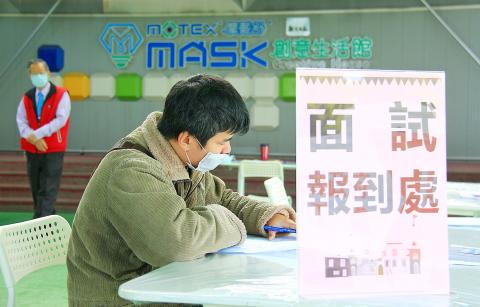
Photo: Chen Kuan-pei, Taipei Times
The company’s statement came after New Taipei City Mayor Hou You-yi (侯友宜) said in an interview yesterday morning that Hon Hai had earlier reached out to the city about manufacturing masks for the domestic market as Taiwan continues to face a shortage, the Chinese-language Liberty Times (the sister newspaper of the Taipei Times) reported yesterday.
Hon Hai plans to set up 10 mask production lines at facilities held by its Hong-Kong listed subsidiary, FIT Hon Teng Ltd (鴻騰精密), in the city by the end of this month, the company said.
Mass production is scheduled to begin next month with an estimated daily output of 1 million units, Hon Hai said.
The company, known internationally as Foxconn Technology Group (富士康科技集團), has been hit by production delays at its Chinese assembly plants caused by the outbreak, and has already planned to produce masks in China so that it can ensure a steady supply for its China-based employees.
Earlier this month, it began trial production of masks through its Foxconn Industrial Internet Co Ltd (富士康工業互聯網) subsidiary at its Longhua Park plant in Shenzhen, Guangdong Province.
The Longhua Park plant is expected to produce 2 million masks per day by the end of the month, the company said.
Its mask output in Taiwan would also contribute to the government’s centralized mask distribution policy, which has been extended until the end of April.
Domestic production of masks, which the Ministry of Economic Affairs is supervising, has increased from 4.2 million units per day last week to 5.5 million units per day this week, ministry data showed.
Total production is expected to amount to 10 million masks on a daily basis by the end of next month, the ministry said.

The demise of the coal industry left the US’ Appalachian region in tatters, with lost jobs, spoiled water and countless kilometers of abandoned underground mines. Now entrepreneurs are eyeing the rural region with ambitious visions to rebuild its economy by converting old mines into solar power systems and data centers that could help fuel the increasing power demands of the artificial intelligence (AI) boom. One such project is underway by a non-profit team calling itself Energy DELTA (Discovery, Education, Learning and Technology Accelerator) Lab, which is looking to develop energy sources on about 26,305 hectares of old coal land in

Taiwan’s exports soared 56 percent year-on-year to an all-time high of US$64.05 billion last month, propelled by surging global demand for artificial intelligence (AI), high-performance computing and cloud service infrastructure, the Ministry of Finance said yesterday. Department of Statistics Director-General Beatrice Tsai (蔡美娜) called the figure an unexpected upside surprise, citing a wave of technology orders from overseas customers alongside the usual year-end shopping season for technology products. Growth is likely to remain strong this month, she said, projecting a 40 percent to 45 percent expansion on an annual basis. The outperformance could prompt the Directorate-General of Budget, Accounting and

Netflix on Friday faced fierce criticism over its blockbuster deal to acquire Warner Bros Discovery. The streaming giant is already viewed as a pariah in some Hollywood circles, largely due to its reluctance to release content in theaters and its disruption of traditional industry practices. As Netflix emerged as the likely winning bidder for Warner Bros — the studio behind Casablanca, the Harry Potter movies and Friends — Hollywood’s elite launched an aggressive campaign against the acquisition. Titanic director James Cameron called the buyout a “disaster,” while a group of prominent producers are lobbying US Congress to oppose the deal,

Two Chinese chipmakers are attracting strong retail investor demand, buoyed by industry peer Moore Threads Technology Co’s (摩爾線程) stellar debut. The retail portion of MetaX Integrated Circuits (Shanghai) Co’s (上海沐曦) upcoming initial public offering (IPO) was 2,986 times oversubscribed on Friday, according to a filing. Meanwhile, Beijing Onmicro Electronics Co (北京昂瑞微), which makes radio frequency chips, was 2,899 times oversubscribed on Friday, its filing showed. The bids coincided with Moore Threads’ trading debut, which surged 425 percent on Friday after raising 8 billion yuan (US$1.13 billion) on bets that the company could emerge as a viable local competitor to Nvidia


 RSS
RSS