


The COVID-19 outbreak could damage global economic growth this year, IMF managing director Kristalina Georgieva said on Sunday, but added that a sharp and rapid economic rebound could follow.
“There may be a cut that we are still hoping would be in the 0.1-0.2 percentage space,” Georgieva told the Global Women’s Forum in Dubai.
She said the full impact of the spreading disease that has killed more than 1,770 people would depend on how quickly it was contained.
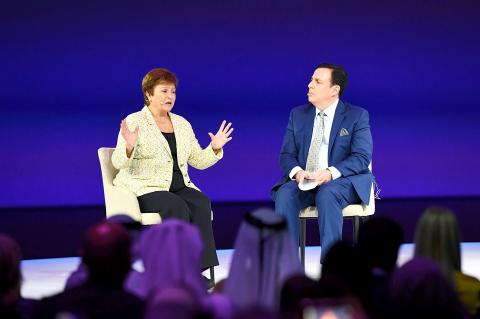
Photo: AFP
“I advise everybody not to jump to premature conclusions. There is still a great deal of uncertainty. We operate with scenarios, not yet with projections, ask me in 10 days,” Georgieva said.
In its update last month to the World Economic Outlook, the IMF lowered global economic growth forecast for this year by 0.1 percentage points to 3.3 percent, following a 2.9 percent growth the previous year, the lowest in a decade.
Georgieva said it was “too early” to assess the full impact of the outbreak, but acknowledged that it had already affected sectors such as tourism and transportation.
“It is too early to say, because we don’t yet quite know what is the nature of this virus. We don’t know how quickly China will be able to contain it. We don’t know whether it will spread to the rest of the world,” she said.
If the disease is “contained rapidly, there can be a sharp drop and a very rapid rebound,” in what is known as the V-shaped impact, she said.
Compared with the effects of the SARS outbreak in 2002 and 2003, she said China’s economy at the time made up just 8 percent of global economy. Now, that figure is 19 percent.
She welcomed the trade agreement signed last month by the US and China, the world’s first and second-largest economies.
“About China, it has been slowing down naturally, transiting from what we can call high-speed to high-quality growth,” she said. “And as a result of the reduction of trade tensions [after the agreement] ... we actually have been predicting some improvement for 2020 in the projections for China.”
Regarding the outbreak, “they’re working very hard to contain the epidemic, they have brought US$115 billion equivalent liquidity so they can perk up the economy,” she said.
However, the world should be concerned “about sluggish growth” affected by uncertainty, Georgieva said.

Cairo’s new monorail slices across the city skyline, running above the familiar chaos of blaring horns and aging buses’ exhaust fumes that mark rush hour below. The US$4.5 billion monorail, opened this month, is among Egypt’s most prominent new transport projects, part of a debt-funded infrastructure drive criticized for sapping state finances while bringing limited benefits to most of the country’s 109 million people. “It feels like you’re in a different country,” said Ramy Sayed, a restaurant manager, aboard a driverless Innovia 300 train. “No noise, no traffic, we’re not used to this.” The eastern line runs 56km from the bustling middle-class

Taiwanese firms have increased investment in the Philippines in recent years as Manila’s ties with Washington deepen and global supply chains continue to shift away from China, an expert at the Chung-Hua Institution for Economic Research (CIER, 中華經濟研究院) said yesterday. The Philippines had not been among Taiwanese investors’ top choices in Southeast Asia, CIER Taiwan ASEAN Studies Center director Kristy Hsu (徐遵慈) said at a seminar in Taipei. However, Taiwan’s investment in the country has grown significantly since the COVID-19 pandemic, reaching US $257 million last year, a high in recent years, she said. Although Taiwan’s total investment in the Philippines still lags
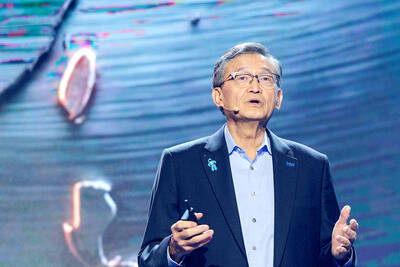
Intel Corp regards Taiwan Semiconductor Manufacturing Co (TSMC, 台積電) as a longstanding partner, as the US chipmaker would continue outsourcing production of advanced chips to TSMC, Intel chief executive officer Lip-Bu Tan (陳立武) said yesterday. “I don’t look at people as competitors. I look at the collaboration... Nvidia is also, you know, a good friend,” Tan told a news conference following his keynote speech at the Computex trade show in Taipei. “It’s a very trusted partnership for us... We are a big, top customer for them, and we’re going to continue doing that,” he said, referring to TSMC, the world’s largest foundry

Artificial intelligence (AI) agents would supplant smartphones as the center of people’s digital lives, fundamentally reshaping personal devices and driving a major computing upgrade cycle, Qualcomm Inc CEO Cristiano Amon said yesterday. In his keynote speech for this year’s Computex trade show in Taipei, Amon said that the rise of "agentic AI" — AI systems capable of reasoning, planning and carrying out tasks autonomously — would transform how people interact with technology across phones, PCs, vehicles and wearable devices. Describing the technology as the next major evolution in computing, Amon said that "2026 is the year of agents.” For decades, smartphones have sat


 RSS
RSS