


Nissan Motor Co would go bankrupt within two to three years, Carlos Ghosn last year told a defense attorney during more than 10 hours of interviews before the auto executive skipped bail and left Japan.
The former chairman and chief executive officer of Nissan Motor Co and Renault SA made the prediction in a series of conversations about his arrest and prosecution, said Nobuo Gohara, a former prosecutor who also is a vocal critic of Japan’s justice system.
“He told me that Nissan will probably go bankrupt within two to three years,” Gohara said in a news conference in Tokyo on Wednesday.
He held the conference to discuss his conversations with the now-fugitive titan in the automobile field.
Ghosn did not offer detailed reasons why Nissan would run into difficulties, the lawyer said.
Nissan spokeswoman Azusa Momose declined to comment.
The Yokohama-based company is suffering from declining car sales in China and Europe, prompting it to slash profit and sales forecasts for the fiscal year ending March 31 and say it would eliminate 12,500 jobs globally.
Gohara said that he met with and interviewed Ghosn five times during a two-month period for a book he planned to publish before the start of Ghosn’s trial, which is no longer likely to happen.
Gohara last met with Ghosn two days before his escape last month to Beirut.
The attorney said he had permission from Ghosn to disclose the details of their conversations.
Gohara regularly comments on issues surrounding the Japanese justice system in his blog and TV appearances.
Since Ghosn’s arrest, he has also criticized what he calls Japan’s “hostage justice” system and the country’s recent introduction of plea bargaining.
The 65-year-old Ghosn, speaking earlier this month from Beirut, said he fled Japan because he no longer thought he would have a fair and speedy trial.
The former executive was facing several charges of financial misconduct, including underreporting his income and breach of trust. In the latter charges, Japanese prosecutors accused him of transferring personal trading losses to Nissan and using company funds for his own and his family’s gains.
Ghosn insisted that he was the victim of a conspiracy to take him out because he was working on a merger of Nissan and alliance partner Renault. Mitsubishi Motors Corp is the third member.
“Nissan and prosecutors worked together to bring a criminal case against Ghosn,” Gohara said in Tokyo.
Ghosn spent a total of almost 130 days in a Tokyo jail and was contemplating trial in a country where prosecutors virtually never lose.
He was freed on bail last year under strict conditions, such as not being able to communicate with his wife and only being allowed to use a computer in his lawyer’s office.

The domestic unit of the Chinese-owned, Dutch-headquartered chipmaker Nexperia BV will soon be able to produce semiconductors locally within China, according to two company sources. Nexperia is at the center of a global tug-of-war over critical semiconductor technology, with a Dutch court in February ordering a probe into alleged mismanagement at the company. The geopolitical tussle has disrupted supply chains, with some carmakers reportedly forced to cut production due to chip shortages. Local production would allow Nexperia’s domestic arm, Nexperia Semiconductors (China) Ltd (安世半導體中國), to bypass restrictions in place since October on the supply of silicon wafers — etched with tiny components to

Singapore-based ride-hailing and delivery giant Grab Holdings Ltd has applied for regulatory approval to acquire the Taiwan operations of Germany-based Delivery Hero SE's Foodpanda in a deal valued at about US$600 million. Grab submitted the filing to the Fair Trade Commission on Friday last week, with the transaction subject to regulatory review and approval, the company said in a statement yesterday. Its independent governance structure would help foster a healthy and competitive market in Taiwan if the deal is approved, Grab said. Grab, which is listed on the NASDAQ, said in the filing that US-based Uber Technologies Inc holds about 13 percent of
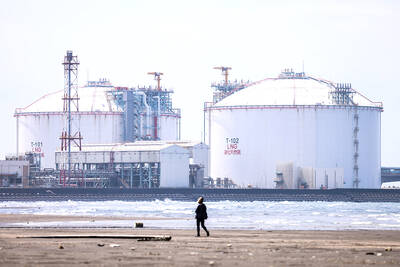
Taiwan is open to joining a global liquefied natural gas (LNG) program if one is created, but on the condition that countries provide delivery even in a scenario where there is a conflict with China, an energy department official said yesterday. While Taiwan’s priority is to have enough LNG at home, the nation is open to exploring potential strategic reserves in other countries such as Japan or South Korea, Energy Administration Deputy Director-General Chen Chung-hsien (陳崇憲) said. While the LNG market does not have a global reserve for emergencies like that of oil, the concept has been raised a few times —

Taiwan Semiconductor Manufacturing Co (TSMC, 台積電) yesterday received government approval to deploy its advanced 3-nanometer (3nm) process at its second fab currently under construction in Japan, the Ministry of Economic Affairs said in a news release. The ministry green-lit the plan for the facility in Kumamoto, which is scheduled to start installing equipment and come online in 2028 with a monthly production capacity of 15,000 12-inch wafers, the ministry said. The Department of Investment Review in June 2024 authorized a US$5.26 billion investment for the facility, slated to manufacture 6- to 12nm chips, significantly less advanced than 3nm process. At a meeting with


 RSS
RSS