


Amid rising defaults and tighter liquidity for Chinese privately owned enterprises, the nation’s banks are letting some companies fail, something Deutsche Bank AG says presents bigger opportunities for foreign investors in troubled debt.
The German lender is an active distressed player in the Asia-Pacific region and has bet on some of the biggest restructuring, including commodities trader Noble Group Holdings Ltd.
China is taking steps to allow more foreign investment in the nation’s 2.37 trillion yuan (US$345.5 billion) non-performing loan (NPL) market. It is to give US investors direct access to the nation’s soured debt market as part of this week’s “phase 1” trade deal.
“There are signs we are seeing the beginning of a distressed debt cycle in China,” Deutsche Bank Asia Pacific investment bank cohead Amit Khattar said in an interview. “Distressed debt in China is going to be really interesting.”
Defaults in China’s onshore corporate bond market hit a record high last year and troubles have continued in the offshore market as well.
State-backed Qinghai Provincial Investment Group Co (青海省投資集團有限公司) missed a coupon payment on a US dollar bond due last week and there have been jitters over luxury clothing giant Shandong Ruyi Technology Group Co (山東如意科技集團), whose unit missed a payment on a loan facility last year.
During the global financial crisis, China distress “didn’t play out” because banks came to the rescue, but that is not happening at the same pace anymore as lenders refocus on asset quality and profitability, Khattar said.
China’s pile of bad debt is one area in which the firm potentially sees an opportunity.
The nation’s asset management firms have dominated the market so far, but as defaults rise the pool of soured debt is increasing. Most of the onshore debt nonpayments have been for private companies.
“Traditionally, it’s been harder to buy secondary loans in China and we haven’t been particularly active in China NPLs,” Khattar said. “If the pace of distress creation goes up, then foreign firms will have a greater role to play.”
Deutsche Bank has also been active in India, its other main market for financing and distressed business in the region.
It has deployed a “significant amount of capital” in India’s shadow banking sector and sees a strong “risk-reward” from lending to stressed companies, Khattar said.
However, there have been surprises for foreign investors, notably a court ruling last year on recovering funds in relation to Essar Steel India Ltd, one of the nation’s so-called “Dirty Dozen” that were pushed to the bankruptcy courts in 2017.
That was resolved late last year and the pace of distressed activity is likely to pick up with that, though there have been delays, Khattar said.
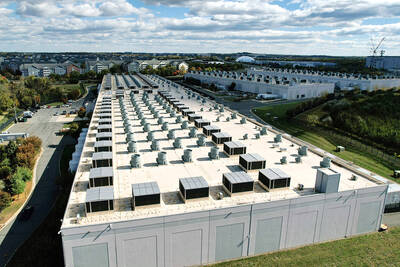
The demise of the coal industry left the US’ Appalachian region in tatters, with lost jobs, spoiled water and countless kilometers of abandoned underground mines. Now entrepreneurs are eyeing the rural region with ambitious visions to rebuild its economy by converting old mines into solar power systems and data centers that could help fuel the increasing power demands of the artificial intelligence (AI) boom. One such project is underway by a non-profit team calling itself Energy DELTA (Discovery, Education, Learning and Technology Accelerator) Lab, which is looking to develop energy sources on about 26,305 hectares of old coal land in
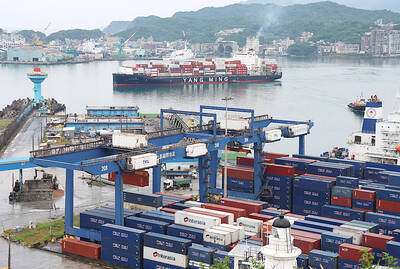
Taiwan’s exports soared 56 percent year-on-year to an all-time high of US$64.05 billion last month, propelled by surging global demand for artificial intelligence (AI), high-performance computing and cloud service infrastructure, the Ministry of Finance said yesterday. Department of Statistics Director-General Beatrice Tsai (蔡美娜) called the figure an unexpected upside surprise, citing a wave of technology orders from overseas customers alongside the usual year-end shopping season for technology products. Growth is likely to remain strong this month, she said, projecting a 40 percent to 45 percent expansion on an annual basis. The outperformance could prompt the Directorate-General of Budget, Accounting and
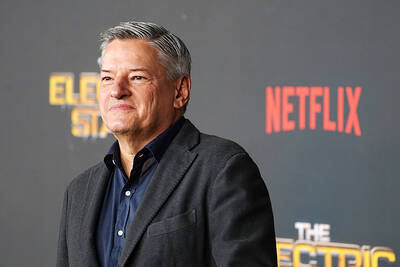
Netflix on Friday faced fierce criticism over its blockbuster deal to acquire Warner Bros Discovery. The streaming giant is already viewed as a pariah in some Hollywood circles, largely due to its reluctance to release content in theaters and its disruption of traditional industry practices. As Netflix emerged as the likely winning bidder for Warner Bros — the studio behind Casablanca, the Harry Potter movies and Friends — Hollywood’s elite launched an aggressive campaign against the acquisition. Titanic director James Cameron called the buyout a “disaster,” while a group of prominent producers are lobbying US Congress to oppose the deal,

Two Chinese chipmakers are attracting strong retail investor demand, buoyed by industry peer Moore Threads Technology Co’s (摩爾線程) stellar debut. The retail portion of MetaX Integrated Circuits (Shanghai) Co’s (上海沐曦) upcoming initial public offering (IPO) was 2,986 times oversubscribed on Friday, according to a filing. Meanwhile, Beijing Onmicro Electronics Co (北京昂瑞微), which makes radio frequency chips, was 2,899 times oversubscribed on Friday, its filing showed. The bids coincided with Moore Threads’ trading debut, which surged 425 percent on Friday after raising 8 billion yuan (US$1.13 billion) on bets that the company could emerge as a viable local competitor to Nvidia


 RSS
RSS