


Led by the technology sector, the nation’s initial public offering (IPO) market could stage a rebound next year, after hitting rock bottom this year because of US-China trade tensions, PricewaterhouseCoopers (PwC) Taiwan said yesterday.
The number of IPOs could rise to 50 next year, from a record low of 39 this year, as the US and China eye a trade deal and companies make adjustments to rein in uncertainties, PwC Taiwan assurance services partner Lin Yi-fan (林一帆) said at a media briefing in Taipei.
“Firms involved in 5G deployment and artificial intelligence applications have evolved to such an extent that they would be ready for an IPO in the next two years,” Lin said.
The target is reasonable, as the Taiwan Stock Exchange and the Taipei Exchange have each said that their goal is to host 24 IPOs next year, he said.
Next year would be a turning point for Taiwanese companies, many of which used to consider China their first and only destination of choice for overseas expansion, but now believe it is wise and necessary to diversify, Lin said.
That awareness would not necessarily lead to relocation out of China, but setting up manufacturing bases in multiple locations to better cope with tariff disputes and other risks, he said.
Taiwan has emerged as a favorable investment destination and would become more attractive when uncertainty over the Jan. 11 elections subsides, Lin said.
Firms embracing automation, 5G and artificial intelligence technologies are fueling the business of local companies in those supply chains, he said.
The government’s policies to encourage capital repatriation have not yet achieved the desired effect, as many companies and investors have preferred to stay on the sidelines and see how others fare, Lin said.
Sentiment has also turned more positive in the local property market, with an uptick in prices and rents, he said.
PwC Taiwan is seeking to take advantage of the trend by setting up a real-estate brokerage division, PwC Taiwan chairman Joseph Chou (周建宏) said.
The new unit consists of 10 employees with their own revenue target, he added.
“PwC Taiwan is to turn 50 next year and it has to reposition itself by taking up new challenges,” Chou said.
The global economy is expected to slow next year, with monetary easing by central banks and household consumption expected to be the main growth drivers, PwC Taiwan said, adding that diversified manufacturing bases would gain importance as trade disputes linger.

Elon Musk’s lieutenants have reached out to chip industry suppliers, including Applied Materials Inc, Tokyo Electron Ltd and Lam Research Corp, for his envisioned Terafab, early steps in an audacious and likely arduous attempt to break into the production of cutting-edge chips. Staff working for the joint venture between Tesla Inc and Space Exploration Technologies Corp (SpaceX) have sought price quotes and delivery times for an array of chipmaking gear, people familiar with the matter said. In past weeks, they’ve contacted makers of photomasks, substrates, etchers, depositors, cleaning devices, testers and other tools, according to the people, who asked not to

JET JUICE: The war on Iran’s secondary effects have seen fuel prices skyrocket, knocking flight schedules down to earth in return as airlines struggle with costs Airline passengers should brace for more irritation in the next few months as carriers worldwide cancel flights and ground planes to cope with stratospheric increases in jet-fuel prices. Dutch flag carrier KLM is the latest company to cut its schedule, saying on Thursday that it would scrap 80 return flights at Amsterdam’s Schiphol Airport in the coming month. That puts it in the same league as United Airlines Holdings Inc, Deutsche Lufthansa AG and Cathay Pacific Airways Ltd, which have all pruned itineraries to mitigate costs. Global capacity for next month has been reduced by about 3 percentage points, with all
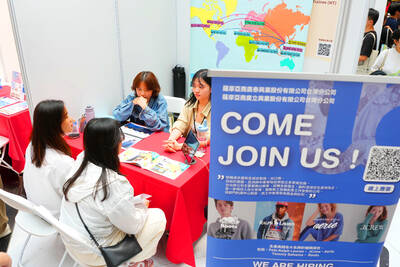
Taiwan is attracting a growing number of foreign jobseekers as companies increasingly recruit overseas talent to ease labor shortages and expand global reach, recruitment platform 104 Job Bank (104人力銀行) said yesterday. More than 40,000 foreign nationals searched for jobs in Taiwan through the platform last year, a 28 percent increase from a year earlier, the company said. Malaysians accounted for the largest share of overseas jobseekers at 12.2 percent, followed by Indonesians at 11.9 percent and Vietnamese at 10.8 percent. Indonesian applicants surged more than 50 percent year-on-year, while Vietnamese jobseekers rose by more than 30 percent. Applicants from the
NO SHORTCUTS: Asked about Elon Musk’s Terafab initiative, TSMC CEO C.C. Wei said it takes two to three years to build a fab and another one to two to ramp it up Taiwan Semiconductor Manufacturing Co (TSMC, 台積電) yesterday raised its revenue growth forecast for this year to above 30 percent, up from the 25 percent it estimated three months earlier, citing extremely robust artificial intelligence (AI)-related chip demand. “Our customers and customers’ customers, who are mainly cloud service providers, continue to send us very positive signals and outlook,” TSMC chairman and CEO C.C. Wei (魏哲家) said at an earnings conference. The company also hiked its capital expenditure for this year toward the higher end of its forecast, or US$56 billion, as it aims to step up advanced chip capacity expansions, such as


 RSS
RSS