


Local shares on Friday ended slightly higher as investors locked in earlier gains, which eroded an upturn on the main board by the end of the trading session ahead of the nearest technical resistance level, with the index breaching 11,600 points, dealers said.
Market sentiment continued to be dictated by uncertainty over global trade as the US and China have yet to sign a “phase one” agreement to resolve their trade disputes, while turnover remained thin, as many foreign institutional investors were away from the trading floor for year-end holidays, they said.
The TAIEX on Friday ended up 14.99 points, or 0.13 percent, at 11,609.64, rising 1 percent from a close of 11,489.57 on Nov. 29, after moving between 11,577.83 and 11,657.65, with turnover totaling NT$109.61 billion (US$3.59 billion).
The market opened up 0.39 percent and soon rose to the day’s high on follow-through buying from a session earlier, when the TAIEX closed up 0.73 percent, but with the weighted index breaching 11,600 points and moving closer to the technical hurdles at about 11,668 points, an intraday high recorded on Nov. 6, selling emerged to force the main board to give up its earlier gains, the dealers said.
Profit-taking focused on large-cap stocks in the bellwether electronics sector, such as contract chipmaker Taiwan Semiconductor Manufacturing Co (TSMC, 台積電), while some investors shifted their attention to select old economy stocks, which played catch-up with their tech counterparts, they said.
“Technically speaking, the local main board has fallen into consolidation mode, in particular ahead of 11,668 points,” equity market analyst Andy Hsu (許博傑) said. “So, even though the TAIEX opened higher today, the willingness to chase prices appeared weak.”
“With many foreign institutional investors having stepped away from the local market for the holiday period, turnover continued to fall, making it unlikely that the TAIEX will make a breakthrough anytime soon,” Hsu said.
Friday’s turnover was less than the average of NT$111.4 billion in the previous five trading sessions, Hsu said, adding that trading volume could shrink further as the holidays approach.
“Therefore, as tech heavyweights in the bellwether electronics sector, including TSMC, saw their gains eroded, the broader market simply followed suit,” Hsu said.
TSMC, the most heavily weighted stock on the local market, rose 0.32 percent to close at NT$313 after coming off a high of NT$316, with 17.66 million shares changing hands. In line with TSMC’s fluctuations, the electronics sector ended up 0.13 percent to end at 504.37, off a high of 509.95.
Also in the tech sector, iPhone assembler Hon Hai Precision Industry Co (鴻海精密), second behind TSMC in terms of market capitalization, rose 0.67 percent to close at NT$90.50, off a high of NT$90.90.
While its sales for last month hit a monthly record high, Largan Precision Co (大立光), a supplier of smartphone camera lenses to Apple Inc, fell 0.42 percent to end at NT$4,690 after hitting a high of NT$4,755.00.
Outperforming the broader market, stocks of passive electronic components, such as multilayer ceramic capacitors and resistors, attracted buying on tight supply, with Yageo Corp (國巨) up 1.93 percent to close at NT$369 and rival Walsin Technology Corp (華新科) up 2.84 percent to end at NT$181.
Certain old economy stocks benefited from rotational buying throughout the session to provide additional support to the broader market, the dealers said.
Among the gaining old economy stocks, Asia Cement Corp (亞洲水泥) rose 1.42 percent to close at NT$46.45, food brand Uni-President Enterprises Corp (統一企業) added 1.25 percent to end at NT$72.70 and Formosa Plastics Corp (台灣塑膠) grew 0.83 percent to end at NT$97.20.
In the financial sector, which closed down 0.03 percent, Cathay Financial Holding Co (國泰金控) lost 0.6 percent to end at NT$41.25 and Fubon Financial Holding Co (富邦金控) fell 0.11 percent to close at NT$45.45.
“Today’s thin turnover also reflected continued concern over the trade friction between Washington and Beijing, as both sides have given mixed signals about their talks,” Hsu said.
Foreign institutional investors bought a net NT$2.75 billion of shares on the main board, Taiwan Stock Exchange data showed.
Elsewhere in Asia on Friday, optimism over the China-US trade talks kept markets buoyant, with investors betting the two would eventually sign a partial deal, although they remain nervous as next week’s deadline for fresh tariffs draws closer.
Sentiment across trading floors ebbed and flowed throughout the week as observers tried to gauge the state of play in the long-running negotiations, with both sides making positive, then negative comments on the outlook.
US President Donald Trump caused upheaval by saying that he would be happy if a pact was not signed until after US elections in November next year; reimposed tariffs on Argentina and Brazil; and threatened France with 100 percent levies over a digital tax.
However, talks appeared back on track after reports that US officials were hopeful an agreement would be signed, while Trump on Thursday said that things were “moving along well.”
The latest soundings allowed investors to return to the buying that has helped propel global markets for weeks.
China on Friday offered its latest olive branch, saying that it would waive tariffs on “some” imports of key US soybean and pork imports, providing extra support to traders.
Hong Kong’s Hang Seng on Friday climbed 281.33 points, or 1.1 percent, to 26,498.37, gaining 0.6 percent from a close of 26,346.49 on Nov. 29.
The Shanghai Composite on Friday rose 12.55 points, or 0.4 percent, to 2,912.01, a surge of 1.4 percent from 2,871.98 a week earlier.
Tokyo’s Nikkei 225 on Friday closed up 54.31 points, or 0.2 percent, at 23,354.40, rising 0.3 percent from 23,293.91 on Nov. 29.
Sydney added 0.4 percent, while Singapore, Wellington, Manila, Bangkok and Jakarta each gained 0.2 percent and Mumbai slipped 0.4 percent
Seoul’s KOSPI on Friday jumped 21.11 points, or 1 percent, to 2,081.85, but slid 0.3 percent from 2,087.96 a week earlier.
“It’s been rather a strange week for global equity markets,” CMC Markets UK analyst Michael Hewson said. “Moving from an expectation that we could well see some movement on trade between the US and China in the next couple of weeks, to the prospect that any solution may well not happen until after the next [US] presidential election.”
“As a result of these mixed signals, investors appear to be taking a more cautious view as to what may happen next,” he added.
Traders remain on edge before Sunday next week — when the US is scheduled to impose tariffs on more China goods.
“Things are looking modestly positive, but that can change on a dime,” Glenmede Trust investment strategy officer Michael Reynolds told Bloomberg News. “We’re expecting trade to dominate the narrative for the next week and a half as we approach that Dec. 15 deadline.”
Still, analysts have said that progress in the talks is key for both sides.
The next round of tariffs “will punish the US consumer as prices of children’s toys, laptops and other electronics will jump higher,” OANDA Corp senior market analyst Edward Moya said. “It could be political suicide in some battleground states if Trump went forward with these next rounds of tariffs.”
While traders were hopeful that the US would not go ahead with the levies, markets “are skeptical we will see a phase-one deal this side of the Christmas holiday,” he added.

SECOND-RATE: Models distilled from US products do not perform the same as the original and undo measures that ensure the systems are neutral, the US’ cable said The US Department of State has ordered a global push to bring attention to what it said are widespread efforts by Chinese companies, including artificial intelligence (AI) start-up DeepSeek (深度求索), to steal intellectual property from US AI labs, according to a diplomatic cable. The cable, dated Friday and sent to diplomatic and consular posts around the world, instructs diplomatic staff to speak to their foreign counterparts about “concerns over adversaries’ extraction and distillation of US AI models.” Distillation is the process of training smaller AI models using output from larger, more expensive ones to lower the costs of training a powerful new
Micron Technology Inc is a driving force pushing the US Congress to pass legislation that would put new export restrictions on equipment its Chinese competitors use to make their chips, according to people familiar with the matter. A US House of Representatives panel yesterday was to vote on the “MATCH Act,” a bill designed to close gaps in restrictions on chipmaking equipment. It would also pressure foreign companies that sell equipment to Chinese chipmaking facilities to align with export curbs on US companies like Lam Research Corp and Applied Materials Inc. The bill targets facilities operated by China’s ChangXin Memory Technologies Inc

Singapore-based ride-hailing and delivery giant Grab Holdings’ planned acquisition of Foodpanda’s Taiwan operations has yet to enter the formal review stage, as regulators await supplementary documents, the Fair Trade Commission (FTC) said yesterday. Acting FTC Chairman Chen Chih-min (陳志民) told the legislature’s Economics Committee that although Grab submitted its application on March 27, the case has not been officially accepted because required materials remain incomplete. Once the filing is finalized, the FTC would launch a formal probe into the deal, focusing on issues such as cross-shareholding and potential restrictions on market competition, Chen told lawmakers. Grab last month announced that it would acquire
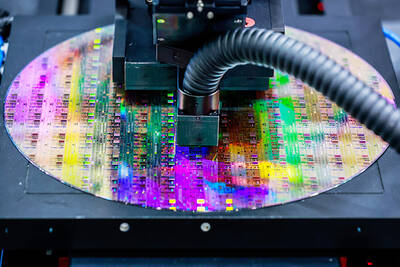
The artificial intelligence (AI) boom has triggered a seismic reshuffling of global equity markets, with Taiwan and South Korea muscling past European nations one by one. With its stock market now valued at nearly US$4.3 trillion, Taiwan surpassed the UK, Europe’s biggest market, earlier this month, data compiled by Bloomberg showed. South Korea is about US$140 billion away from doing the same. The tech-heavy Asian markets have shot past Germany and France in the past seven months. The shift is largely down to massive gains in shares of three companies that provide essential hardware for AI: Taiwan Semiconductor Manufacturing Co (TSMC, 台積電),


 RSS
RSS