


Mobile phone chip designer MediaTek Inc (聯發科) yesterday unveiled its first 5G system-on-a-chip (SoC) product, dubbed the Dimensity 1000, in preparation for the launch of 5G phones by Chinese customers during the Lunar New Year holiday.
The launch of the flagship 5G solution is a significant step for MediaTek, indicating that the company has for the first time caught up with Qualcomm Inc in migrating to next-generation wireless technology.
The Hsinchu-based company lagged behind its major rival in rolling out 2G, 3G and 4G chips, after entering the mobile phone chip business 14 years ago.

Photo: CNA
MediaTek said that it has invested NT$100 billion (US$3.28 billion) in researching and developing the 5G chip.
The Dimensity 1000 is to be produced by Taiwan Semiconductor Manufacturing Co (台積電) using 7-nanometer process technology, the most advanced technology available.
“This [Dimensity 1000] is our first 5G SoC product. We will have a full series of 5G SoC products in the future, covering different segments,” MediaTek chief executive officer Rick Tsai (蔡力行) told a media briefing in Taipei.
Apart from China, MediaTek also aims to sell its 5G solutions to Europe, the US and South Korea, he said.
Tsai declined to confirm speculation that Samsung Electronics Co is a potential customer for the 5G chips, but said that 5G would be an important driver of company growth next year.
Oppo Mobile Telecommunications Corp (歐珀移動), Vivo Electronics Corp (維沃移動通信) and China Mobile Ltd (中國移動), among other Chinese customers, appeared in a MediaTek video to express their excitement about the launch of the 5G SoC.
“The mobile phone is certainly the biggest and the first application for 5G [technology] in the initial stage, but not the only application,” Tsai said. “MediaTek plans to expand 5G [technology] beyond mobile phones to areas such as networking CPE [customer-premises equipment].”
MediaTek’s collaboration with Intel Corp was the first step in this expansion, Tsai added.
On Monday, Intel said that it has partnered with MediaTek on the development, certification and support of 5G modems for PCs.
The announcement came seven months after the US chip giant decided to exit the 5G mobile modem market to focus on 5G modems for PCs and smart home applications.
Dell Inc and HP Inc are expected to be among the first original equipment manufacturers in early 2021 to deliver laptops powered by Intel and MediaTek’s 5G solutions, the two companies said in a joint statement said.
Intel’s endorsement “suggests that MediaTek’s 5G technology is highly competitive,” Yuanta Securities Investment Consulting Co (元大投顧) analyst Steve Huang (黃柏璁) said in a report.
Intel sold its 5G modem business to Apple Inc in July, Huang added.
“MediaTek’s 5G modem has the potential to penetrate into newer addressable markets, such as the Internet of Things and self-driving vehicles,” Huang said.

Cairo’s new monorail slices across the city skyline, running above the familiar chaos of blaring horns and aging buses’ exhaust fumes that mark rush hour below. The US$4.5 billion monorail, opened this month, is among Egypt’s most prominent new transport projects, part of a debt-funded infrastructure drive criticized for sapping state finances while bringing limited benefits to most of the country’s 109 million people. “It feels like you’re in a different country,” said Ramy Sayed, a restaurant manager, aboard a driverless Innovia 300 train. “No noise, no traffic, we’re not used to this.” The eastern line runs 56km from the bustling middle-class
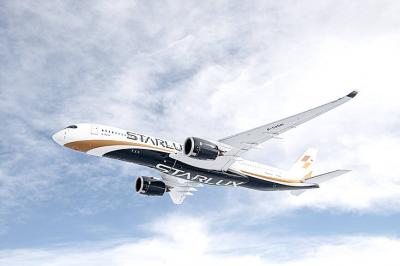
Starlux Airlines Co (星宇航空) today unveiled a long-haul network expansion plan at a shareholders’ meeting in Taipei, including direct flights to Barcelona, Spain, and Zurich, Switzerland, as well as a service connecting Taipei, Sydney and New Zealand. Starlux is to become the first Taiwanese carrier to offer non-stop services to the two European cities, while the inaugural oceanic route is expected to expand transit opportunities within the Australia-New Zealand market, Starlux said. Flight services to Chicago, Dallas, Washington and New York are under evaluation, the airline added. Prior to the shareholders’ meeting, the airline earlier this year announced that it would be

Taiwanese firms have increased investment in the Philippines in recent years as Manila’s ties with Washington deepen and global supply chains continue to shift away from China, an expert at the Chung-Hua Institution for Economic Research (CIER, 中華經濟研究院) said yesterday. The Philippines had not been among Taiwanese investors’ top choices in Southeast Asia, CIER Taiwan ASEAN Studies Center director Kristy Hsu (徐遵慈) said at a seminar in Taipei. However, Taiwan’s investment in the country has grown significantly since the COVID-19 pandemic, reaching US $257 million last year, a high in recent years, she said. Although Taiwan’s total investment in the Philippines still lags

Intel Corp regards Taiwan Semiconductor Manufacturing Co (TSMC, 台積電) as a longstanding partner, as the US chipmaker would continue outsourcing production of advanced chips to TSMC, Intel chief executive officer Lip-Bu Tan (陳立武) said yesterday. “I don’t look at people as competitors. I look at the collaboration... Nvidia is also, you know, a good friend,” Tan told a news conference following his keynote speech at the Computex trade show in Taipei. “It’s a very trusted partnership for us... We are a big, top customer for them, and we’re going to continue doing that,” he said, referring to TSMC, the world’s largest foundry


 RSS
RSS