


Electronic components supplier Lite-On Technology Corp (光寶科技) yesterday reported that net profit grew 18 percent year-on-year to NT$3.11 billion (US$102.29 million) last quarter, translating into earnings per share of NT$1.34 — the most in three years.
Gross margin and operating margin increased to 16.2 percent and 6.7 percent from 15.8 percent and 6.2 percent respectively, due to operational efficiency, better supply-chain management and an improved product mix, the company said.
However, third-quarter revenue dropped 10 percent year-on-year to NT$48.16 billion, as Lite-On’s three main business segments experienced declines.
Revenue from the company’s storage segment, which contributed 13 percent of total revenue last quarter, declined 35.43 percent annually to NT$6.25 billion, company data showed.
Lite-On vice chairman and chief operating officer Warren Chen (陳廣中) blamed the disappointing results on the company’s solid-state drive (SSD) business.
Its sale to Toshiba Memory Holdings Corp for US$165 million was approved more than two months ago. The deal is expected to be completed by April next year.
“Supply was much higher than demand [for SSDs] in the first two quarters this year,” Chen said, adding that falling prices of NAND flash memory chips over the past 18 months have further dampened sales.
The SSD business recovered slightly last quarter due to the rising popularity of gaming devices, but is expected to dip again this quarter as market demand has peaked for the year, he said.
The company’s optical disk drive business is expected to report flat performance this quarter, although Chen said he was hopeful that this segment would improve next year on the back of increasing demand for data centers.
The information technology (IT) segment, which contributed 67 percent to Lite-On’s revenue, reported a slight annual drop in sales to NT$32.13 billion last quarter.
However, growth in demand in various areas such as cloud-based computing, artificial-intelligence appliances and gaming devices would benefit the segment this quarter, Chen said.
In May, the company began mass production of networking devices, as well as other IT products, at its Kaohsiung plant and has another plot in the city standing by “just in case” the trade conflict between the US and China exacerbates, he said.
“Although the trade conflict has only affected our revenue by a single-digit percentage this year, we are still closely monitoring any changes or resolutions that might come about within the next two months,” Chen said.
Sales growth in the company’s automotive electronics business stalled last quarter.
“Our clients have been launching new models at a slower pace, as demand in the automotive market is flagging,” Chen said.
The firm’s optoelectronics segment — which is composed of automotive electronics, LED components and lighting products, as well as camera modules — reported that revenue decreased 7.6 percent annually to NT$7.37 billion last quarter, contributing 15 percent to total revenue.
Meanwhile, Lite-On is expanding its Vietnamese plant as it looks to relocate production of labor-intensive products from China, Chen said, adding that mass production is expected to start by the end of next year.
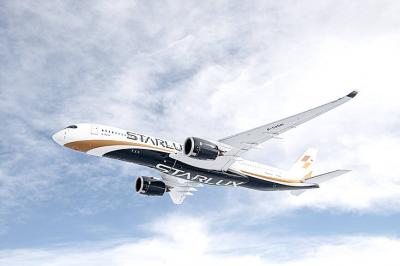
Starlux Airlines Co (星宇航空) today unveiled a long-haul network expansion plan at a shareholders’ meeting in Taipei, including direct flights to Barcelona, Spain, and Zurich, Switzerland, as well as a service connecting Taipei, Sydney and New Zealand. Starlux is to become the first Taiwanese carrier to offer non-stop services to the two European cities, while the inaugural oceanic route is expected to expand transit opportunities within the Australia-New Zealand market, Starlux said. Flight services to Chicago, Dallas, Washington and New York are under evaluation, the airline added. Prior to the shareholders’ meeting, the airline earlier this year announced that it would be
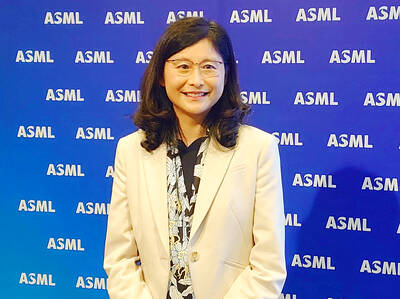
Netherlands-based semiconductor equipment supplier ASML Holding NV yesterday said that it is planning to hire an additional 1,000 people in Taiwan this year in response to growing demand from clients. ASML had previously planned to recruit 600 people this year, but that the plan has been adjusted upward, ASML vice president and ASML Taiwan general manager Grace Wang (汪佳慧) told reporters. ASML has a workforce of more than 4,500 in Taiwan, accounting for about 10 percent of its global total, Wang said. This year’s recruitment campaign would focus on adding people in the customer support, manufacturing and supply chain domains to assist ASML

UNDER MICROSCOPE: Taiwan detained three people who allegedly conspired to buy servers in Taiwan and export them using fraudulent documentation, prosecutors said Nvidia Corp chief executive officer Jensen Huang (黃仁勳) on Saturday urged Super Micro Computer Inc to tighten up on compliance after Taiwan detained three people this week for allegedly making fraudulent declarations about artificial intelligence (AI) servers made by its US partner. The development marked the nation’s first crackdown on semiconductor smuggling, which grew after the US slapped restrictions on exports of high-end chips such as Nvidia AI accelerators to China. Nvidia is “rigorous” in explaining regulations to all of its partners, Huang told reporters after arriving in Taipei. “Ultimately Super Micro has to run their own company,” he said in response to

Nvidia Corp yesterday announced that CEO Jensen Huang (黃仁勳) would attend an employee meeting in Taipei tomorrow to celebrate the launch of the company’s Taiwan headquarters project. Huang would attend a gathering at the site of Nvidia’s planned headquarters in Beitou Shilin Technology Park (北投士林科技園區), the company said in a statement. After arriving in Taiwan on Saturday last week, Huang told reporters that he plans to meet with Quanta Computer Inc (廣達) chairman Barry Lam (林百里) and Taiwan Semiconductor Manufacturing Co (TSMC, 台積電) chairman C.C. Wei (魏哲家), and would attend the groundbreaking ceremony for Nvidia’s Taiwan headquarters tomorrow. Nvidia has not yet applied


 RSS
RSS