


Electric scooter-sharing service provider Wemo Corp (威摩科技) yesterday said that it expects to turn a profit next year as growing demand has prompted the company to double the size of its fleet and expand its business overseas.
“We hope to start making a profit in cities like Taipei next year, although some might remain unprofitable,” Wemo cofounder and chief executive officer Jeffrey Wu (吳昕霈) told a media briefing in Taipei.
The cofounder is a member of the Wu family that owns Shin Kong Group (新光集團), which operates businesses in the insurance, banking, synthetic fibers, retail and healthcare sectors.
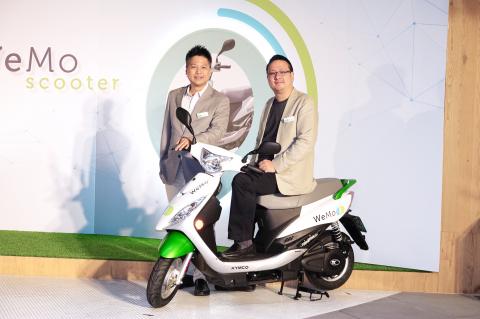
Photo: Chen Ping-hung, Taipei Times
His optimism is built on a booming gig economy that includes vehicle-sharing and food-delivery services, not only in Taiwan, but around the globe.
Wemo has received numerous proposals to utilize its know-how to provide services or create joint ventures in Japan and Southeastern Asian nations, Wu said.
The firms include real-estate developers and vehicle leasing firms that want to tap the vehicle-sharing market, he said.
“We believe there is a good chance that [overseas expansion] will happen next year,” Wu said.
Wemo has 300,000 registered riders and that number is expected to double to about 600,000 by next year, he said.
Wemo plans to deploy between 10,000 and 15,000 electric scooters next year, up from 5,000 vehicles this year, to grab a larger share of the growing market, he added.
Wemo, which operates in Taipei, New Taipei City and Kaohsiung, also plans to expand its services to the nation’s other major cities, Wu said.
The company is in talks with private parking-lot operators to provide spaces for its scooters, which is in addition to 20 parking lots and street-side parking spaces run by the Taipei and New Taipei City governments, he said.
Wemo expects to add an additional 1,000 parking spaces in the first half of next year, which would bring the number of parking spaces to 2,000, he added.
Wemo plans to offer a new NT$99 monthly contract for 125 minutes of scooter use as it battles growing competition from Gogoro Inc (睿能創意), which is expanding its scooter-sharing service GoShare.
That is NT$0.8 per minute, a 30 percent discount compared with its current charge of NT$2.5 per minute, the company said.
The company is planning an initial public offering within the next five to seven years, it added.

Taiwan Semiconductor Manufacturing Co (TSMC, 台積電) last week recorded an increase in the number of shareholders to the highest in almost eight months, despite its share price falling 3.38 percent from the previous week, Taiwan Stock Exchange data released on Saturday showed. As of Friday, TSMC had 1.88 million shareholders, the most since the week of April 25 and an increase of 31,870 from the previous week, the data showed. The number of shareholders jumped despite a drop of NT$50 (US$1.59), or 3.38 percent, in TSMC’s share price from a week earlier to NT$1,430, as investors took profits from their earlier gains

In a high-security Shenzhen laboratory, Chinese scientists have built what Washington has spent years trying to prevent: a prototype of a machine capable of producing the cutting-edge semiconductor chips that power artificial intelligence (AI), smartphones and weapons central to Western military dominance, Reuters has learned. Completed early this year and undergoing testing, the prototype fills nearly an entire factory floor. It was built by a team of former engineers from Dutch semiconductor giant ASML who reverse-engineered the company’s extreme ultraviolet lithography (EUV) machines, according to two people with knowledge of the project. EUV machines sit at the heart of a technological Cold
Taiwan’s long-term economic competitiveness will hinge not only on national champions like Taiwan Semiconductor Manufacturing Co. (TSMC, 台積電) but also on the widespread adoption of artificial intelligence (AI) and other emerging technologies, a US-based scholar has said. At a lecture in Taipei on Tuesday, Jeffrey Ding, assistant professor of political science at the George Washington University and author of "Technology and the Rise of Great Powers," argued that historical experience shows that general-purpose technologies (GPTs) — such as electricity, computers and now AI — shape long-term economic advantages through their diffusion across the broader economy. "What really matters is not who pioneers
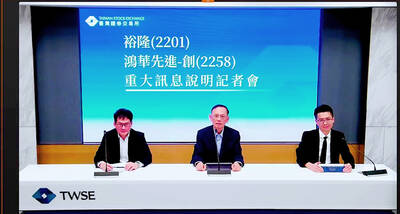
TAIWAN VALUE CHAIN: Foxtron is to fully own Luxgen following the transaction and it plans to launch a new electric model, the Foxtron Bria, in Taiwan next year Yulon Motor Co (裕隆汽車) yesterday said that its board of directors approved the disposal of its electric vehicle (EV) unit, Luxgen Motor Co (納智捷汽車), to Foxtron Vehicle Technologies Co (鴻華先進) for NT$787.6 million (US$24.98 million). Foxtron, a half-half joint venture between Yulon affiliate Hua-Chuang Automobile Information Technical Center Co (華創車電) and Hon Hai Precision Industry Co (鴻海精密), expects to wrap up the deal in the first quarter of next year. Foxtron would fully own Luxgen following the transaction, including five car distributing companies, outlets and all employees. The deal is subject to the approval of the Fair Trade Commission, Foxtron said. “Foxtron will be


 RSS
RSS