


Spending on artificial intelligence (AI) in the Asia-Pacific region is expected to surge by more than 50 percent on an annual basis to US$6.2 billion this year, market advisory firm International Data Corp (IDC) said.
“Artificial intelligence is having an impact across many industries with widespread utilization, but is still at a nascent stage in the Asia-Pacific,” IDC associate market analyst for Asia-Pacific Ritika Srivastava said in a report on Friday last week.
“From providing chatbots for better customer service to improving the efficiency of operations and tasks for their business models, industries like banking, retail and professional services are spending in this technology at scale,” Srivastava said.
The banking industry would lead the way in spending on AI and contribute about 10.7 percent of overall spending in the Asia-Pacific region, the report said.
Banks would mostly focus on AI/cognitive systems for fraud analysis and investigation, while also investing in automated customer service agents, it said.
The retail industry would become the second-biggest spender on AI with an estimated 10.2 percent contribution through investments in AI-enabled solutions, including expert shopping advisers, product recommendations and merchandising for omni-channel operations, it added.
Although spending on AI is concentrated on hardware, with nearly US$4 billion allocated to servers and storage this year, IDC said that it expects the focus to shift to software over the next four years, with a compound annual growth rate in spending of 71.3 percent.
China has been the largest contributor to spending on AI this year, with 71 percent of overall spending in the Asia-Pacific region, the report said.
“Not surprisingly, China is the primary source of AI investment in Asia, as it remains a priority very much for government and state organizations, as well as a small number of aggressive digital native enterprises like Tencent [Holdings Ltd (騰訊)], Baidu [Inc (百度)] and Alibaba [Group Holding Ltd (阿里巴巴)],” IDC Asia-Pacific associate vice president Christopher Marshall said in a statement.
“Elsewhere in Asia, although experimentation is common, enterprise deployment of AI is still relatively rare, and much remains to be done if Asia-Pacific companies hope to compete with major players in China and the US,” Marshall said.
Nevertheless, South Korea and Australia are slowly gaining momentum in the adoption of AI solutions, the report found.
IDC predicted that overall spending on AI would increase from last year at a compound annual growth rate of 39.6 percent to US$21.4 billion by 2023.


Taiwan’s foreign exchange reserves fell below the US$600 billion mark at the end of last month, with the central bank reporting a total of US$596.89 billion — a decline of US$8.6 billion from February — ending a three-month streak of increases. The central bank attributed the drop to a combination of factors such as outflows by foreign institutional investors, currency fluctuations and its own market interventions. “The large-scale outflows disrupted the balance of supply and demand in the foreign exchange market, prompting the central bank to intervene repeatedly by selling US dollars to stabilize the local currency,” Department of Foreign

Intel Corp is joining Elon Musk’s long-shot effort to develop semiconductors for Tesla Inc, Space Exploration Technologies Corp and xAI, marking a surprising twist in the chipmaker’s comeback bid. Intel would help the Terafab project “refactor” the technology in a chip factory, the company said on Tuesday in a post on X, Musk’s social media platform. That is a stage in the development process that typically helps make chips more powerful or reliable. The chipmaker’s shares jumped 4.2 percent to US$52.91 in New York trading on Tuesday. The Terafab project is a grand plan by Musk to eventually manufacture his own chips for
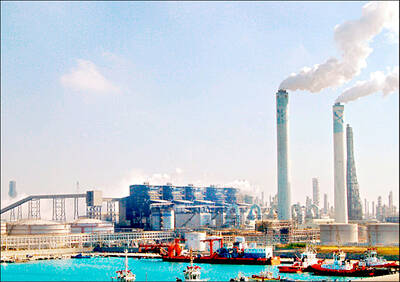
Taiwan Power Co (Taipower, 台電) yesterday said it plans to resume operations at two coal-fired power generators for three months to boost security of electricity supply as liquefied natural gas (LNG) supply risks are running high due to the Middle East conflict. The two coal-fired power generators are at Mailiao Power Plant in Yunlin County’s Mailiao Township (麥寮). The plant, operated by Formosa Plastics Group (台塑集團), supplied electricity to Taipower’s power grid until the end of last year. Taipower’s decision came about one month after Minister of Economic Affairs Kung Ming-hsin (龔明鑫) on March 10 said that the nation had no imminent

Some robotaxi passengers were left stranded in the middle of fast-moving traffic in a major Chinese city after their driverless vehicles stopped running, according to police and media reports on Wednesday. A preliminary investigation indicates more than 100 robotaxis came to a halt because of a “system malfunction,” police in the city of Wuhan said in a statement, without elaborating. No injuries were reported. One passenger told Chinese media that their robotaxi stopped after turning a corner. An instruction on a screen read: “Driving system malfunction. Staff are expected to arrive in 5 minutes.” After no one showed up, the passenger pushed


 RSS
RSS