


A local consortium is to take over development of the Twin Towers project near Taipei Railway Station after the original winner of the contract was removed due to national security concerns, the Taipei City Government said yesterday.
The local group — consisting of contract computer maker Clevo Co (藍天電腦) and its property development affiliate Hongwell Group (宏匯集團) — would take over the contract after meeting certain requirements, including submitting NT$1.9 billion (US$62.07 million), it said.
The consortium lost a contest in December last year to another consortium led by Hong Kong-based Nan Hai Development Ltd (南海發展) and Malaysian property developer Malton Berhad.
However, the Investment Commission in July revoked the approval, citing national security concerns.
Nan Hai Development is a unit of Nan Hai Holding Co (南海金控) that owns businesses in China, Hong Kong, North America, Europe and Australia in the culture and media sectors, property development and IT application services.
Nan Hai chairman Yu Pun-hoi (于品海) called the decision unfair and legally shaky, but failed in an attempt to appeal the decision in court.
The Taipei City Government said it would press ahead with the project after it had given Nan Hai sufficient time to submit its appeal.
The city government had previously been unsuccessful in its attempts to find developers for the project valued at NT$60 billion, which has been at the center of a series of bribery scandals over the past 20 years.
The local team welcomed the invitation, saying it has been ready since announcing its decision to enter the bidding last year.
Hongwell earlier said that it would work with US architecture and engineering firm Skidmore, Owings & Merrill LLP to build the complex.
The US firm is known for designing iconic buildings, with its portfolio including the One World Trade Center in New York and the Burj Khalifa in Dubai, United Arab Emirates, Hongwell said.
Clevo chairman and head of the consortium Kent Hsu (許坤泰) said that 16 local lenders had agreed to provide loans for 60 percent of the construction costs and his own companies would provide the remaining 40 percent.
Hsu added that he has previously made several property investments in conjunction with railway lines and Mass Rapid Transit systems.
The group is responsible for three such projects in Taipei’s Neihu District (內湖) and New Taipei City’s Sinjhuang District (新莊).
The Twin Towers complex would add more than 60,000 ping (198,347m2) of commercial space to the area and create thousands of job opportunities.
“We want to roll up our sleeves and start construction right away,” Hsu said in a statement.

SECOND-RATE: Models distilled from US products do not perform the same as the original and undo measures that ensure the systems are neutral, the US’ cable said The US Department of State has ordered a global push to bring attention to what it said are widespread efforts by Chinese companies, including artificial intelligence (AI) start-up DeepSeek (深度求索), to steal intellectual property from US AI labs, according to a diplomatic cable. The cable, dated Friday and sent to diplomatic and consular posts around the world, instructs diplomatic staff to speak to their foreign counterparts about “concerns over adversaries’ extraction and distillation of US AI models.” Distillation is the process of training smaller AI models using output from larger, more expensive ones to lower the costs of training a powerful new
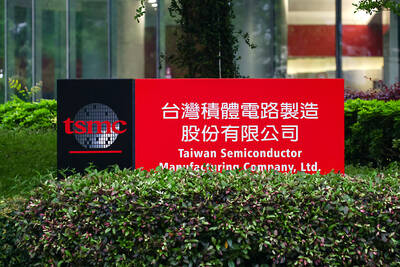
Shares of Taiwan Semiconductor Manufacturing Co (TSMC, 台積電) have repeatedly hit new highs, but an equity analyst said the stock’s valuation remains within a reasonable range and any pullback would likely be technical. The contract chipmaker’s historical price-to-earnings (P/E) ratio has ranged between 20 and 30, Cathay Futures Consultant Co (國泰證期) analyst Tsai Ming-han (蔡明翰) told Central News Agency. With market consensus projecting that TSMC would post earnings per share of about NT$100 (US$3.17) this year, supported by strong global demand for artificial intelligence (AI) applications, and the stock currently trading at a P/E ratio of below 25, Tsai said the valuation
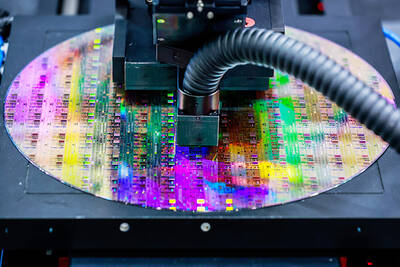
The artificial intelligence (AI) boom has triggered a seismic reshuffling of global equity markets, with Taiwan and South Korea muscling past European nations one by one. With its stock market now valued at nearly US$4.3 trillion, Taiwan surpassed the UK, Europe’s biggest market, earlier this month, data compiled by Bloomberg showed. South Korea is about US$140 billion away from doing the same. The tech-heavy Asian markets have shot past Germany and France in the past seven months. The shift is largely down to massive gains in shares of three companies that provide essential hardware for AI: Taiwan Semiconductor Manufacturing Co (TSMC, 台積電),
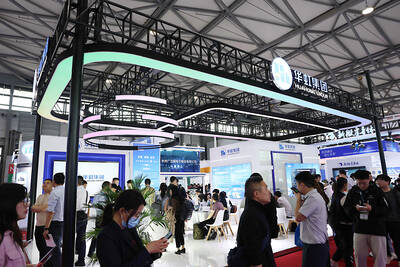
The US Department of Commerce last week ordered multiple chip equipment companies to halt shipments of certain tools to China’s second-largest chipmaker, Hua Hong Semiconductor Ltd (華虹半導體), its latest action to slow the country’s development of advanced chips, two people familiar with the matter said. The department sent letters to at least a handful of companies informing them of restrictions on tools and other materials destined for two Hua Hong facilities US officials believe make China’s most sophisticated chips, the people said. Top US chip equipment companies Lam Research Corp, Applied Materials Inc and KLA Corp, each of which has significant


 RSS
RSS