


The Financial Supervisory Commission (FSC) yesterday said it will urge online food delivery platform operators to purchase accident insurance for their drivers after two couriers were killed in traffic crashes on Thursday and Sunday.
As the couriers were not insured against accidents by their employers, Foodpanda Taiwan Co (富胖達) and Uber Eats Taiwan, which hire drivers as contractors rather than employees, their families will likely receive compensation of up to NT$2 million (US$65,317) each from the Compulsory Automobile Liability Insurance (CALI), the commission told a question-and-answer session at a meeting of the Legislative Yuan’s Finance Committee.
All drivers are required to purchase CALI as minimum insurance in case of traffic accidents.
However, its perceived insufficient coverage caused a furor among lawmakers, who accused the food delivery companies of doing too little to protect their drivers.
“In the US, Uber Eats provides insurance for its drivers, who are on the job immediately after an order is placed via the app, but the local unit does not offer such coverage, even though it does not cost much to purchase accident insurance,” Chinese Nationalist Party (KMT) Legislator Lai Shyh-bao (賴士葆) said.
As many food couriers are students who do not know how to protect their rights as workers, the government should stand up for them and ask the platform operators to do more, Lai said.
Democratic Progressive Party Legislator Karen Yu (余宛如) said that delivery service operators are not willing to purchase accident insurance for their drivers because they do not view them as employees.
According to the contract between Foodpanda and its delivery personnel, couriers are responsible for their own safety or any damage caused by accidents.
The government should fix this loophole, she added.
Commission Chairman Wellington Koo (顧立雄) said food delivery service providers should take responsibility and provide sufficient insurance for their couriers.
Although the commission cannot directly supervise the companies, it would ask the Non-life Insurance Association to send letters to the Ministry of Labor to suggest suitable insurance products within one week, Koo said.
Uber Eats yesterday said it regrets the tragedy and that it would provide assistance to its driver’s family.
Only couriers who have signed contracts with its freight forwarding partners in Kaohsiung and Taoyuan as well as Pingtung County are insured against accidents, with compensation of up to NT$2 million, Uber Eats said.
The company said it plans to extend the coverage to all drivers by the end of this year by asking all partners to purchase accident policies.
SECOND-RATE: Models distilled from US products do not perform the same as the original and undo measures that ensure the systems are neutral, the US’ cable said The US Department of State has ordered a global push to bring attention to what it said are widespread efforts by Chinese companies, including artificial intelligence (AI) start-up DeepSeek (深度求索), to steal intellectual property from US AI labs, according to a diplomatic cable. The cable, dated Friday and sent to diplomatic and consular posts around the world, instructs diplomatic staff to speak to their foreign counterparts about “concerns over adversaries’ extraction and distillation of US AI models.” Distillation is the process of training smaller AI models using output from larger, more expensive ones to lower the costs of training a powerful new
Shares of Taiwan Semiconductor Manufacturing Co (TSMC, 台積電) have repeatedly hit new highs, but an equity analyst said the stock’s valuation remains within a reasonable range and any pullback would likely be technical. The contract chipmaker’s historical price-to-earnings (P/E) ratio has ranged between 20 and 30, Cathay Futures Consultant Co (國泰證期) analyst Tsai Ming-han (蔡明翰) told Central News Agency. With market consensus projecting that TSMC would post earnings per share of about NT$100 (US$3.17) this year, supported by strong global demand for artificial intelligence (AI) applications, and the stock currently trading at a P/E ratio of below 25, Tsai said the valuation
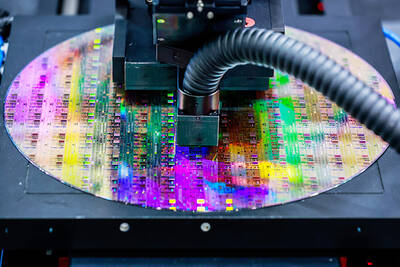
The artificial intelligence (AI) boom has triggered a seismic reshuffling of global equity markets, with Taiwan and South Korea muscling past European nations one by one. With its stock market now valued at nearly US$4.3 trillion, Taiwan surpassed the UK, Europe’s biggest market, earlier this month, data compiled by Bloomberg showed. South Korea is about US$140 billion away from doing the same. The tech-heavy Asian markets have shot past Germany and France in the past seven months. The shift is largely down to massive gains in shares of three companies that provide essential hardware for AI: Taiwan Semiconductor Manufacturing Co (TSMC, 台積電),
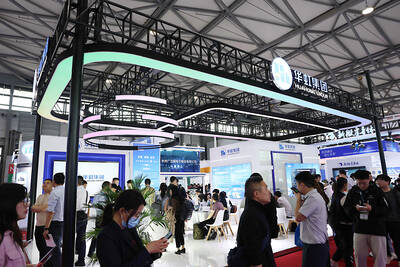
The US Department of Commerce last week ordered multiple chip equipment companies to halt shipments of certain tools to China’s second-largest chipmaker, Hua Hong Semiconductor Ltd (華虹半導體), its latest action to slow the country’s development of advanced chips, two people familiar with the matter said. The department sent letters to at least a handful of companies informing them of restrictions on tools and other materials destined for two Hua Hong facilities US officials believe make China’s most sophisticated chips, the people said. Top US chip equipment companies Lam Research Corp, Applied Materials Inc and KLA Corp, each of which has significant


 RSS
RSS