


Solar wafer maker Sino-American Silicon Products Inc (SAS, 中美晶) on Wednesday said that its board of directors had approved a plan to invest up to NT$1 billion (US$32.41 million) to increase its share of automotive electronic components maker Actron Technology Corp (朋程) in a bid to deepen collaboration between the firms.
The Hsinchu-based company decided to subscribe to a bulk of new share offering from Actron, which aims to raise NT$1.4 billion by issuing 16 million common shares, SAS said in a company statement.
Each share is priced at NT$87.50, representing a discount of 2.89 percent to Actron’s closing price of NT$90.10 on the Taipei Exchange on Wednesday.
Stock markets were closed on Thursday and yesterday for the Double Ten National Day holiday.
Proceeds from the fundraising are to be used to build a new production line for insulated-gate bipolar transistor (IGBT) modules, a crucial component for electric and hybrid vehicles, to broaden Actron’s product lineup, SAS said.
Actron is the world’s biggest supplier of automotive rectifier diodes, which are primarily used in gasoline-fueled cars. Its clients include Japan’s Mitsubishi Electric Corp and Denso Corp, and France’s Valeo Group.
SAS, which currently holds a 6.62 percent stake in Actron and has a seat on its board, said it intends to deepen ties with Actron, as the latter has established a long-term client relationship with GlobalWafers Co (環球晶圓), a silicon wafer manufacturer that is 51 percent owned by SAS.
“Investing in Actron will help SAS advance its investment in the semiconductor industry,” SAS said.
The deal “will be advantageous to both companies’ future development and accelerate the process of building subsequent IGBT industry chains to contribute to the semiconductor industry in Taiwan,” it said.
SAS had a rich net cash figure of NT$39.71 billion as of the end of June, thanks to a substantial contribution from GlobalWafers, according to the company’s financial statement.
SAS chairman Michael Lu (盧明光), who is also the chairman and CEO of Actron, is the biggest investor of Actron, with a 7 percent stake.
Actron’s net profit plunged 28 percent to NT$185 million in the first half of this year, compared with NT$257.11 million in the same period last year, as macroeconomic uncertainty curtailed global car sales, it said in a filing to the Taiwan Stock Exchange.
Earnings per share fell to NT$2.46 from NT$3.41.
Revenue slid 1.1 percent year-on-year to NT$288.57 million last month, from NT$291.78 million a year ago.
That led to a 10.88 percent annual decrease in sales in the first nine months of this year to NT$2.4 billion, company data showed.

SECOND-RATE: Models distilled from US products do not perform the same as the original and undo measures that ensure the systems are neutral, the US’ cable said The US Department of State has ordered a global push to bring attention to what it said are widespread efforts by Chinese companies, including artificial intelligence (AI) start-up DeepSeek (深度求索), to steal intellectual property from US AI labs, according to a diplomatic cable. The cable, dated Friday and sent to diplomatic and consular posts around the world, instructs diplomatic staff to speak to their foreign counterparts about “concerns over adversaries’ extraction and distillation of US AI models.” Distillation is the process of training smaller AI models using output from larger, more expensive ones to lower the costs of training a powerful new
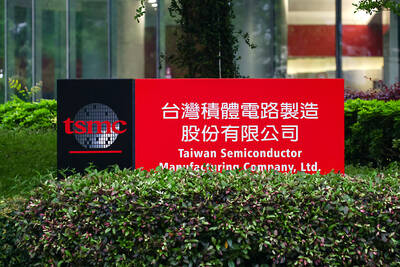
Shares of Taiwan Semiconductor Manufacturing Co (TSMC, 台積電) have repeatedly hit new highs, but an equity analyst said the stock’s valuation remains within a reasonable range and any pullback would likely be technical. The contract chipmaker’s historical price-to-earnings (P/E) ratio has ranged between 20 and 30, Cathay Futures Consultant Co (國泰證期) analyst Tsai Ming-han (蔡明翰) told Central News Agency. With market consensus projecting that TSMC would post earnings per share of about NT$100 (US$3.17) this year, supported by strong global demand for artificial intelligence (AI) applications, and the stock currently trading at a P/E ratio of below 25, Tsai said the valuation
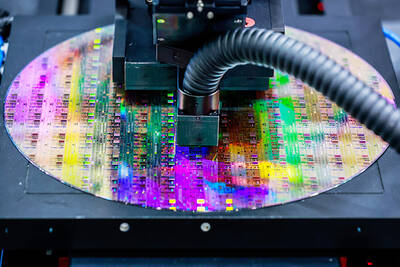
The artificial intelligence (AI) boom has triggered a seismic reshuffling of global equity markets, with Taiwan and South Korea muscling past European nations one by one. With its stock market now valued at nearly US$4.3 trillion, Taiwan surpassed the UK, Europe’s biggest market, earlier this month, data compiled by Bloomberg showed. South Korea is about US$140 billion away from doing the same. The tech-heavy Asian markets have shot past Germany and France in the past seven months. The shift is largely down to massive gains in shares of three companies that provide essential hardware for AI: Taiwan Semiconductor Manufacturing Co (TSMC, 台積電),
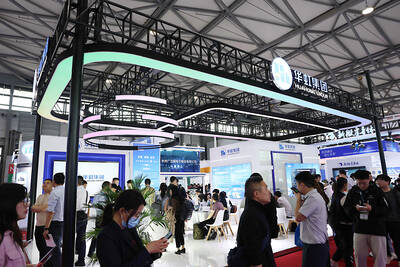
The US Department of Commerce last week ordered multiple chip equipment companies to halt shipments of certain tools to China’s second-largest chipmaker, Hua Hong Semiconductor Ltd (華虹半導體), its latest action to slow the country’s development of advanced chips, two people familiar with the matter said. The department sent letters to at least a handful of companies informing them of restrictions on tools and other materials destined for two Hua Hong facilities US officials believe make China’s most sophisticated chips, the people said. Top US chip equipment companies Lam Research Corp, Applied Materials Inc and KLA Corp, each of which has significant


 RSS
RSS