


EVA Airways Corp (長榮航空) plans to expand its fleet size from 79 to 93 aircraft by 2022 after taking delivery of all 24 Boeing 787 Dreamliner jetliners that it ordered in 2015 to serve high-density routes.
The airline has so far received four 787-9 aircraft and four 787-10 jets, the latest of which arrived from the US yesterday.
The deal was valued at more than US$7 billion, according to the list price at that time.
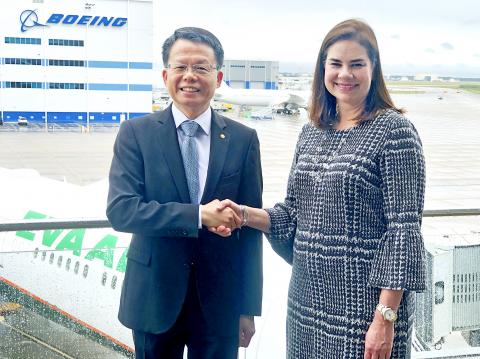
Photo: Kao Shih-ching, Taipei Times
EVA is expected to receive five more 787-10 jets next year, another five in 2021 and six more in 2022, EVA president Clay Sun (孫嘉明) told reporters at a delivery ceremony at Boeing Co’s factory in South Carolina on Monday.
The addition of the wide-body 787 Dreamliners, which have a range of 6,100 to 7,100 nautical miles (11,297km to 13,149km) with a full load of passengers, would provide EVA with new momentum in the next few years, Sun said.
The company is using most of the new aircraft on short-haul flights, such as from Taiwan to Tokyo, Osaka, Japan, and Hong Kong, and would expand their use to long-haul flights, Sun said.
The airline plans to start using the aircraft in flights from Taiwan to Brisbane, Australia, later this month and to Vancouver, Canada, in the first quarter of next year, expanding the current service between Taiwan and Vienna, Austria, he said.
EVA would use part of its 787 fleet on some intra-Asian routes, such as from Taiwan to Chengdu, China, Hanoi, Vietnam, Chiang Mai, Thailand, and Phnom Penh, Cambodia, in light of the rising number of passengers, he added.
Despite being the first carrier in the world to offer premium economy class — which is between economy class and business class in terms of price and comfort — EVA has decided not to equip its 787 fleet with it, as some of the aircraft would be used on short-haul flights, in which passengers are less willing to pay more for better seats, Sun said.
The older, rented single-aisle Airbus A321-200 jetliners would be used in flights to second-tier cities in China and Southeast Asia, as well as on supplementary flights to Tokyo in the winter, he said.
As 10-year lease contracts for 24 A321-200 planes would expire in a few years — three in 2022 and 21 by 2026 — EVA plans to purchase new narrow-body jets, either the Airbus A321neo or Boeing 737 MAX, Sun said.
Despite 737 MAX aircraft being grounded worldwide since March and the US planemaker has yet to solve the problems following two crashes since October last year, EVA would still consider the aircraft as an option, he said.
“No airline dares purchase the 737 MAX for the time being, but Airbus’ production schedule for its A321neo is full. We hope Boeing can provide a solution soon,” Sun said.
“We are not rushing to make a call, as we still have plenty of time to evaluate the performance of the two [kinds of] aircraft and how Boeing will solve the problem, because we can still extend the lease on the older A321-200s,” he said.
The airline would reach a decision in the middle of next year at the earliest and would not purchase the 737 MAX before regulators worldwide allow the airplane to fly, EVA spokesman David Chen (陳耀銘) said.
With second-quarter net profit shrinking 98 percent from a year earlier to NT$33 million (US$1.07 million) due to a strike that began in June, EVA’s net profit dropped 42 percent to NT$1.94 billion in the first half of the year.
However, Sun said he is upbeat about performance in the third quarter due to rising sales, but is concerned about the fourth quarter in the wake of fewer passengers from China.
The company would still turn a profit this year amid the headwinds, but it would be less than last year, he added.
Taiwan Semiconductor Manufacturing Co (TSMC, 台積電) yesterday reported record revenue of NT$416.975 billion (US$13.17 billion) for last month, putting the world’s largest contract chipmaker on track to set a record for quarterly revenue. Last month’s figure surpassed March’s record NT$415.19 billion and represented increases of 1.5 percent from April and 30.1 percent from a year earlier. For the first five months of the year, TSMC generated NT$1.96 trillion in revenue, up 30 percent year-on-year, it said in a statement. TSMC has forecast second-quarter revenue of between US$39 billion and US$40.2 billion, representing sequential growth of about 10 percent and year-on-year growth of about

Infineon Technologies AG is preparing to open its largest single investment, a 5 billion euro (US$5.8 billion) semiconductor factory built with the help of EU subsidies, as the bloc seeks to boost chip production. The power chip fab, which is an extension of the German company’s Dresden campus, is scheduled to open on July 2, Infineon chief operating officer Alexander Gorski said this week at the site. The project is a major recipient of EU Chips Act funds, receiving about 1 billion euros in subsidies. The new plant represents a rare success for the bloc’s flagship semiconductor law, which was drawn up during
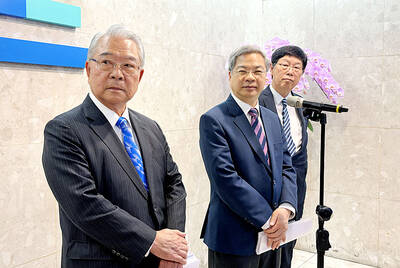
PATENT PROBE: US lawmakers called for a ban on imports of chips made by TSMC if they are found to infringe on US patents, with a preliminary ruling expected soon Minister of Economic Affairs Kung Ming-hsin (龔明鑫) yesterday expressed confidence in Taiwan Semiconductor Manufacturing Co’s (TSMC, 台積電) compliance with patent regulations after reports linked the company to a patent infringement lawsuit in the US. US Representative Ryan Zinke, and US senators Tim Sheehy, Roger Marshall and Bernie Moreno urged the US International Trade Commission in a May 22 letter to ban imports of chips made by TSMC if they are found to infringe on US patents, Axios reported on Wednesday. An administrative law judge is expected to issue a preliminary ruling this month, with the commission potentially making a final decision in
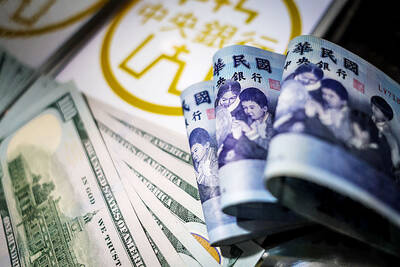
Taiwan remained the sixth-largest net creditor nation in the world last year, despite a fall of more than 10 percent in its net international investment position (NIIP) over the year, the central bank said yesterday. The NIIP is the difference between a country’s external financial assets and its external financial liabilities. Taiwan’s external financial assets hit US$3.27 trillion at the end of last year, up US$275.75 billion or 9.2 percent from a year earlier, the central bank said in its annual NIIP report. The growth largely reflected an increase in holdings of overseas marketable securities by residents in Taiwan, as well as a


 RSS
RSS