


With demand for smartphones and personal computers declining, large outsourced semiconductor assembly and test (OSAT) companies should fare better than their smaller rivals because of their better technological capabilities, more diversified product portfolios and financial flexibility on research and development, Fitch Ratings said.
The industry could see a short-term recovery in revenue after a severe downturn in the first half of this year, thanks to the arrival of new-generation smartphones and better demand for wearables and automotives, the international ratings agency said.
Larger firms, such as Taiwan’s ASE Technology Holding Co (ASE, 日月光投資控股) and US-based Amkor Technologies, should see faster growth and gain market share at the expense of Chinese rivals Jiangsu Changjiang Electronic Technology (江蘇長電科技) and Singapore’s Global A&T Electronics Ltd, it said.
Larger chip assembly and test companies have conservative leverage and have been diversifying to offer new products, such as wearables, automotive and Internet of Things, where demand is growing rapidly, it said.
These new products should make bigger contributions to revenues, Fitch said, adding that small consumer electronics and flexible hardware, such as foldable phones, would give large OSAT companies an advantage, as they possess the technological edge in system-in-package (SiP) and advanced packaging technologies.
Global smartphone sales are forecast to shrink 2.5 percent this year due to saturation in developed markets, an extended replacement cycle and a lack of eye-catching features in new models, Fitch said, citing figures from US technology research body Gartner.
PC shipments are likely to stagnate, in line with the previous eight years, it said.
OSAT companies rely heavily on the smartphone segment to drive revenue, Fitch said.
The ongoing US-China trade dispute and restrictions on US companies selling software and hardware to China’s Huawei Technologies Co (華為) could affect the financial recovery of Chinese OSAT firms in the near term, it said.
However, Taiwanese OSAT companies could emerge unscathed given their limited manufacturing activity in China, but they might still be indirectly affected by lower demand from US-based customers that are exposed to Huawei, it said.
Challenging conditions for the OSAT industry would last into next year, it said.
Most OSAT companies plan to boost capacity on expectations of businesses linked to 5G-ready handsets, but a concrete pickup in demand seems unlikely, as 5G coverage remains patchy in the UK, the US, Australia and other large markets, Fitch said, adding that China would start to roll out 5G next year.
Large OSAT firms would be at the forefront of 5G-related demand, as their advanced packaging capabilities are suited to 5G chips, Fitch said.
A protracted industry slowdown could hit smaller OSAT companies with less than 5 percent market share such as Powertech Technology Inc (力成科技), ChipMOS Technologies Inc (南茂) and Chipbond Technology Corp (頎邦).
They could seek merger and acquisition opportunities to expand their scale and strengthen their market positions, Fitch said.
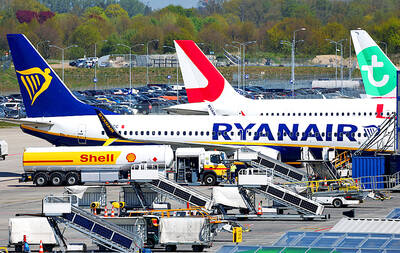
Ryanair, Transavia, Volotea and other low-cost airlines are feeling the financial pain from high jet fuel prices as a result of the Middle East war and are cutting flights. The closure of the Strait of Hormuz has taken a huge chunk of oil supplies off the market, sending the price of jet fuel soaring and triggering fears of shortages that could force airlines to cancel flights. Airlines are not waiting for a lack of supplies to react. “Travel alert: Airlines are cutting thousands of flights right now,” Travel Therapy host Karen Schaler said in an Instagram reel this past weekend.
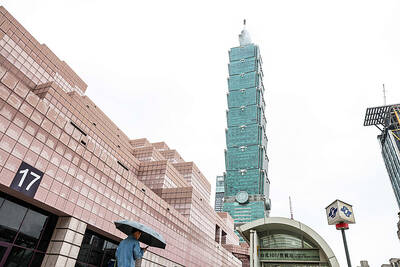
MANAGING RISKS: Taiwan has secured LNG sufficient to cover 95 percent of electricity demand for next month, UBS said, describing the government’s approach as proactive UBS Group AG has raised its forecast for Taiwan’s economic growth this year to 8 percent, up from 6.9 percent previously, and said expansion could reach as high as 8.6 percent if external energy shocks are avoided. The upgrade reflects a stronger-than-expected first-quarter performance and sustained momentum in artificial intelligence (AI)-driven exports, which UBS said are providing a firm foundation for growth despite geopolitical and energy risks. Taiwan’s GDP expanded 13.69 percent year-on-year in the first quarter, the fastest growth since the second quarter of 1987, the Directorate-General of Budget, Accounting and Statistics (DGBAS) reported on Thursday. On a seasonally

The Fair Trade Commission’s (FTC) ongoing review of Grab Holdings Ltd’s US$600 million acquisition of Foodpanda Taiwan’s operations, announced on March 23, has taken on fresh urgency as industry experts warn that the transaction could embed significant Chinese cybersecurity vulnerabilities into Taiwan’s digital infrastructure through Grab’s deep ties to autonomous-driving firm WeRide (文遠知行). Less than 16 months after the FTC blocked Uber Eats’ direct attempt to acquire Foodpanda Taiwan — citing potential combined market shares of 80 to 90 percent — the emergence of Grab as the buyer has prompted questions about whether the same competitive harm is simply being rerouted
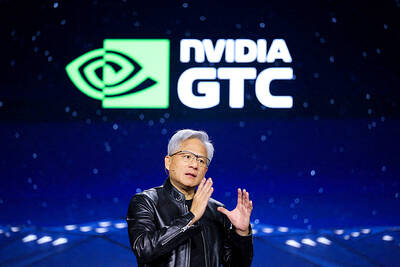
The list of Asian stocks that benefit from business partnership with Nvidia Corp is getting longer, as the region further integrates into the artificial intelligence (AI) chip giant’s business ecosystem. Just in the past week, South Korea’s LG Electronics Inc, Taiwan’s Nanya Technology Corp (南亞科技), as well as China’s Huizhou Desay SV Automotive Co (德賽西威) and Pateo Connect Technology Shanghai Corp (博泰車聯) have become the latest to rally on news of tie-ups, supply-chain participation or product collaboration with the US chip designer. Asian suppliers account for about 90 percent of Nvidia’s production costs, up from about 65 percent last year, data compiled


 RSS
RSS