


Chunghwa Picture Tubes Ltd (CPT, 中華映管) yesterday said that most of its employees would only receive part of their monthly salaries as the company has run out of cash due to slumping orders.
The LCD panel maker has used up all of its working funds and would not be able to pay severance fees, retirement fees and other perks, it said in a filing with the Taiwan Stock Exchange.
CPT had applied for insolvency protection with the Taoyuan District Court, but its hopes were dashed after the court on July 29 rejected its restructuring plan and overruled its final appeal.
“The company has depleted all its capital and failed to fully pay employees’ August salaries on Sept. 11,” CPT said in the filing. “The board of directors has approved the proposal to pay employees part of their salaries on Sept. 12.”
Based on the plan, the company is to pay foreign workers 40 percent of their monthly salaries, while local workers whose monthly pay is lower than NT$50,000 (US$1,610) would receive 55 percent.
Employees with monthly salaries between NT$50,000 and NT$70,000 would be paid 15 percent and those with monthly salaries higher than NT$70,000 would only receive 10 percent, CPT said.
The company would also freeze pay to employees in managerial positions higher than department director, it said.
To pay debts owed to employees, the company said it would dispose of its assets to raise cash.
The Taoyuan Department of Labor called on CPT’s parent company, Tatung Co (大同), to help solve the financial difficulty and safeguard employee interests.
“Since Tatung holds seats on CPT’s board, Tatung should take responsibility and help CPT tackle its financial crisis,” the department said in a statement.
CPT could face a fine of NT$20,000 to NT$1 million for not paying its employees their full salaries on time, the department said.
The 48-year-old CPT two weeks ago faced imminent risk of collapse after it failed to receive any orders and said it would lay off all of its 2,100 employees.
The company also owed NT$100 million in electricity bills to Taiwan Power Co (台電) for its main flat-panel manufacturing fab in Taoyuan’s Longtan District (龍潭), which was shut down on Monday last week due to a power outage.
In related news, Japan-based Sakai Display Products Corp (SDP), which is partly owned by Sharp Corp, yesterday said that former Hon Hai Precision Industry Co (鴻海集團) chairman Terry Gou (郭台銘) has given up his more than 50 percent stake in the company in an attempt to draw a line between Gou and his LCD investment in China.
Gou’s 10.5-generation LCD plant in Guangzhou, China, has halted production amid plummeting panel prices and is seeking new capital, the Nikkei Asian Review reported.
The plant was set up under an agreement between Gou and the Guangzhou City Government in March 2017, a few months before Gou’s LCD project in Wisconsin was agreed upon, the newspaper said.
SDP said that the Guangzhou plant has completed its first-phase construction and is looking to increase production efficiency and technological skills, it reported.
Additional reporting by Natasha Li
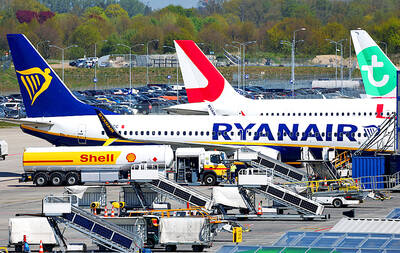
Ryanair, Transavia, Volotea and other low-cost airlines are feeling the financial pain from high jet fuel prices as a result of the Middle East war and are cutting flights. The closure of the Strait of Hormuz has taken a huge chunk of oil supplies off the market, sending the price of jet fuel soaring and triggering fears of shortages that could force airlines to cancel flights. Airlines are not waiting for a lack of supplies to react. “Travel alert: Airlines are cutting thousands of flights right now,” Travel Therapy host Karen Schaler said in an Instagram reel this past weekend.
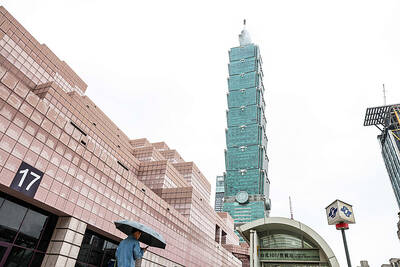
MANAGING RISKS: Taiwan has secured LNG sufficient to cover 95 percent of electricity demand for next month, UBS said, describing the government’s approach as proactive UBS Group AG has raised its forecast for Taiwan’s economic growth this year to 8 percent, up from 6.9 percent previously, and said expansion could reach as high as 8.6 percent if external energy shocks are avoided. The upgrade reflects a stronger-than-expected first-quarter performance and sustained momentum in artificial intelligence (AI)-driven exports, which UBS said are providing a firm foundation for growth despite geopolitical and energy risks. Taiwan’s GDP expanded 13.69 percent year-on-year in the first quarter, the fastest growth since the second quarter of 1987, the Directorate-General of Budget, Accounting and Statistics (DGBAS) reported on Thursday. On a seasonally
The Fair Trade Commission’s (FTC) ongoing review of Grab Holdings Ltd’s US$600 million acquisition of Foodpanda Taiwan’s operations, announced on March 23, has taken on fresh urgency as industry experts warn that the transaction could embed significant Chinese cybersecurity vulnerabilities into Taiwan’s digital infrastructure through Grab’s deep ties to autonomous-driving firm WeRide (文遠知行). Less than 16 months after the FTC blocked Uber Eats’ direct attempt to acquire Foodpanda Taiwan — citing potential combined market shares of 80 to 90 percent — the emergence of Grab as the buyer has prompted questions about whether the same competitive harm is simply being rerouted

The list of Asian stocks that benefit from business partnership with Nvidia Corp is getting longer, as the region further integrates into the artificial intelligence (AI) chip giant’s business ecosystem. Just in the past week, South Korea’s LG Electronics Inc, Taiwan’s Nanya Technology Corp (南亞科技), as well as China’s Huizhou Desay SV Automotive Co (德賽西威) and Pateo Connect Technology Shanghai Corp (博泰車聯) have become the latest to rally on news of tie-ups, supply-chain participation or product collaboration with the US chip designer. Asian suppliers account for about 90 percent of Nvidia’s production costs, up from about 65 percent last year, data compiled


 RSS
RSS