


Sun Hung Kai Properties Ltd (新鴻基地產), Hong Kong’s biggest developer, is offering new homes at a discount to entice buyers amid a worsening political crisis.
The first batch of units in the Kowloon development Cullinan West III have been priced at 20 percent lower than current market levels in the area.
The pricing is described by the developer as “traveling back in time” — it is close to the price set two years ago for the first phase of the same development, even though home values have risen 8 percent in the period.
“Recent social events and the US-China trade war have heightened some buyers’ wait-and-see attitude,” Sun Hung Kai Properties deputy managing director Victor Lui (雷霆) said.
Housing demand remains strong, as reflected by the good reception for other new projects, Lui said.
Months-long anti-government protests have put more property buyers on the sidelines and sales have been hit across the board.
The transaction value for new luxury homes slumped 31 percent in July to an eight-month low, Centaline Property Agency Ltd (中原地產) data showed.
Monthly rents for ultra-luxury residences have fallen by about the same amount, the South China Morning Post reported on Tuesday, citing Landscope Christie’s International Real Estate.
What began as protests against now-withdrawn legislation that would have allowed extraditions to the mainland have grown into demonstrations for wider democracy.
With Hong Kong Chief Executive Carrie Lam (林鄭月娥) refusing to satisfy protesters’ demands other than officially killing the controversial bill, the unrest looks set to linger.
SLUMP IN TOURISM
The protests in Hong Kong, now in their 15th week, continue to impact the territory’s tourism industry and in particular visitors from the mainland, who are usually its biggest group of tourists.
The number of Chinese group tours to the territory in the first 10 days of this month fell 90 percent compared with the previous year, Travel Industry Council of Hong Kong data showed.
Last month, the decline was 63 percent compared with the previous year.
Hong Kong’s hotel industry is struggling with a collapse in bookings after protesters disrupted flights from the territory’s airport last month.
Hong Kong’s economy contracted 0.4 percent in the second quarter from the previous period, raising the prospect of a technical recession.
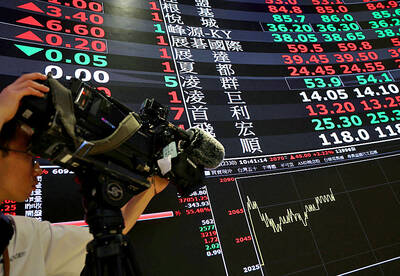
After several years flying high as Asia’s best Nvidia Corp proxy, Taiwan Semiconductor Manufacturing Co (TSMC, 台積電) is increasingly vying with other artificial intelligence (AI) stocks for investor attention. Stock traders are chasing a wider array of beneficiaries as mainstream usage of AI creates demand for hardware beyond the most-advanced chips TSMC makes for Nvidia. Subthemes from the deepening memory crunch to advances in robotics are also luring bids. At the same time, investment caps on single stocks are pushing funds to diversify, while retail investors long familiar with TSMC through its US depositary receipts are being offered a broader set of
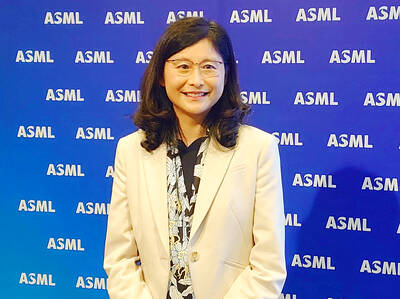
Netherlands-based semiconductor equipment supplier ASML Holding NV yesterday said that it is planning to hire an additional 1,000 people in Taiwan this year in response to growing demand from clients. ASML had previously planned to recruit 600 people this year, but that the plan has been adjusted upward, ASML vice president and ASML Taiwan general manager Grace Wang (汪佳慧) told reporters. ASML has a workforce of more than 4,500 in Taiwan, accounting for about 10 percent of its global total, Wang said. This year’s recruitment campaign would focus on adding people in the customer support, manufacturing and supply chain domains to assist ASML
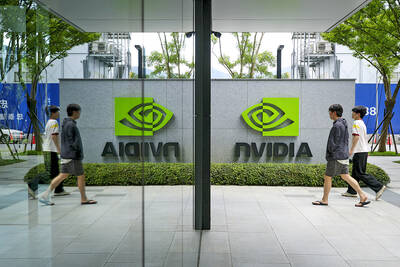
UNDER MICROSCOPE: Taiwan detained three people who allegedly conspired to buy servers in Taiwan and export them using fraudulent documentation, prosecutors said Nvidia Corp chief executive officer Jensen Huang (黃仁勳) on Saturday urged Super Micro Computer Inc to tighten up on compliance after Taiwan detained three people this week for allegedly making fraudulent declarations about artificial intelligence (AI) servers made by its US partner. The development marked the nation’s first crackdown on semiconductor smuggling, which grew after the US slapped restrictions on exports of high-end chips such as Nvidia AI accelerators to China. Nvidia is “rigorous” in explaining regulations to all of its partners, Huang told reporters after arriving in Taipei. “Ultimately Super Micro has to run their own company,” he said in response to
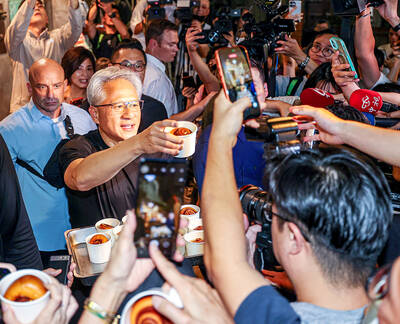
Nvidia Corp yesterday announced that CEO Jensen Huang (黃仁勳) would attend an employee meeting in Taipei tomorrow to celebrate the launch of the company’s Taiwan headquarters project. Huang would attend a gathering at the site of Nvidia’s planned headquarters in Beitou Shilin Technology Park (北投士林科技園區), the company said in a statement. After arriving in Taiwan on Saturday last week, Huang told reporters that he plans to meet with Quanta Computer Inc (廣達) chairman Barry Lam (林百里) and Taiwan Semiconductor Manufacturing Co (TSMC, 台積電) chairman C.C. Wei (魏哲家), and would attend the groundbreaking ceremony for Nvidia’s Taiwan headquarters tomorrow. Nvidia has not yet applied


 RSS
RSS