


Formosa Plastics Group’s (FPG, 台塑集團) four major units reported disappointing sales for last month, as product prices dropped further amid languid demand.
Formosa Chemicals & Fibre Corp (FCFC, 台灣化學纖維), which manufactures integrated plastic and nylon products, saw sales decline 28.62 percent annually and 5.36 percent monthly to NT$25.99 billion (US$831.5 million), as its major products’ prices declined by more than US$200 per tonne compared with a year earlier, company vice chairman Hong Fu-yuan (洪福源) told a media briefing in Taipei.
The company’s No. 3 aromatics plant in Yunlin County’s Mailiao Township (麥寮) and its Vietnamese plant also underwent annual maintainance, which affected shipments of plastics and nylon products, he said.
“Longer maintenance at our plants will make sales this quarter lower annually and quarterly,” Hong said, but added that next quarter would be better as utilization rates would return to normal.
Demand for daily necessities was robust, as shipments of chemical products, such as terephthalic acid and polybutylene succinate, increased this year, he said.
This should help ease the effect of seasonality, he said.
Formosa Petrochemical Corp (FPCC, 台塑石化), the group’s oil refinery arm, said that shipments of refined petroleum products softened by 981,000 barrels from a year earlier and 377,000 barrels from July.
That led to a 23.46 percent decline in revenue to NT$53.48 billion last month from a year earlier or 6.28 percent from July, company data showed.
Sales of olefins products fell 35.8 percent annually and 14.9 percent monthly due to weaker product prices and lower utilization rates, FPCC president Tsao Minh (曹明) said.
However, “spreads of refining oil have been stable at US$8 per barrel recently, while shipments of olefins should pick up gradually after the end of maintenance. Sales should improve next quarter if crude oil prices remain stable,” Tsao said.
Nan Ya Plastics Corp (南亞塑膠), which makes plastics products, chemicals and electronics materials, saw revenue fall 19.83 percent annually and 3.18 percent monthly to NT$23.78 billion, as the prices of its two main chemical products — ethylene glycol and bisphenol-A — shrank 42.7 percent and 38.6 percent respectively compared with a year earlier, company data showed.
The company’s polyester and electronics revenue also tumbled due to poor demand as the US-China trade dispute lingers, Nan Ya chairman Wu Chia-chau (吳嘉昭) said.
“Sales are likely to remain at similar levels this month ... and next quarter would be flat from this quarter,” Wu said.
Electronics and plastic products revenue are forecast to rise, which could mitigate the decline in the chemicals business, he added.
The company expects shipments of electronic materials, such as printed circuit boards, to grow on the back of rapid expansion of 5G base stations in China, he said.
Sales at Formosa Plastics Corp (FPC, 台塑), which makes intermediate raw materials for plastics, such as polyvinyl chloride and vinyl chloride, decreased 14.38 percent annually and 3.2 percent monthly to NT$16.95 billion, mainly due to sharp price declines, FPC president and chairman Jason Lin (林健男) said.
Shipments of polyethylene products also slumped as three plants in Mailiao underwent maintenance, while shipments of ethylene-vinyl acetate rose as its competitors in Asia underwent maintenance, he said.
Sales this month are forecast to drop as five additional plants would undergo maintenance, Lin said, adding that he is conservative about next quarter in light of a supply glut and slow demand.


Taiwan’s foreign exchange reserves fell below the US$600 billion mark at the end of last month, with the central bank reporting a total of US$596.89 billion — a decline of US$8.6 billion from February — ending a three-month streak of increases. The central bank attributed the drop to a combination of factors such as outflows by foreign institutional investors, currency fluctuations and its own market interventions. “The large-scale outflows disrupted the balance of supply and demand in the foreign exchange market, prompting the central bank to intervene repeatedly by selling US dollars to stabilize the local currency,” Department of Foreign

Intel Corp is joining Elon Musk’s long-shot effort to develop semiconductors for Tesla Inc, Space Exploration Technologies Corp and xAI, marking a surprising twist in the chipmaker’s comeback bid. Intel would help the Terafab project “refactor” the technology in a chip factory, the company said on Tuesday in a post on X, Musk’s social media platform. That is a stage in the development process that typically helps make chips more powerful or reliable. The chipmaker’s shares jumped 4.2 percent to US$52.91 in New York trading on Tuesday. The Terafab project is a grand plan by Musk to eventually manufacture his own chips for
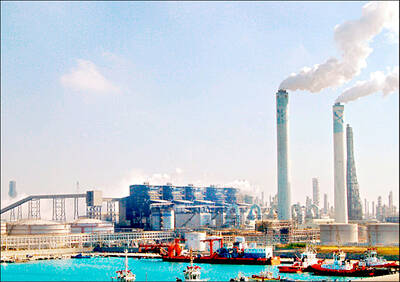
Taiwan Power Co (Taipower, 台電) yesterday said it plans to resume operations at two coal-fired power generators for three months to boost security of electricity supply as liquefied natural gas (LNG) supply risks are running high due to the Middle East conflict. The two coal-fired power generators are at Mailiao Power Plant in Yunlin County’s Mailiao Township (麥寮). The plant, operated by Formosa Plastics Group (台塑集團), supplied electricity to Taipower’s power grid until the end of last year. Taipower’s decision came about one month after Minister of Economic Affairs Kung Ming-hsin (龔明鑫) on March 10 said that the nation had no imminent

Some robotaxi passengers were left stranded in the middle of fast-moving traffic in a major Chinese city after their driverless vehicles stopped running, according to police and media reports on Wednesday. A preliminary investigation indicates more than 100 robotaxis came to a halt because of a “system malfunction,” police in the city of Wuhan said in a statement, without elaborating. No injuries were reported. One passenger told Chinese media that their robotaxi stopped after turning a corner. An instruction on a screen read: “Driving system malfunction. Staff are expected to arrive in 5 minutes.” After no one showed up, the passenger pushed


 RSS
RSS