


Ever since James Dean reveled in teen angst in his Mercury coupe in the 1955 classic Rebel Without a Cause, cars have been pumping exhaust into pop culture.
A decade later it was Steve McQueen losing hubcaps in a Bullitt Mustang, then Burt Reynolds burst into box office lore as the cop-fleeing Bandit behind the wheel of a Pontiac Trans Am. This month, Jason Statham swerved a McLaren 720S under two tractor trailers to escape the motorcycle-riding antagonist in the latest Fast and Furious film, Hobbs & Shaw.
However, while gas guzzlers have scorched their mark on the silver screen, electric vehicles (EV) are largely still waiting for their turn to reign over the red carpet. Plug-ins might be capturing more cool factor, especially Tesla Inc and its high-tech rides, but they are yet to land much time on screen. Since these models typically lose money and still make up less than 2 percent of the US market, automakers still devote much of their precious marketing dollars promoting combustion cars by getting them cast for roles on make-believe roads.
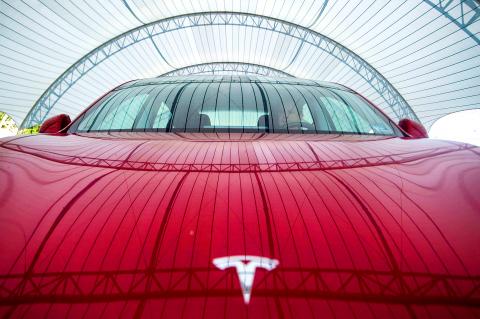
Photo: Reuters
“The business 101 would be that you’re making a ton of money on your large pickup trucks and your large SUVs, so the dollar you put into marketing on those pays back more than the dollar you put into the EVs that you’re losing money on,” said Mark Wakefield, head of the automotive practice at consulting firm AlixPartners.
There have been a handful of recent exceptions. The smash-hit Marvel Studios film Avengers: Endgame features Iron Man in an electric Audi e-tron GT, and the car stars as just the kind of futuristic gadget Tony Stark would want to own.
However, automakers are still mostly sticking to showing off the sports cars that burnish brand image or their moneymakers in movies and television series. Take General Motors Co: While it was in bankruptcy, the automaker had trouble keeping Camaros in stock the summer it starred as Bumblebee in the Transformers series. The Chevrolet Bolt, meanwhile, has been much harder to find on screen.
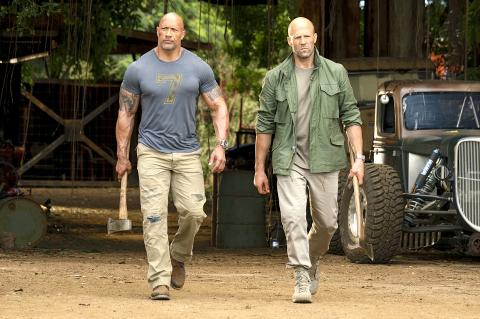
Photo: AP
Placement in a big movie can cost an automaker millions. TV spots tend to go for much less. When it comes to placing products in Hollywood, television and music videos, “typically you don’t pay for it unless it is central to the plot line or the car name is mentioned,” Michael McSunas, the former leader of product placement for Fiat Chrysler Automobiles NV, said in an e-mail.
Companies will typically pay for a vehicle’s transportation to the set or have an agency handle the placements for them. Overall, the average paid placement for television is about US$30,000, McSunas said.
“A car in this country is a lot more than a vehicle on four wheels that you get from point A to point B,” said Robert Thompson, a Syracuse University television and population culture media professor. “Cars are filled with American mythology, and lots of it. And the electric car just hasn’t been around long enough to gather that kind of mythology.”
Electric vehicles were largely curio for green activists until 2012, when Tesla’s Model S started selling. The Nissan Leaf also was establishing a market position, and the public started seeing more EVs on the road, raising their profile, said Raejean Fellows, president of the Electric Auto Association.
However, the road to Tesla getting traction in the market has not been through theaters. The electric-car leader eschews traditional advertising and instead relies on the promotional prowess of its showman chief executive officer, Elon Musk.
The automakers that do have big advertising budgets have few EVs to feature on film. That will change, but it is still expected to take years — Bloomberg New Energy Finance predicts that electric vehicles will take over a majority of the global market in about 2037.
When battery-powered cars do get on screen, they are often lampooned as slow or nerdy. Cinema Vehicles, one of the largest suppliers of rental vehicles in Hollywood, television and commercials, said it has just one electric vehicle at its Los Angeles lot: a 2011 Nissan Leaf.
The car served as the Uber that actor Kumail Nanjiani’s character, Stu, drives in the film Stuber about a cop on the hunt for a brutal killer.
The Leaf takes a beating. At one point in the film, two of Stu’s riders giggle at his choice of transportation.
“Stop laughing; this is a Leaf,” Stu tells them.
They erupt in even louder laughter.
In the series Curb Your Enthusiasm, Larry David’s ride was a Toyota Prius hybrid. David, who played everyone’s bete noire in the satirical series about his own life, was often seen slowly puttering down the street as comical music played in the background.
“An awful lot of the culture of electric vehicles within popular culture has probably tended to be more pejorative than it has been celebratory,” Thompson said. “It’s not right, but there are an awful lot of people out there who make the assumption that people who drive electric cars are also people who eat kale.”
One group trying to turn the mockery on its head is public-private advocacy group Veloz, which recently debuted a campaign called Kicking Gas, in which Arnold Schwarzenegger pokes fun at the internal-combustion engine.
“On behalf of big oil, I want to thank you all for choosing muscle cars that use gasoline,” Schwarzenegger, who plays a car salesman, says over a dealership intercom.
Automakers will not want to strike a similar tone in advertising their EVs, as the companies would effectively be shaming what is in showrooms.
“The golden rule is that you don’t talk bad about your product,” Wakefield said. “Effectively, it is talking bad about the 99 percent of your portfolio that is selling and, of that portfolio, a third of it is highly profitable.”
“You don’t want to kill the golden goose,” he said.

HORMUZ ISSUE: The US president said he expected crude prices to drop at the end of the war, which he called a ‘minor excursion’ that could continue ‘for a little while’ The United Arab Emirates (UAE) and Kuwait started reducing oil production, as the near-closure of the crucial Strait of Hormuz ripples through energy markets and affects global supply. Abu Dhabi National Oil Co (ADNOC) is “managing offshore production levels to address storage requirements,” the company said in a statement, without giving details. Kuwait Petroleum Corp said it was lowering production at its oil fields and refineries after “Iranian threats against safe passage of ships through the Strait of Hormuz.” The war in the Middle East has all but closed Hormuz, the narrow waterway linking the Persian Gulf to the open seas,

Apple Inc increased iPhone production in India by about 53 percent last year and now makes a quarter of its marquee devices there, reflecting the US company’s efforts to avoid tariffs on China. The company assembled about 55 million iPhones in India last year, up from 36 million a year earlier, people familiar with the matter said, asking not to be named because the numbers aren’t public. Apple makes about 220 million to 230 million iPhones a year globally, with India’s share of the total increasing rapidly. Apple has accelerated its expansion in the world’s most populous country in recent years, bolstered
HEADWINDS: The company said it expects its computer business, as well as consumer electronics and communications segments to see revenue declines due to seasonality Pegatron Corp (和碩) yesterday said it aims to grow its artificial intelligence (AI) server revenue more than 10-fold this year from last year, driven by orders from neocloud solutions clients and large cloud service providers. The electronics manufacturing service provider said AI server revenue growth would be driven primarily by the Nvidia Corp GB300 server platform. Server shipments are expected to increase each quarter this year, with the second half likely to outperform the first half, it said. The AI server market is expected to broaden this year as more inference applications emerge, which would drive demand for system-on-chip, application-specific integrated circuits

PROJECTION: TSMC said it expects strong growth this year, with revenue in US dollars projected to grow by about 30 percent, outperforming the industry Taiwan Semiconductor Manufacturing Co (TSMC, 台積電) yesterday reported consolidated sales last month reached NT$317.66 billion (US$9.98 billion), the highest ever for the month of February, driven by robust demand for chips built using the company’s advanced 3-nanometer (3nm) process. Last month’s figure was up 22.2 percent from a year earlier, but fell 20.8 percent from January, the world’s largest contract chipmaker said in a statement. For the first two months of the year, TSMC posted cumulative sales of NT$718.91 billion, up 29.9 percent from a year earlier. Analysts attributed the growth to sustained global demand for artificial intelligence (AI) products


 RSS
RSS