


Taiwan Semiconductor Manufacturing Co (TSMC, 台積電) has again made the list of global top 100 companies in terms of market capitalization, although its ranking this year fell to 37th from 23rd last year due to a value decline, a report by PricewaterhouseCoopers (PwC) showed yesterday.
TSMC, which is the world’s largest contract maker of chips used in smartphones, laptops and high-performance computing devices, is the only Taiwanese firm that secured a spot on the list for a second consecutive year, PwC said.
The annual report ranks the top 100 global companies by market capitalization and compares how the list has evolved over the past year and decade. It identifies the risers and fallers, looks at regional and sector dynamics and provides a view on how the global landscape has changed over time.
TSMC stayed on the list with a market value of US$206 billion, a 6.3 percent decline from last year, bucking the trend of a 5 percent increase for the top 100 firms and a 6 percent pickup for the technology sector, the report said.
The technology industry continues to hold its place as the largest sector in terms of market capitalization at US$5,691 billion, although it was hardest hit during a sell-off linked to the US-China trade dispute, the report said.
The healthcare, consumer services and telecommunications sectors grew 15 percent each, while financial conglomerates saw a 3 percent retreat, the report said.
The US continues to dominate with 54 firms on the list, representing 63 percent of overall value, up from 51 percent 10 years ago, PwC said.
Microsoft Corp took the crown as the most valuable public company for the first time, ending a seven-year reign by Apple Inc, which dropped to second, followed by Amazon.com Inc, Alphabet Inc, Berkshire Hathaway Inc, Facebook Inc, Alibaba Group Holding Ltd (阿里巴巴), Tencent Holdings Ltd (騰訊), Johnson & Johnson and Exxon Mobile Corp.
Eleven European companies dropped off the list, an overall 12 percent decline in the region’s value share from last year.
The decline was due in part to the Brexit drama, the report said.
“The US continues to be the powerhouse of the global top 100 firms, thanks to its strong economic showings,” PwC Taiwan official Eileen Liang (梁華玲) said.
In the long term, the international consultancy expects to see a growing contribution from India and other developing markets, including technology companies in greater China that would challenge the rankings, Liang said.
The prominence of companies from leading global unicorns in greater China might be a precursor to this realignment, she said.
A unicorn is a privately held start-up valued at more than US$1 billion.
Nearly half — 48 percent — of the top 100 unicorns are from the US, while greater China contributes 31 percent, PwC said.
As unicorns are more likely to have public initial offerings and acquisitions, more top 100 firms should come from the greater China area, Liang said.
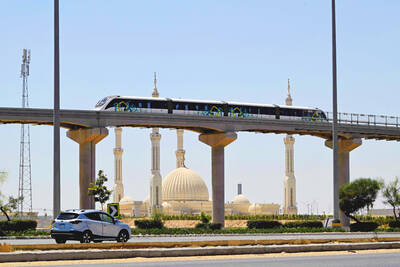
Cairo’s new monorail slices across the city skyline, running above the familiar chaos of blaring horns and aging buses’ exhaust fumes that mark rush hour below. The US$4.5 billion monorail, opened this month, is among Egypt’s most prominent new transport projects, part of a debt-funded infrastructure drive criticized for sapping state finances while bringing limited benefits to most of the country’s 109 million people. “It feels like you’re in a different country,” said Ramy Sayed, a restaurant manager, aboard a driverless Innovia 300 train. “No noise, no traffic, we’re not used to this.” The eastern line runs 56km from the bustling middle-class
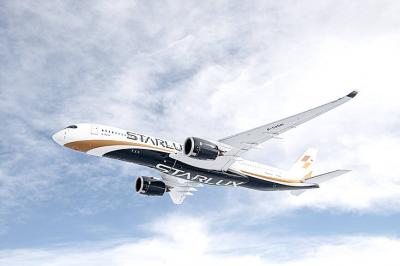
Starlux Airlines Co (星宇航空) today unveiled a long-haul network expansion plan at a shareholders’ meeting in Taipei, including direct flights to Barcelona, Spain, and Zurich, Switzerland, as well as a service connecting Taipei, Sydney and New Zealand. Starlux is to become the first Taiwanese carrier to offer non-stop services to the two European cities, while the inaugural oceanic route is expected to expand transit opportunities within the Australia-New Zealand market, Starlux said. Flight services to Chicago, Dallas, Washington and New York are under evaluation, the airline added. Prior to the shareholders’ meeting, the airline earlier this year announced that it would be

Taiwanese firms have increased investment in the Philippines in recent years as Manila’s ties with Washington deepen and global supply chains continue to shift away from China, an expert at the Chung-Hua Institution for Economic Research (CIER, 中華經濟研究院) said yesterday. The Philippines had not been among Taiwanese investors’ top choices in Southeast Asia, CIER Taiwan ASEAN Studies Center director Kristy Hsu (徐遵慈) said at a seminar in Taipei. However, Taiwan’s investment in the country has grown significantly since the COVID-19 pandemic, reaching US $257 million last year, a high in recent years, she said. Although Taiwan’s total investment in the Philippines still lags
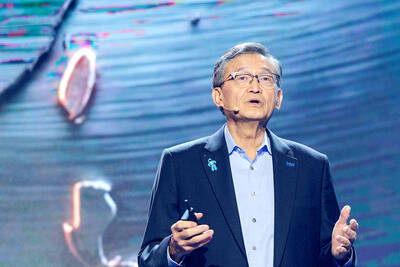
Intel Corp regards Taiwan Semiconductor Manufacturing Co (TSMC, 台積電) as a longstanding partner, as the US chipmaker would continue outsourcing production of advanced chips to TSMC, Intel chief executive officer Lip-Bu Tan (陳立武) said yesterday. “I don’t look at people as competitors. I look at the collaboration... Nvidia is also, you know, a good friend,” Tan told a news conference following his keynote speech at the Computex trade show in Taipei. “It’s a very trusted partnership for us... We are a big, top customer for them, and we’re going to continue doing that,” he said, referring to TSMC, the world’s largest foundry


 RSS
RSS