


The local stock market yesterday tumbled 1.7 percent as foreign institutional investors dumped a net NT$19 billion (US$605.6 million) of local shares, after US President Donald Trump announced a new 10 percent tariff on US$300 billion of Chinese imports from next month.
The TAIEX ended 182.71 points lower at 10,549.04, with turnover of NT$158.05 billion, Taiwan Stock Exchange (TWSE) data showed.
The plunge was led by large-cap stocks and mobile phone and notebook computer manufacturers, as the two electronic devices are among the products on the tariff list.
With US$45.8 billion of smartphones and US$38.7 billion of notebooks expected to be included in the new tariff list, investor confidence regarding the two industries has weakened, Capital Investment Trust Corp (群益投信) fund manager Daniel Tsai (蔡彥正) told the Taipei Times by telephone.
As the US-China trade dispute might escalate because of Trump’s latest move, the US is expected to maintain its ban on Huawei Technologies Co (華為), Tsai said, adding that this prompted concern about a weakening business outlook for Huawei’s chip suppliers in the US and that the effect could spread to the whole semiconductor supply chain.
“As the tariffs will increase the retail prices of consumer goods, consumers will be less willing to spend money ... which could become a drag on economic growth. This is the reason investors lost confidence [in the stock market],” Tsai said.
Shares of electronic components suffered the brunt of the stock market rout. Smartphone camera lens maker Largan Precision Co’s (大立光) shares plunged 7.93 percent to NT$3,890, while Elite Material Co (台光電) and Iteq Corp (聯茂), which manufacture copper-clad laminates for printed circuit boards, saw their shares plummet 6.35 and 6.91 percent to NT$118 and NT$128, respectively, TWSE data showed.
Shares of Taiwan Semiconductor Manufacturing Co (台積電), the largest contract chipmaker in the world, fell 1.95 percent to close at NT$251.5, while shares of Hon Hai Precision Industry Co (鴻海精密), the world’s largest contract electronics maker, sank 3.08 percent to NT$75.5, the TWSE data showed.
The TAIEX’s decline yesterday marked the fourth-largest daily loss since the beginning of this year, after an 1.8 percent plunge on May 6, a 1.78 percent decline on Jan. 2 and a 1.74 percent drop on May 9, Tsai said.
The TAIEX fared similarly to its regional peers yesterday, with the Nikkei index dropping 2.11 percent, the Hang Seng declining 2.35 percent and the Shanghai Composite Index dropping 1.41 percent.
The TAIEX is unlikely to drift into a downward spiral, unless local companies begin trimming their financial forecasts, Tsai said.
Despite the US Federal Reserve’s interest rate cut on Wednesday, the New Taiwan dollar fell against the greenback amid heavy selling pressure, shedding NT$0.194 to close at NT$31.376, Taipei Forex Inc data showed.
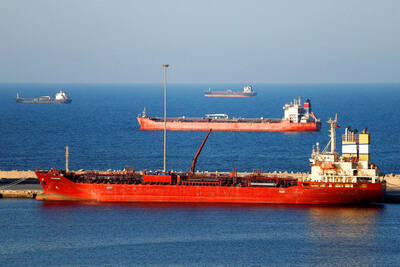
HORMUZ ISSUE: The US president said he expected crude prices to drop at the end of the war, which he called a ‘minor excursion’ that could continue ‘for a little while’ The United Arab Emirates (UAE) and Kuwait started reducing oil production, as the near-closure of the crucial Strait of Hormuz ripples through energy markets and affects global supply. Abu Dhabi National Oil Co (ADNOC) is “managing offshore production levels to address storage requirements,” the company said in a statement, without giving details. Kuwait Petroleum Corp said it was lowering production at its oil fields and refineries after “Iranian threats against safe passage of ships through the Strait of Hormuz.” The war in the Middle East has all but closed Hormuz, the narrow waterway linking the Persian Gulf to the open seas,

Nanya Technology Corp (南亞科技) yesterday said the DRAM supply crunch could extend through 2028, as the artificial intelligence (AI) boom has led the world’s major memory makers to dramatically reduce production of standard DRAM and allocate a significant portion of their capacity for high-bandwidth memory (HBM) chips. The most severe supply constraints would stretch to the first half of next year due to “very limited” increases in new DRAM capacity worldwide, Nanya Technology president Lee Pei-ing (李培瑛) told a news briefing. The company plans to increase monthly 12-inch wafer capacity to 20,000 in the first half of 2028 after a

Taiwan has enough crude oil reserves for more than 100 days and sufficient natural gas reserves for more than 11 days, both above the regulatory safety requirement, Minister of Economic Affairs Kung Ming-hsin (龔明鑫) said yesterday, adding that the government would prioritize domestic price stability as conflicts in the Middle East continue. Overall, energy supply for this month is secure, and the government is continuing efforts to ensure sufficient supply for next month, Kung told reporters after meeting with representatives from business groups at the ministry in Taipei. The ministry has been holding daily cross-ministry meetings at the Executive Yuan to ensure

RATIONING: The proposal would give the Trump administration ample leverage to negotiate investments in the US as it decides how many chips to give each country US officials are debating a new regulatory framework for exporting artificial intelligence (AI) chips and are considering requiring foreign nations to invest in US AI data centers or security guarantees as a condition for granting exports of 200,000 chips or more, according to a document seen by Reuters. The rules are not yet final and could change. They would be the first attempt to regulate the flow of AI chips to US allies and partners since US President Donald Trump’s administration said it rescinded its predecessor’s so-called AI diffusion rules. Those rules sought to keep a significant amount of AI


 RSS
RSS