

The nation’s manufacturing purchasing managers’ index (PMI) contracted last month, as the electronics sector improved, but most other sectors remained weak, Chung-Hua Institution for Economic Research (CIER, 中華經濟研究院) officials told a news conference yesterday.
“Uncertainty has subsided, but overall operating conditions have stalled,” CIER president Chen Shi-kuan (陳思寬) said.
The reading came in at 48 last month, compared with 48.1 in June.
Scores larger than 50 point to an expansion, while values below the threshold suggests a contraction.
Business recovered to 51.6 for suppliers of electronics and optical devices, and accelerated to 59.7 for makers of textile and food products, which the institute attributed to the advent of the high season.
The sub-index on new business orders came in at 48.2, compared with 48.7 in June, dragged by companies selling chemical products, biomedicine, raw materials and machinery equipment.
The gauges on industrial output and employment posted mild growth at 50.3 and 50.1 respectively, as customers started to build inventory, according to CIER’s monthly survey.
Supply Management Institute in Taiwan (中華採購與供應管理協會) executive director Steve Lai (賴樹鑫) said that Taiwanese exports have stabilized and should gain further momentum in the second half of the year.
Although the market is not expecting major breakthrough features for the new iPhone, the release of next-generation models would still spur replacement demand, Lai said.
The sub-index on raw material prices rose significantly from 40.7 to 49, while input prices climbed from 45.7 to 47.5, the survey showed, suggesting an approaching turnaround.
Companies in general remain cautious, but appear to be regaining confidence about the business outlook, Chen said.
That explained why the reading on the six-month business outlook rose from 42.9 to 49.3, he said.
A recovery in exports and resilient domestic demand might lend support to the nation’s economic growth, Academia Sinica Institute of Economics director Kamhon Kan (簡錦漢) said.
A separate survey by CIER showed that the non-manufacturing purchasing managers’ index gained 2.9 points to 54.9 last month.
All service-oriented sectors reported a pickup last month, Chen said, adding that department stores and restaurants should continue thriving with the upcoming Ghost Festival, Mid-Autumn Festival and anniversary promotions, Chen said.
However, hotels and recreation facilities might take a hit after Beijing banned individual tourists from visiting Taiwan, as of yesterday, he said.
The government has extended a subsidy program for domestic travel from next month to ease the impact.


INFRINGEMENT: The investigation comes after a complaint from Vicor Corp, with the company seeking a limited exclusion order as well as cease-and-desist orders, the ITA said The US International Trade Commission (USITC) has launched a Section 337 investigation naming Taiwanese technology companies, including Hon Hai Precision Industry Co (鴻海), Delta Electronics Inc (台達電) and Quanta Computer Inc (廣達), as respondents. The Ministry of Economic Affairs (MOEA) pledged assistance if needed. The USITC said on Friday in a statement that it had voted to institute an investigation under Section 337 of the US Tariff Act of 1930 into certain vertical power delivery systems, related components and computing devices incorporating such systems. The investigation covers 20 companies from Taiwan, China, Germany and the US, the commission said, adding that it
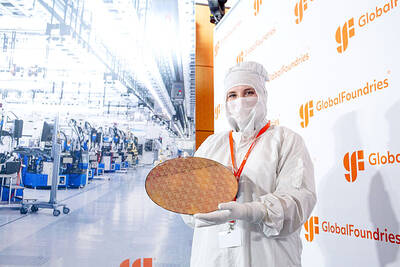
PACKAGING PUSH: The chipmaker said that it would begin ramping up silicon interposer production in New York in the first half of 2028 to support AI systems GlobalFoundries Inc shares gained as much as 7 percent after the chip manufacturer announced a five-year, US$2 billion deal to provide US production capacity to Taiwan Semiconductor Manufacturing Co (TSMC, 台積電). Under the agreement, announced on Thursday, GlobalFoundries is to help supply components known as silicon interposers. The US company is to rely on manufacturing at its facility in Malta, New York, and said it has the option to expand capacity “as customer demand grows.” An interposer is a small layer of silicon that sits between a chip and its packaging. It is home to the wires that carry electronic signals and
A man charged along with Super Micro Computer Inc co-founder Yih-Shyan “Wally” Liaw (廖益賢) of conspiring to send cutting-edge chips to China in violation of US export controls pleaded guilty, court documents said. Ting-Wei “Willy” Sun (孫廷瑋), a former outside contractor described by US authorities as a “fixer” who allegedly aided in the sales, pleaded guilty on Thursday at a hearing in federal court in New York as part of an agreement with prosecutors, court filings showed. Prosecutors claimed the men were part of a scheme to send Nvidia Corp-powered servers to an unnamed Southeast Asian company and then divert them to
SECOND-TOP MONTH: September revenue was 0.6 percent lower month-on-month, but despite the drop, it was the firm’s highest-ever sales report for the month Taiwan Semiconductor Manufacturing Co (TSMC, 台積電) yesterday reported record quarterly revenue for last quarter, after sales last month hit the second-highest monthly level in the company’s history. Revenue in the quarter ended last month was NT$1.49 trillion (US$46.75 billion), up 17 percent from NT$1.27 trillion in the second quarter and exceeding the combined prediction of 19 LSEG SmartEstimate analysts of NT$1.46 trillion. Last quarter’s figure — which was up 12 percent from the midpoint of last year — also surpassed the company’s July estimates of US$44.6 billion to US$45.8 billion amid surging demand for the ramp-up of its advanced 2-nanometer technology, artificial


 RSS
RSS