


DBS Bank (星展銀行) has maintained its GDP growth forecast for the nation at 1.9 percent for this year, as better-than-expected investment has offset declining exports, Singapore-based DBS economist Ma Tieying (馬鐵英) told a news conference in Taipei.
That compares with a growth estimate of 2.2 percent by Cathay Financial Holding Co (國泰金控), 2.1 percent by Standard Chartered Bank (渣打銀行), 2.01 percent by Academia Sinica and 2.06 percent by the Chung-Hua Institution for Economic Research (中華經濟研究院).
DBS has cut its GDP growth forecast for Singapore from 3 percent to 0.7 percent due to slumping exports and has lowered its forecast for Hong Kong from 2.5 percent to less than 2 percent due to political events, Ma said.
“Taiwan is likely to rank second among the four Asian Dragons, after only South Korea’s 2.1 percent growth,” Ma said.
Taiwanese exports showed a slight pickup of 0.5 percent last month from a year earlier after five consecutive months of declines, but the whole year’s exports are still expected to decline by less than 5 percent from last year, Ma said.
By comparison, domestic investment is forecast to grow 4.9 percent this year, the highest in six years, on the back of 93 returning businesses investing about NT$452 billion (US$14.54 billion), she said.
“Taiwan has seen capital goods imports continue to climb this year, which was strange at first glance considering that the nation’s exports were plummeting, but it makes sense as more Taiwanese firms prepare to move home,” Ma said.
Most of the returning firms belong to the information and communications technology sector, as they try to avoid extra tariffs amid a trade dispute between China and the US, she said.
Overall, a growing service industry, increasing arrivals of foreign tourists, rising exports to the US, solid private consumption and mild inflation have also helped the nation’s economy mitigate the effects of falling exports, she said.
The nation is forecast to post 1.7 percent GDP growth in the second quarter, flat from the previous quarter, and 1.9 percent and 2.2 percent growth respectively in the third and fourth quarters, she added.
The Directorate-General of Budget, Accounting and Statistics is scheduled to reveal second-quarter GDP growth and update its full-year GDP forecast next month after trimming its forecast from 2.27 percent to 2.19 percent in May.

SECOND-RATE: Models distilled from US products do not perform the same as the original and undo measures that ensure the systems are neutral, the US’ cable said The US Department of State has ordered a global push to bring attention to what it said are widespread efforts by Chinese companies, including artificial intelligence (AI) start-up DeepSeek (深度求索), to steal intellectual property from US AI labs, according to a diplomatic cable. The cable, dated Friday and sent to diplomatic and consular posts around the world, instructs diplomatic staff to speak to their foreign counterparts about “concerns over adversaries’ extraction and distillation of US AI models.” Distillation is the process of training smaller AI models using output from larger, more expensive ones to lower the costs of training a powerful new

Singapore-based ride-hailing and delivery giant Grab Holdings’ planned acquisition of Foodpanda’s Taiwan operations has yet to enter the formal review stage, as regulators await supplementary documents, the Fair Trade Commission (FTC) said yesterday. Acting FTC Chairman Chen Chih-min (陳志民) told the legislature’s Economics Committee that although Grab submitted its application on March 27, the case has not been officially accepted because required materials remain incomplete. Once the filing is finalized, the FTC would launch a formal probe into the deal, focusing on issues such as cross-shareholding and potential restrictions on market competition, Chen told lawmakers. Grab last month announced that it would acquire
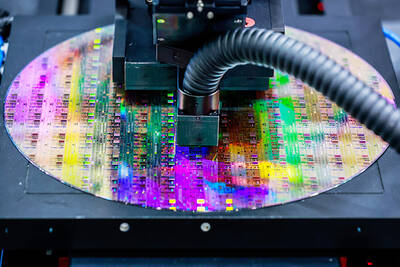
The artificial intelligence (AI) boom has triggered a seismic reshuffling of global equity markets, with Taiwan and South Korea muscling past European nations one by one. With its stock market now valued at nearly US$4.3 trillion, Taiwan surpassed the UK, Europe’s biggest market, earlier this month, data compiled by Bloomberg showed. South Korea is about US$140 billion away from doing the same. The tech-heavy Asian markets have shot past Germany and France in the past seven months. The shift is largely down to massive gains in shares of three companies that provide essential hardware for AI: Taiwan Semiconductor Manufacturing Co (TSMC, 台積電),
Shares of Taiwan Semiconductor Manufacturing Co (TSMC, 台積電) have repeatedly hit new highs, but an equity analyst said the stock’s valuation remains within a reasonable range and any pullback would likely be technical. The contract chipmaker’s historical price-to-earnings (P/E) ratio has ranged between 20 and 30, Cathay Futures Consultant Co (國泰證期) analyst Tsai Ming-han (蔡明翰) told Central News Agency. With market consensus projecting that TSMC would post earnings per share of about NT$100 (US$3.17) this year, supported by strong global demand for artificial intelligence (AI) applications, and the stock currently trading at a P/E ratio of below 25, Tsai said the valuation


 RSS
RSS