


The Industrial Development Bureau (IDB) on Wednesday last week said that up to 32 companies have shown an interest in applying to a governmental program meant to help companies expand their production space at the nation’s industrial zones and science parks.
In an effort to accommodate companies relocating production sites back to Taiwan, the Ministry of Economic Affairs launched the program early last year to allow “vertical expansion” of companies’ manufacturing facilities without the need to acquire extra plots of land.
Thanks to a favorable response industry-wide, the Executive Yuan in April approved an expansion of the program so that it now covers government-designated industrial zones and science parks, agriculture zones, biotechnology parks and other industrial areas not subject to urban planning regulations.
To further encourage companies to participate in the program, the government has outlined a reward system that allows companies to increase their building bulk ratio by up to 50 percent through new investment, a commitment to energy management and the setup of feedback funds, the bureau said.
An application to the Taichung Industrial Park (台中工業區) by Largan Precision Co (大立光) to expand an existing production site and one to New Taipei City’s Shulin Industrial Park (樹林工業區) by another company have been approved, the Central News Agency (CNA) quoted IDB Deputy Director Yang Po-keng (楊伯耕) as saying.
The bureau said that applications from four companies are under review, while another two are awaiting review.
The companies being reviewed plan to invest up to NT$11.7 billion (US$376.44 million), which would provide an estimated 4,300 job opportunities, the bureau said.
Separately, Wistron Corp (緯創資通) on Thursday last week said that Apple Inc is using the Taiwanese firm to ship iPhones assembled in India to the European market.
Speaking with CNA, a source in India familiar with the deal between Apple and Wistron said that the US company is shipping a small quantity of iPhone 6S and iPhone 7 models assembled in India by the Taiwanese firm.
Whether the number of shipments increases depends on market demand, the source said.
India’s Economic Times earlier on Thursday reported that shipments of Wistron-assembled iPhones to some European markets represented “another step in the iconic smartphone company’s efforts to make India an export hub.”
The shipments have boosted “the government’s Make in India plan,” the report said.
Wistron is the first Apple supplier to make iPhones in India.
The Taiwanese manufacturer is making iPhones at its production site on the outskirts of Bangalore, which has the highest concentration of IT companies in the South Asian market.
Additional reporting by CNA

GROWING OWINGS: While Luxembourg and China swapped the top three spots, the US continued to be the largest exposure for Taiwan for the 41st consecutive quarter The US remained the largest debtor nation to Taiwan’s banking sector for the 41st consecutive quarter at the end of September, after local banks’ exposure to the US market rose more than 2 percent from three months earlier, the central bank said. Exposure to the US increased to US$198.896 billion, up US$4.026 billion, or 2.07 percent, from US$194.87 billion in the previous quarter, data released by the central bank showed on Friday. Of the increase, about US$1.4 billion came from banks’ investments in securitized products and interbank loans in the US, while another US$2.6 billion stemmed from trust assets, including mutual funds,

AI TALENT: No financial details were released about the deal, in which top Groq executives, including its CEO, would join Nvidia to help advance the technology Nvidia Corp has agreed to a licensing deal with artificial intelligence (AI) start-up Groq, furthering its investments in companies connected to the AI boom and gaining the right to add a new type of technology to its products. The world’s largest publicly traded company has paid for the right to use Groq’s technology and is to integrate its chip design into future products. Some of the start-up’s executives are leaving to join Nvidia to help with that effort, the companies said. Groq would continue as an independent company with a new chief executive, it said on Wednesday in a post on its Web
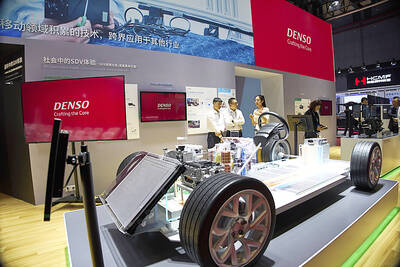
JOINT EFFORTS: MediaTek would partner with Denso to develop custom chips to support the car-part specialist company’s driver-assist systems in an expanding market MediaTek Inc (聯發科), the world’s largest mobile phone chip designer, yesterday said it is working closely with Japan’s Denso Corp to build a custom automotive system-on-chip (SoC) solution tailored for advanced driver-assistance systems and cockpit systems, adding another customer to its new application-specific IC (ASIC) business. This effort merges Denso’s automotive-grade safety expertise and deep vehicle integration with MediaTek’s technologies cultivated through the development of Media- Tek’s Dimensity AX, leveraging efficient, high-performance SoCs and artificial intelligence (AI) capabilities to offer a scalable, production-ready platform for next-generation driver assistance, the company said in a statement yesterday. “Through this collaboration, we are bringing two

Even as the US is embarked on a bitter rivalry with China over the deployment of artificial intelligence (AI), Chinese technology is quietly making inroads into the US market. Despite considerable geopolitical tensions, Chinese open-source AI models are winning over a growing number of programmers and companies in the US. These are different from the closed generative AI models that have become household names — ChatGPT-maker OpenAI or Google’s Gemini — whose inner workings are fiercely protected. In contrast, “open” models offered by many Chinese rivals, from Alibaba (阿里巴巴) to DeepSeek (深度求索), allow programmers to customize parts of the software to suit their


 RSS
RSS