


The Taiwan Institute of Economic Research (TIER, 台灣經濟研究院) yesterday kept its forecast for the nation’s GDP growth this year unchanged at 2.12 percent, with exports weakening, but the possibility that private investment might be stronger than expected.
Exports were soft with a 4.2 percent contraction in the first quarter, reflecting a slowdown in global trade flows, TIER president Chang Chien-yi (張建一) said.
However, the Taipei-based think tank left its forecast intact on expectations that the recovery of private investment would accelerate in light of capital equipment purchases by local semiconductor firms, Chang said.
Imports of capital equipment, a critical gauge of corporate expansion or upgrade needs, jumped 15.4 percent in the January-to-March period, with semiconductor equipment surging 41.2 percent, Ministry of Finance data showed.
Taiwan is home to the world’s largest chip makers, designers and packagers of related shipments, with the industry driving 25 percent of overall exports.
The aggressive equipment acquisitions suggest that local firms are upbeat about business in the second half, a trend that might receive further support from stimulus measures to encourage capital repatriation and facility relocations, Chang said.
So far, the Ministry of Economic Affairs has approved 35 applications valued at NT$137 billion (US$4.43 billion) to move manufacturing facilities to Taiwan from China to avoid heavy tariffs imposed by Washington on Chinese exports, TIER said.
The relocation wave has prompted the think tank to raise its projection of capital formation increase for this year to 5.36 percent, from a prediction in January of 4.6 percent, it said.
Private consumption might improve at a pace of 2.3 percent, up from a prediction of 2.2 percent in January, with people expected to be more comfortable spending following rallies across global bourses as the US and China negotiate an end to the tariff dispute, the institute said.
The TAIEX gained 2.42 percent last month, with daily turnover rising to NT$113.51 billion, it said, adding that companies in other sectors also gained more confidence.
The sentiment reading for the manufacturing industry increased 4.7 points to 95.93, while the index for the service industry rose 5.51 points to 91.25, it said, citing a monthly poll.
Firms involved in construction and property brokerage bucked the trend, turning less confident, with the sentiment gauge shedding 2.95 points to 94.13.
Pricing differences continued to weigh on property transactions, while political factors ahead of next year’s presidential election deepened uncertainty, TIER said.
Slower GDP growth in China, Europe and the US poses the biggest downside risk for Taiwan’s economy, as these trade partners account for 65 percent of the nation’s total exports, TIER economist Gordon Sun (孫明德) said.

Taiwan Semiconductor Manufacturing Co (TSMC, 台積電) last week recorded an increase in the number of shareholders to the highest in almost eight months, despite its share price falling 3.38 percent from the previous week, Taiwan Stock Exchange data released on Saturday showed. As of Friday, TSMC had 1.88 million shareholders, the most since the week of April 25 and an increase of 31,870 from the previous week, the data showed. The number of shareholders jumped despite a drop of NT$50 (US$1.59), or 3.38 percent, in TSMC’s share price from a week earlier to NT$1,430, as investors took profits from their earlier gains
AI TALENT: No financial details were released about the deal, in which top Groq executives, including its CEO, would join Nvidia to help advance the technology Nvidia Corp has agreed to a licensing deal with artificial intelligence (AI) start-up Groq, furthering its investments in companies connected to the AI boom and gaining the right to add a new type of technology to its products. The world’s largest publicly traded company has paid for the right to use Groq’s technology and is to integrate its chip design into future products. Some of the start-up’s executives are leaving to join Nvidia to help with that effort, the companies said. Groq would continue as an independent company with a new chief executive, it said on Wednesday in a post on its Web

CHINA RIVAL: The chips are positioned to compete with Nvidia’s Hopper and Blackwell products and would enable clusters connecting more than 100,000 chips Moore Threads Technology Co (摩爾線程) introduced a new generation of chips aimed at reducing artificial intelligence (AI) developers’ dependence on Nvidia Corp’s hardware, just weeks after pulling off one of the most successful Chinese initial public offerings (IPOs) in years. “These products will significantly enhance world-class computing speed and capabilities that all developers aspire to,” Moore Threads CEO Zhang Jianzhong (張建中), a former Nvidia executive, said on Saturday at a company event in Beijing. “We hope they can meet the needs of more developers in China so that you no longer need to wait for advanced foreign products.” Chinese chipmakers are in
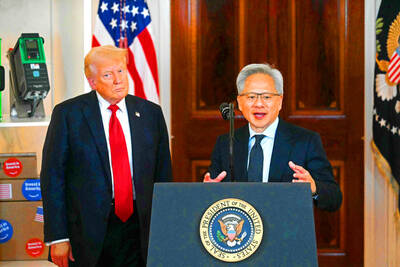
POLICY REVERSAL: The decision to allow sales of Nvidia’s H200 chips to China came after years of tightening controls and has drawn objections among some Republicans US House Republicans are calling for arms-sale-style congressional oversight of artificial intelligence (AI) chip exports as US President Donald Trump’s administration moves to approve licenses for Nvidia Corp to ship its H200 processor to China. US Representative Brian Mast, the Republican chairman of the US House Committee on Foreign Affairs, which oversees export controls, on Friday introduced a bill dubbed the AI Overwatch Act that would require the US Congress to be notified of AI chips sales to adversaries. Any processors equal to or higher in capabilities than Nvidia’s H20 would be subject to oversight, the draft bill says. Lawmakers would have


 RSS
RSS