


GlobalWafers Co (環球晶圓), the world’s No. 3 silicon wafer supplier, yesterday said that net profits last year soared to an all-time high, thanks to vibrant customer demand and a price rebound.
Net profits surged 160 percent to NT$13.64 billion (US$442.31 million) from NT$5.28 billion in 2017, while earnings per share jumped to NT$31.18 from NT$12.68 in 2017, GlobalWafers said, adding that gross margin rose to a historical high of 37.8 percent from 25.6 percent.
“In addition to very strong market demand, I think long-term agreement policy is one of the main factors contributing to the company’s overall performance last year,” chairwoman Doris Hsu (徐秀蘭) told an investors’ conference.
GlobalWafers has honored every long-term agreement with every customer and no breach of contract has occurred, Hsu said in a bid to quell concern over clients reportedly planning to negotiate down prices amid a semiconductor slowdown.
As of the end of December last year, the company had booked record-high cash prepayments totaling NT$22.52 billion, it said.
GlobalWafers started this year on a good note, as it has secured new long-term supply contracts with fixed prices either equal to or a little higher than the prices in existing contracts, Hsu said.
“This is very important information we want to share,” she said. “None of the new long-term contract prices are lower than the existing [contracts].”
As a result, the company’s average selling price would continue to improve this year from last year, fueled by demand for advanced wafers and specialty wafers for 5G and power management chips, she added.
The price upticks are to offset a decline in ordinary wafers, Hsu said, adding that for the whole of this year, the average selling price might increase by a mid-single-digit percentage on an annual basis.
Some customers are to still be undergoing an inventory correction in the second quarter, as demand for high-end mobile phones, memory and handheld devices is softening amid US-China trade tensions and macroeconomic uncertainties, Hsu said.
“We expect the market will recover from the second half of the year,” Hsu said. “We are very confident that GlobalWafers will keep growing this year.”
GlobalWafers said that its optimism is based on the expectation that the 5G, artificial intelligence, electric vehicle and 3D NAND memory chip segments would drive demand in the near future.
Most of the company’s capacity has been booked by customers, who have inked multi-year supply agreements with the company and have made payments in advance, it said.
To supply clients in the region, the company is building a 300mm fab in South Korea, which is to start contributing revenue from next year, it added.
Separately yesterday, GlobalWafers said its board of directors has approved the distribution of a cash dividend of NT$25 per share, representing an 80 percent payout ratio.
The proposal is subject to approval from the company’s shareholders during their annual meeting to be held on June 25.
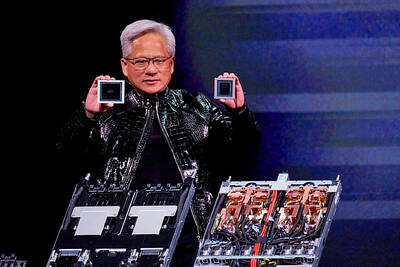
Nvidia Corp chief executive officer Jensen Huang (黃仁勳) on Monday introduced the company’s latest supercomputer platform, featuring six new chips made by Taiwan Semiconductor Manufacturing Co (TSMC, 台積電), saying that it is now “in full production.” “If Vera Rubin is going to be in time for this year, it must be in production by now, and so, today I can tell you that Vera Rubin is in full production,” Huang said during his keynote speech at CES in Las Vegas. The rollout of six concurrent chips for Vera Rubin — the company’s next-generation artificial intelligence (AI) computing platform — marks a strategic
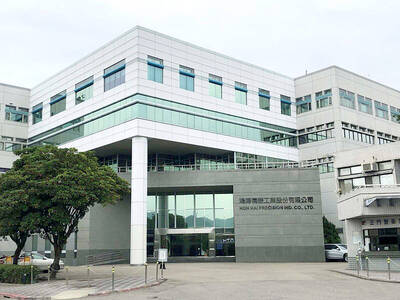
REVENUE PERFORMANCE: Cloud and network products, and electronic components saw strong increases, while smart consumer electronics and computing products fell Hon Hai Precision Industry Co (鴻海精密) yesterday posted 26.51 percent quarterly growth in revenue for last quarter to NT$2.6 trillion (US$82.44 billion), the strongest on record for the period and above expectations, but the company forecast a slight revenue dip this quarter due to seasonal factors. On an annual basis, revenue last quarter grew 22.07 percent, the company said. Analysts on average estimated about NT$2.4 trillion increase. Hon Hai, which assembles servers for Nvidia Corp and iPhones for Apple Inc, is expanding its capacity in the US, adding artificial intelligence (AI) server production in Wisconsin and Texas, where it operates established campuses. This
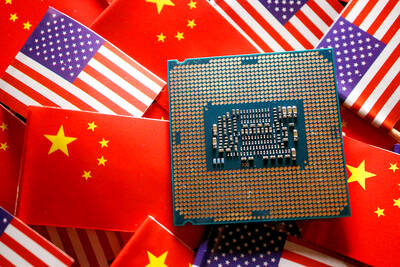
US President Donald Trump on Friday blocked US photonics firm HieFo Corp’s US$3 million acquisition of assets in New Jersey-based aerospace and defense specialist Emcore Corp, citing national security and China-related concerns. In an order released by the White House, Trump said HieFo was “controlled by a citizen of the People’s Republic of China” and that its 2024 acquisition of Emcore’s businesses led the US president to believe that it might “take action that threatens to impair the national security of the United States.” The order did not name the person or detail Trump’s concerns. “The Transaction is hereby prohibited,”
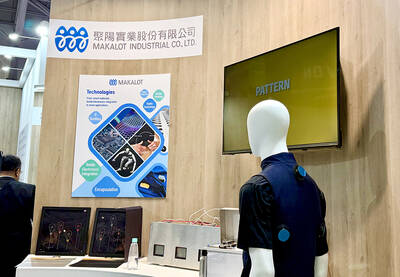
Garment maker Makalot Industrial Co (聚陽) yesterday reported lower-than-expected fourth-quarter revenue of NT$7.93 billion (US$251.44 million), down 9.48 percent from NT$8.76 billion a year earlier. On a quarterly basis, revenue fell 10.83 percent from NT$8.89 billion, company data showed. The figure was also lower than market expectations of NT$8.05 billion, according to data compiled by Yuanta Securities Investment and Consulting Co (元大投顧), which had projected NT$8.22 billion. Makalot’s revenue this quarter would likely increase by a mid-teens percentage as the industry is entering its high season, Yuanta said. Overall, Makalot’s revenue last year totaled NT$34.43 billion, down 3.08 percent from its record NT$35.52


 RSS
RSS