


Even after a plunge last month that wiped US$46 billion off Chinese healthcare stocks, domestic drugmakers might be far from their floor as a Beijing-led policy shift gathers pace.
China’s plan to drive down generic drug prices through a centralized bulk procurement program is set to redraw the industry by forcing its thousands of small generic drugmakers to streamline and consolidate after decades of enjoying outsized profit margins.
“There won’t be a second act for traditional generic drugmakers in China,” said Dai Ming (戴明), Shanghai-based fund manager at Hengsheng Asset Management Co (恒盛資產管理)
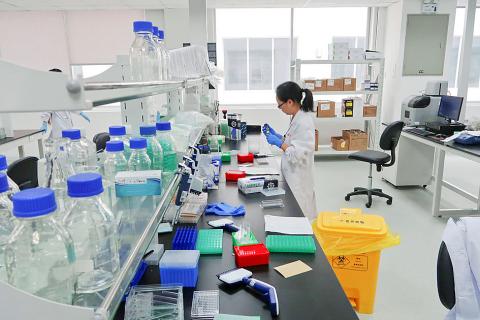
Photo: Reuters
“In the past, there was hope that these companies would benefit from more government investment in healthcare due to the aging population, but now these healthcare stocks will be further hurt by policy and undergo a greater correction,” Dai said.
To survive the shifting landscape and rely less on generics — drugs whose patents have expired — many companies are scrambling to pump money into research and development (R&D).
Discovering a new medicine allows companies to earn high profits for as long as the new drug is covered by a patent, balancing out the loss of revenue from the fall in generic drug prices.
Chinese companies had been in a sweet spot.
Among the top 100 generic drugmakers, Chinese firms had a 74 percent gross margin and an 18 percent profit margin in the third quarter of last year, compared with a global average of 55 percent and 9.5 percent respectively, according to data compiled by Bloomberg.
The privileged position was due to the quirks of China’s regulatory system. While multinational giants had to wait years for approval to import their new drugs, the domestic generic makers could do a thriving business in copying, testing and getting local permission for the medicines.
At the same time, the industry benefited because of the lack of a centralized system for quality control.
Multinationals like Pfizer Inc and AstraZeneca PLC could win more hospital tenders for their off-patent drugs, as they could more easily offer quality assurances for their higher-cost medicines. That kept prices elevated throughout the pharma sector.
Now, China has embarked on a pilot program in which major cities buy certain drugs in bulk, forcing companies to bid for contracts and driving prices down by an average of 52 percent, one by as much as 90 percent.
Chinese Vice Premier Sun Chunlan (孫春蘭) last week said that China would be expanding the program to cover more cities and drugs, as medicine prices must fall for healthcare to be affordable for the public.
Chinese companies that are already heavily invested in R&D stand the best chance of surviving the new landscape.
Among firms listed in China, Jiangsu Hengrui Medicine Co (恆瑞醫藥) has invested the most in research by far — amounting to 16 percent of revenue in the latest quarter. Guangzhou-based Yipinhong Pharmaceutical Co (一品紅藥業) is in second place with 8.4 percent. Zhejiang Jingxin Pharmaceutical Co (京新藥業), Chengdu Kanghong Pharmaceutical Group Co (康弘藥業) and Tianjin Lisheng Pharmaceutical Co (天津力生製藥) have each invested about 8 percent of sales into research.
Among Hong Kong-traded shares, CSPC Pharmaceutical Group Ltd (石藥集團) has 8.14 percent of sales invested in research and Sino Biopharmaceutical Ltd (中國生物製藥) has 6.23 percent.
Jiangsu Hengrui gets 20 percent of its revenue from novel drugs and 80 percent from generics, a ratio it wants to flip, Lianshan Zhang, president of global R&D, said in an interview last month.
However, a successful novel drug can take decades to develop, and the Chinese pharmaceuticals are up against the deep pockets and research talent of the multinationals, which are enjoying rapid approval from Chinese regulators for their new medicine.
CHIP RACE: Three years of overbroad export controls drove foreign competitors to pursue their own AI chips, and ‘cost US taxpayers billions of dollars,’ Nvidia said China has figured out the US strategy for allowing it to buy Nvidia Corp’s H200s and is rejecting the artificial intelligence (AI) chip in favor of domestically developed semiconductors, White House AI adviser David Sacks said, citing news reports. US President Donald Trump on Monday said that he would allow shipments of Nvidia’s H200 chips to China, part of an administration effort backed by Sacks to challenge Chinese tech champions such as Huawei Technologies Co (華為) by bringing US competition to their home market. On Friday, Sacks signaled that he was uncertain about whether that approach would work. “They’re rejecting our chips,” Sacks

NATIONAL SECURITY: Intel’s testing of ACM tools despite US government control ‘highlights egregious gaps in US technology protection policies,’ a former official said Chipmaker Intel Corp has tested chipmaking tools this year from a toolmaker with deep roots in China and two overseas units that were targeted by US sanctions, according to two sources with direct knowledge of the matter. Intel, which fended off calls for its CEO’s resignation from US President Donald Trump in August over his alleged ties to China, got the tools from ACM Research Inc, a Fremont, California-based producer of chipmaking equipment. Two of ACM’s units, based in Shanghai and South Korea, were among a number of firms barred last year from receiving US technology over claims they have

It is challenging to build infrastructure in much of Europe. Constrained budgets and polarized politics tend to undermine long-term projects, forcing officials to react to emergencies rather than plan for the future. Not in Austria. Today, the country is to officially open its Koralmbahn tunnel, the 5.9 billion euro (US$6.9 billion) centerpiece of a groundbreaking new railway that will eventually run from Poland’s Baltic coast to the Adriatic Sea, transforming travel within Austria and positioning the Alpine nation at the forefront of logistics in Europe. “It is Austria’s biggest socio-economic experiment in over a century,” said Eric Kirschner, an economist at Graz-based Joanneum

OPTION: Uber said it could provide higher pay for batch trips, if incentives for batching is not removed entirely, as the latter would force it to pass on the costs to consumers Uber Technologies Inc yesterday warned that proposed restrictions on batching orders and minimum wages could prompt a NT$20 delivery fee increase in Taiwan, as lower efficiency would drive up costs. Uber CEO Dara Khosrowshahi made the remarks yesterday during his visit to Taiwan. He is on a multileg trip to the region, which includes stops in South Korea and Japan. His visit coincided the release last month of the Ministry of Labor’s draft bill on the delivery sector, which aims to safeguard delivery workers’ rights and improve their welfare. The ministry set the minimum pay for local food delivery drivers at


 RSS
RSS