


Nanya Technology Corp (南亞科技) yesterday saw its shares tumble 8.23 percent after the DRAM chipmaker cut its shipment forecast for this quarter, as US-China trade tensions and supply constraints on microprocessors from Intel Corp took their toll.
The memory chipmaker said shipments would decline by about 15 percent this quarter, as higher US tariffs on Chinese goods curtailed end demand and caused production line issues in the supply chain.
In October, the company forecast a flat quarter this quarter in terms of shipments.
For the full year, shipments are expected grow at a slower pace of 40 percent year-on-year, compared with the firm’s original estimate of 48 percent, Nanya Technology said in a statement.
Nanya Technology posted revenue of NT$5.4 billion (US$175.29 million) for last month, a 19.67 percent decline from October’s NT$6.73 billion.
Due to flagging demand, shipments dropped by about 15 percent, while the chipmaker’s average selling price dipped 1 to 3 percent from October, the firm said.
Revenue shrank 5.95 percent year-on-year from NT$5.74 billion.
In the first 11 months, revenue surged 63.16 percent year-on-year to NT$48.97 billion from NT$30.93 billion, as the DRAM sector’s nine-quarter boom only began to reverse this quarter.
Nanya Technology shares dropped to NT$56.9 yesterday, compared with the TAIEX’s loss of 1.65 percent.
Jih Sun Securities Investment Consulting Co (日盛投顧) said Nanya Technology has achieved 47 percent of its revenue forecast of NT$25.8 billion for this quarter.
“The fourth quarter is usually a peak season, but it appears to be a different story this year,” Jih Sun said yesterday in a research note.
The investment consultant retained its “neutral” rating on Nanya Technology, as the company is vulnerable to fluctuations in memorychip prices, which are likely to continue to be weak, it said.
However, Maybank said it holds a relatively positive outlook regarding Nanya Technology.
“We are positive about the DRAM industry, because suppliers have been disciplined with regards to capital expenditure and we believe Nanya Technology’s share buyback plan should provide near-term share price support,” Maybank said yesterday in a report.
Maybank kept its target share price for Nanya Technology unchanged at NT$100, but investors should be mindful of the near-term downside risk to sales and earnings, it said.

Taiwan Semiconductor Manufacturing Co (TSMC, 台積電) last week recorded an increase in the number of shareholders to the highest in almost eight months, despite its share price falling 3.38 percent from the previous week, Taiwan Stock Exchange data released on Saturday showed. As of Friday, TSMC had 1.88 million shareholders, the most since the week of April 25 and an increase of 31,870 from the previous week, the data showed. The number of shareholders jumped despite a drop of NT$50 (US$1.59), or 3.38 percent, in TSMC’s share price from a week earlier to NT$1,430, as investors took profits from their earlier gains

In a high-security Shenzhen laboratory, Chinese scientists have built what Washington has spent years trying to prevent: a prototype of a machine capable of producing the cutting-edge semiconductor chips that power artificial intelligence (AI), smartphones and weapons central to Western military dominance, Reuters has learned. Completed early this year and undergoing testing, the prototype fills nearly an entire factory floor. It was built by a team of former engineers from Dutch semiconductor giant ASML who reverse-engineered the company’s extreme ultraviolet lithography (EUV) machines, according to two people with knowledge of the project. EUV machines sit at the heart of a technological Cold
Taiwan’s long-term economic competitiveness will hinge not only on national champions like Taiwan Semiconductor Manufacturing Co. (TSMC, 台積電) but also on the widespread adoption of artificial intelligence (AI) and other emerging technologies, a US-based scholar has said. At a lecture in Taipei on Tuesday, Jeffrey Ding, assistant professor of political science at the George Washington University and author of "Technology and the Rise of Great Powers," argued that historical experience shows that general-purpose technologies (GPTs) — such as electricity, computers and now AI — shape long-term economic advantages through their diffusion across the broader economy. "What really matters is not who pioneers
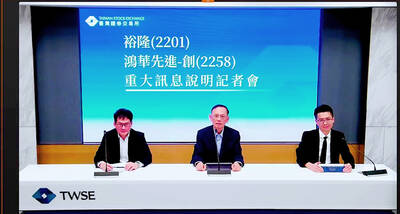
TAIWAN VALUE CHAIN: Foxtron is to fully own Luxgen following the transaction and it plans to launch a new electric model, the Foxtron Bria, in Taiwan next year Yulon Motor Co (裕隆汽車) yesterday said that its board of directors approved the disposal of its electric vehicle (EV) unit, Luxgen Motor Co (納智捷汽車), to Foxtron Vehicle Technologies Co (鴻華先進) for NT$787.6 million (US$24.98 million). Foxtron, a half-half joint venture between Yulon affiliate Hua-Chuang Automobile Information Technical Center Co (華創車電) and Hon Hai Precision Industry Co (鴻海精密), expects to wrap up the deal in the first quarter of next year. Foxtron would fully own Luxgen following the transaction, including five car distributing companies, outlets and all employees. The deal is subject to the approval of the Fair Trade Commission, Foxtron said. “Foxtron will be


 RSS
RSS