


RENEWABLE ENERGY
Motech to lay off workers
Solar cell maker Motech Industries Inc (茂迪) yesterday said it plans to lay off 916 employees as part of its efforts to stay afloat. A cutback in solar-power subsidies in China has exacerbated already weak demand for solar energy products, it said. The job cuts are to take place on Jan. 28, the Tainan-based company said in a statement filed with the Taiwan Stock Exchange. As part of its turnaround efforts, it would only produce high-efficiency solar cells and solar modules, as well as expanding into solar panel assembly, the company said.
TECHNOLOGY
E Ink links with start-up
E-paper display supplier E Ink Holdings Co (元太科技) yesterday said it has formed a strategic partnership with a Chinese LCD panel start-up to develop and sell large e-paper displays for industrial devices, the Internet of Things and other premium electronics. The newly established LCD panel maker, based in Zhejiang Province’s Ningbo, has received start-up money from Guangzhou New Vision Optoelectronic Co (廣州新視界光電) and other investors, E Ink said. The Chinese panel maker would make large-sized LCD panels at a new G7.5 plant for E Ink, the company said. E Ink said it would also broaden the partnership into e-paper film manufacturing and e-paper module assembling.
INTERNET
Line developer forum planned
Japanese mobile messaging giant Line Corp is set to hold Line Taiwan TechPulse — its annual software developer conference — in Taiwan on Dec. 21, featuring an Internet of Things (IoT) interactive zone, an executive at Line Taiwan Ltd (台灣連線) said on Tuesday. This year’s theme is “interaction,” and developers would use the interactive zone to learn how to create more people-to-people interactions and conduct information and service exchanges through the messaging platform, Line Taiwan research and development director Marco Chen (陳鴻嘉) said. A wide range of apps would be available at the event, including Line Chatbot, through which participants can register and report their arrival at events, Chen said. In the IoT interactive area, attendees would be able to carry out interactive tasks and play games using apps to control devices at the site.
TRADE
Taiwan, Japan meet on trade
Taiwan and Japan are set to sign five memorandums of understanding (MOUs) after their annual two-day economic and trade meeting, which begins today in Taipei, with the objective of enhancing cooperation between small and medium-sized enterprises (SMEs), the Ministry of Foreign Affairs said yesterday. The closed-door meeting is to take place at the Ambassador Hotel. Taiwan-Japan Relations Association President Chiou I-jen (邱義仁) and Japan-Taiwan Exchange Association Chairman Mitsuo Ohashi are to lead the delegations in discussions on a wide range of economic and trade issues, the ministry said. Taiwan is expected to express its interest in joining the Comprehensive and Progressive Agreement for Trans-Pacific Partnership, being led by Japan. The Japanese are likely to voice hopes that Taiwan would lift a ban on food imports from five prefectures affected by the 2011 Fukushima Dai-ichi nuclear plant disaster, despite the passage of a referendum on Saturday last week to maintain the ban.
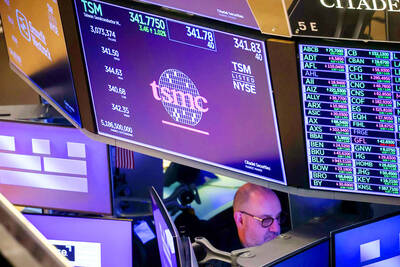
STRONG INTEREST: Analysts have pointed to optimism in TSMC’s growth prospects in the artificial intelligence era as the cause of the rising number of shareholders The number of people holding shares of chipmaker Taiwan Semiconductor Manufacturing Co (TSMC, 台積電) hit a new high last week despite a decline in its stock price, the Taiwan Depository and Clearing Corp (TDCC, 台灣集保) said. The number of TSMC shareholders rose to 2.46 million as of Friday, up 75,536 from a week earlier, TDCC data showed. The stock price fell 1.34 percent during the same week to close at NT$1,840 (US$57.55). The decline in TSMC’s share price resulted from volatility in global tech stocks, driven by rising international crude oil prices as the war against Iran continues. Dealers said
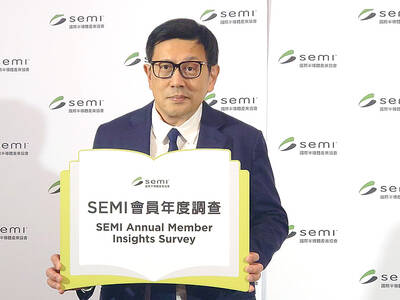
PRICE HIKES: The war in the Middle East would not significantly disrupt supply in the short term, but semiconductor companies are facing price surges for materials Taiwan’s semiconductor companies are not facing imminent supply disruptions of essential chemicals or raw materials due to the war in the Middle East, but surges in material costs loom large, industry association SEMI Taiwan said yesterday. The association’s comments came amid growing concerns that supplies of helium and other key raw materials used in semiconductor production could become a choke point after Qatar shut down its liquefied natural gas (LNG) production and helium output earlier this month due to the conflict. Qatar is the second-largest LNG supplier in the world and accounts for about 33 percent of global helium output. Helium is
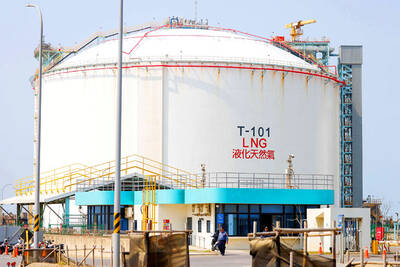
Taiwan’s natural gas supply remains stable through the end of May, despite rising concerns about potential disruptions to Qatari liquefied natural gas (LNG) supplies due to escalating conflicts in the Middle East, the Ministry of Economic Affairs said yesterday. The ministry in a statement said that Taiwan has completed preparations for natural gas supply and shipping schedules through the end of May. It has also made plans to increase natural gas imports from regions outside the Middle East in June to ensure a stable supply, it added. Taiwan sources natural gas from 14 countries and is not solely dependent on the Middle East,

China is clamping down on fertilizer exports to protect its domestic market, industry sources said, putting an additional strain on global markets that were already grappling with shortages caused by the US-Israeli war on Iran. China is among the largest fertilizer exporters — shipping more than US$13 billion of it last year — and it has a history of controlling exports to keep prices low for farmers. Shipments through the war-blocked Strait of Hormuz account for about one-third of the sea-borne supply. This month, Beijing banned exports of nitrogen-potassium fertilizer blends and certain phosphate varieties, sources said. The ban, which has not


 RSS
RSS