


A severe recession would slash US public wealth by about US$5 trillion, causing vastly more damage to Washington’s finances than just an increase in debt and deficits, the IMF said in a report on Tuesday.
Yet governments around the world, many of which face similar dangers, do not clearly publicize their overall net worths, it said.
This creates a potential blind spot for policymakers who could use this knowledge to head off economic risks, the IMF said.
The global crisis lender, which in Indonesia this week is staging its annual meetings with the World Bank, cut its outlook for global GDP on Monday by two-tenths to 3.7 percent through next year.
The fund pointed to rising trade tensions as a cause for worry and also predicted slower growth in the US next year and beyond.
Economists say the chances of a recession in the US are growing due to several factors, including trade tensions and mounting interest rates.
Beyond tax revenues and sovereign debts, a government’s balance sheet contains a range of other assets and liabilities, such as the state enterprises, land and natural resources it owns as well as the money it has to pay to fund public-sector employee pensions.
The difference between the two sides of the ledger is a country’s net worth.
“The scars from the global financial crisis are still evident on public wealth a decade later,” the report said, adding that the net worth of 17 advanced economies together was US$11 trillion lower than it had been prior to the crisis.
Countries that take such a broad approach to their finances might face lower borrowing costs and see higher revenues, making them more resilient in a downturn, the report said.
However, after a decade of recovery, the net worths of most G7 economies are now negative, it said.
China’s net worth has deteriorated to 8 percent of GDP because of off-budget borrowing by local authorities and poor returns from powerful government-run businesses, the IMF found.
Meanwhile, the net worth of the US has been in decline for nearly four decades. Worsening notably due to the global financial crisis, it had sunk by 2016 to negative 17 percent as a share of GDP, the report said.
The federal mortgage giants Fannie Mae and Freddie Mac, which the US government took over during the crisis, have lent a staggering amount — 44 percent of GDP — to the private sector.
However, the biggest source of risk comes from state and local government retirement pensions, which can lose money when Wall Street sinks — meaning the shortfall has to come out of local government budgets.
Towns and states then have to cut spending elsewhere, creating a drag on the economy.
In the US, such pension funds are already underfunded by about eight percent of GDP.
Using a hypothetical “stress test” scenario developed by the US Federal Reserve for banking regulation, the IMF found a severe recession would cut the value of the US’ publicly held assets by an amount equal to 26 percent of GDP by 2020.
At present levels, that would amount to about US$5 trillion.
The scenario, which imagines a deep global recession, rising interest rates, but collapsing stock and real-estate prices, would see sovereign debt balloon by 9 percent, but net worth dive by another 17 percent, mainly because falling real-estate prices would drag down the value of publicly owned structures.
Defaults on mortgages and student loans, as well as pension fund shortfalls would all jump sharply, the report found.
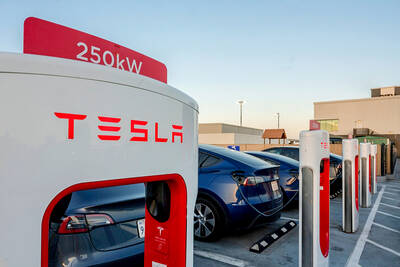
NEW IMPORTS: Car dealer PG Union Corp said it would consider introducing US-made models such as the Jeep Grand Cherokee and Stellantis’ RAM 1500 to Taiwan Tesla Taiwan yesterday said that it does not plan to cut its car prices in the wake of Washington and Taipei signing the Agreement on Reciprocal Trade on Thursday to eliminate tariffs on US-made cars. On the other hand, Mercedes-Benz Taiwan said it is planning to lower the price of its five models imported from the US after the zero tariff comes into effect. Tesla in a statement said it has no plan to adjust the prices of the US-made Model 3, Model S and Model X as tariffs are not the only factor the automaker uses to determine pricing policies. Tesla said

OpenAI has warned US lawmakers that its Chinese rival DeepSeek (深度求索) is using unfair and increasingly sophisticated methods to extract results from leading US artificial intelligence (AI) models to train the next generation of its breakthrough R1 chatbot, a memo reviewed by Bloomberg News showed. In the memo, sent on Thursday to the US House of Representatives Select Committee on China, OpenAI said that DeepSeek had used so-called distillation techniques as part of “ongoing efforts to free-ride on the capabilities developed by OpenAI and other US frontier labs.” The company said it had detected “new, obfuscated methods” designed to evade OpenAI’s defenses
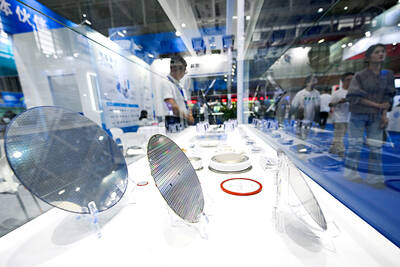
China’s top chipmaker has warned that breakaway spending on artificial intelligence (AI) chips is bringing forward years of future demand, raising the risk that some data centers could sit idle. “Companies would love to build 10 years’ worth of data center capacity within one or two years,” Semiconductor Manufacturing International Corp (SMIC, 中芯) cochief executive officer Zhao Haijun (趙海軍) said yesterday on a call with analysts. “As for what exactly these data centers will do, that hasn’t been fully thought through.” Moody’s Ratings projects that AI-related infrastructure investment would exceed US$3 trillion over the next five years, as developers pour eye-watering sums
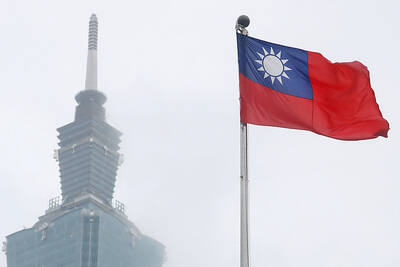
Bank of America Corp nearly doubled its forecast for the nation’s economic growth this year, adding to a slew of upgrades even after a rip-roaring last year propelled by demand for artificial intelligence (AI). The firm lifted its projection to 8 percent from 4.5 percent on “relentless global demand” for the hardware that Taiwanese companies make, according to a note dated yesterday by analysts including Xiaoqing Pi (皮曉青). Taiwan’s GDP expanded 8.63 percent last year, the fastest pace since 2010. The increase “reflects our sustained optimism over Taiwan’s technology driven expansion and is reinforced by several recent developments,” including a more stable currency,


 RSS
RSS