


The number of housing transactions in the six special municipalities last month totaled 17,173 units, a 2.5 percent increase from a month earlier as the property market emerged from Ghost Month and widespread flooding in the south.
The figure represented a 0.8 percent decline from the same period last year.
“The result is not bad,” Sinyi Realty Inc (信義房屋) researcher Tseng Ching-der (曾進德) said.
Taipei reported the fastest monthly increase of 11.9 percent to 2,179 units, as real-estate demand underpinned trading, Taipei City Government statistics showed.
New Taipei City posted a 6.2 percent monthly increase to 4,848 deals, while transactions in Tainan rose 5.4 percent to 1,676 units and those in Taichung gained 1.2 percent to 3,008, local government statistics showed.
Eastern Realty Co (東森房屋) communications manager Layla Yu (于靜芳) said that buying interest was much stronger last month, but a considerable number of potential investors stayed on the sidelines over concerns about falling prices and global uncertainty.
Transactions in Taoyuan and Kaohsiung declined 3.3 percent and 4.5 percent respectively to 2,830 and 2,499 units, local government statistics showed.
Overall transactions in the six special municipalities in the third quarter fell 1 percent quarter-on-quarter to 52,010 units, but gained 3 percent from a year earlier, the data showed.
That lent support to a small, but steady recovery in the domestic property market, Sinyi Realty said.
Evertrust Rehouse Co (永慶房屋) was less upbeat, saying that the annual increase is tapering, from an 8 percent gain in the first quarter to 4 percent in the third quarter, Evertrust researcher Jay Hsieh (謝志傑) said.
The increase is unlikely to gain traction this quarter due partly to a relatively higher base last year, Hsieh said.
Next month’s elections and the intensifying US-China trade war would deepen the cautious sentiment in the market, he said.

GROWING OWINGS: While Luxembourg and China swapped the top three spots, the US continued to be the largest exposure for Taiwan for the 41st consecutive quarter The US remained the largest debtor nation to Taiwan’s banking sector for the 41st consecutive quarter at the end of September, after local banks’ exposure to the US market rose more than 2 percent from three months earlier, the central bank said. Exposure to the US increased to US$198.896 billion, up US$4.026 billion, or 2.07 percent, from US$194.87 billion in the previous quarter, data released by the central bank showed on Friday. Of the increase, about US$1.4 billion came from banks’ investments in securitized products and interbank loans in the US, while another US$2.6 billion stemmed from trust assets, including mutual funds,
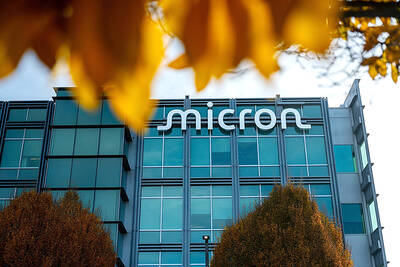
Micron Memory Taiwan Co (台灣美光), a subsidiary of US memorychip maker Micron Technology Inc, has been granted a NT$4.7 billion (US$149.5 million) subsidy under the Ministry of Economic Affairs A+ Corporate Innovation and R&D Enhancement program, the ministry said yesterday. The US memorychip maker’s program aims to back the development of high-performance and high-bandwidth memory chips with a total budget of NT$11.75 billion, the ministry said. Aside from the government funding, Micron is to inject the remaining investment of NT$7.06 billion as the company applied to participate the government’s Global Innovation Partnership Program to deepen technology cooperation, a ministry official told the

Taiwan Semiconductor Manufacturing Co (TSMC, 台積電), the world’s leading advanced chipmaker, officially began volume production of its 2-nanometer chips in the fourth quarter of this year, according to a recent update on the company’s Web site. The low-key announcement confirms that TSMC, the go-to chipmaker for artificial intelligence (AI) hardware providers Nvidia Corp and iPhone maker Apple Inc, met its original roadmap for the next-generation technology. Production is currently centered at Fab 22 in Kaohsiung, utilizing the company’s first-generation nanosheet transistor technology. The new architecture achieves “full-node strides in performance and power consumption,” TSMC said. The company described the 2nm process as

JOINT EFFORTS: MediaTek would partner with Denso to develop custom chips to support the car-part specialist company’s driver-assist systems in an expanding market MediaTek Inc (聯發科), the world’s largest mobile phone chip designer, yesterday said it is working closely with Japan’s Denso Corp to build a custom automotive system-on-chip (SoC) solution tailored for advanced driver-assistance systems and cockpit systems, adding another customer to its new application-specific IC (ASIC) business. This effort merges Denso’s automotive-grade safety expertise and deep vehicle integration with MediaTek’s technologies cultivated through the development of Media- Tek’s Dimensity AX, leveraging efficient, high-performance SoCs and artificial intelligence (AI) capabilities to offer a scalable, production-ready platform for next-generation driver assistance, the company said in a statement yesterday. “Through this collaboration, we are bringing two


 RSS
RSS