


TPK Holding Co Ltd (宸鴻), a maker of touch solutions and a supplier to Apple Inc, yesterday said its revenue last month showed a marked expansion from June, although it remained below last year’s level.
Consolidated revenue surged 56.5 percent to NT$9.31 billion (US$303.95 million), compared with NT$5.95 billion the previous month, hitting the highest monthly level since January.
Last month’s sales were 2.9 percent lower than NT$9.58 billion a year earlier, according to a statement the company posted on its Web site.
TPK did not elaborate on its sales performance for last month, although market watchers said the monthly increase might be due to ramped-up production to prepare for new product launches by clients later this quarter.
On July 26, TPK told investors that its internal target was to grow third-quarter revenue by 70 percent from the second quarter, which it said was a trough for this year.
The company at the time projected revenue for this quarter would reach the level it was during the same period last year, or about NT$30 billion, aligned with product launches.
Due to seasonal factors and product transition that led to weak capacity utilization rates and a low sales scale, TPK in the second quarter reported a net loss of NT$227 million, or losses per share of NT$0.56, its first quarterly loss in two years.
Second-quarter revenue decreased 14.7 percent quarterly and 20.6 percent annually to NT$17.79 billion amid declining shipments, particularly because of a legacy smartphone product from one of its clients approaching the end of production, the company said on July 26.
Apple accounted for 42 percent of TPK’s sales in the second quarter, down from 59 percent in the first quarter, according to an estimate by Yuanta Securities Investment Consulting Co (元大投顧).
From January to last month, TPK’s cumulative revenue totaled NT$47.95 billion, down 10.22 percent from NT$53.41 billion in the same period last year, company data showed.

Apple Inc increased iPhone production in India by about 53 percent last year and now makes a quarter of its marquee devices there, reflecting the US company’s efforts to avoid tariffs on China. The company assembled about 55 million iPhones in India last year, up from 36 million a year earlier, people familiar with the matter said, asking not to be named because the numbers aren’t public. Apple makes about 220 million to 230 million iPhones a year globally, with India’s share of the total increasing rapidly. Apple has accelerated its expansion in the world’s most populous country in recent years, bolstered

HEADWINDS: The company said it expects its computer business, as well as consumer electronics and communications segments to see revenue declines due to seasonality Pegatron Corp (和碩) yesterday said it aims to grow its artificial intelligence (AI) server revenue more than 10-fold this year from last year, driven by orders from neocloud solutions clients and large cloud service providers. The electronics manufacturing service provider said AI server revenue growth would be driven primarily by the Nvidia Corp GB300 server platform. Server shipments are expected to increase each quarter this year, with the second half likely to outperform the first half, it said. The AI server market is expected to broaden this year as more inference applications emerge, which would drive demand for system-on-chip, application-specific integrated circuits

Taiwan Semiconductor Manufacturing Co’s (TSMC, 台積電) share of the global foundry market rose to almost 70 percent last year amid booming demand for artificial intelligence (AI), market information advisory firm TrendForce Corp (集邦科技) said on Thursday. The contract chipmaker posted US$122.54 billion in revenue, up 36.1 percent from a year earlier, accounting for 69.9 percent of the global market, TrendForce said. Its share was up from 64.4 percent in 2024, it said. TSMC’s closest rival, Samsung Electronics, was a distant second, posting US$12.63 billion in sales, down 3.9 percent from a year earlier, for a 7.2 percent share of the global market. In the
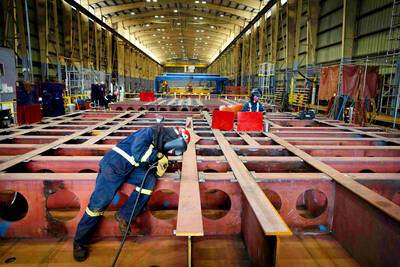
At a massive shipyard in North Vancouver, Canadian workers grind metal beams for a powerful new icebreaker crucial to cementing the country’s presence in the increasingly contested arctic. Icebreakers are specialized, expensive vessels able to navigate in the frozen far north. And “this is the crown jewel,” said Eddie Schehr, vice president of production at the Seaspan shipyard. For Canadian Prime Minister Mark Carney, who heads to Norway next Friday to observe arctic defense drills involving troops from 14 NATO states, Canada’s extreme north has emerged as a strategic priority. “Canada is and forever will be an Arctic nation,” he said ahead of


 RSS
RSS