


The Financial Supervisory Commission (FSC) yesterday said that it could end the practice of opening Taiwan’s equity market on Saturdays to make up for lost trading sessions due to national holidays.
FSC Chairman Wellington Koo (顧立雄) said that the practice — which a few times each year leads to Taipei being the only equity market in the world that is open for trading — could be halted as soon as next year, depending on the opinions of the Taiwan Securities Association’s (券商公會) member brokerages.
A decision by the brokerage industry and regulators should begin to form toward the end of October, Koo said on the sidelines of a financial technology forum in Taipei.
“While most countries have national holidays that put a halt on trading, Taiwan’s Saturday trading sessions are peculiar and need to be examined to be more in line with global norms,” Koo said.
Abolishing equities trading, clearing and settlement on makeup days has been debated for a decade, Koo said.
However, the decision to investigate the issue was not prompted by a suggestion included in the American Chamber of Commerce in Taipei’s latest Taiwan White Paper, he added.
The central bank, which oversees the foreign exchange market, does not agree. It said that currency trading must be kept open on all regular and makeup business days as long as banks are open for business.
Securities and Futures Bureau Deputy Director Chang Chen-shan (張振山) allayed concerns about the commission and central bank’s differing opinions, saying that the nation’s equity and currency markets operate independently of each other.
“The FSC does not need the central bank’s approval to abolish Saturday trading sessions,” Chang said.
In the past two years, Saturday makeup trading sessions have resulted in a far lower turnover compared with the normal daily average, skewing the market’s annual statistics, Chang said.
However, smaller brokerages had opposed halting Saturday trading in the past, in particular during periods of anemic daily turnover, saying that the move would result in lost earnings, he said.
The commission has observed that many brokerage employees have taken on the role of financial advisers and could spend their time on makeup days reaching out to their clients or performing other tasks, Chang said.

GROWING OWINGS: While Luxembourg and China swapped the top three spots, the US continued to be the largest exposure for Taiwan for the 41st consecutive quarter The US remained the largest debtor nation to Taiwan’s banking sector for the 41st consecutive quarter at the end of September, after local banks’ exposure to the US market rose more than 2 percent from three months earlier, the central bank said. Exposure to the US increased to US$198.896 billion, up US$4.026 billion, or 2.07 percent, from US$194.87 billion in the previous quarter, data released by the central bank showed on Friday. Of the increase, about US$1.4 billion came from banks’ investments in securitized products and interbank loans in the US, while another US$2.6 billion stemmed from trust assets, including mutual funds,

AI TALENT: No financial details were released about the deal, in which top Groq executives, including its CEO, would join Nvidia to help advance the technology Nvidia Corp has agreed to a licensing deal with artificial intelligence (AI) start-up Groq, furthering its investments in companies connected to the AI boom and gaining the right to add a new type of technology to its products. The world’s largest publicly traded company has paid for the right to use Groq’s technology and is to integrate its chip design into future products. Some of the start-up’s executives are leaving to join Nvidia to help with that effort, the companies said. Groq would continue as an independent company with a new chief executive, it said on Wednesday in a post on its Web
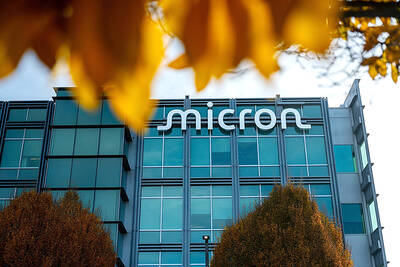
Micron Memory Taiwan Co (台灣美光), a subsidiary of US memorychip maker Micron Technology Inc, has been granted a NT$4.7 billion (US$149.5 million) subsidy under the Ministry of Economic Affairs A+ Corporate Innovation and R&D Enhancement program, the ministry said yesterday. The US memorychip maker’s program aims to back the development of high-performance and high-bandwidth memory chips with a total budget of NT$11.75 billion, the ministry said. Aside from the government funding, Micron is to inject the remaining investment of NT$7.06 billion as the company applied to participate the government’s Global Innovation Partnership Program to deepen technology cooperation, a ministry official told the

JOINT EFFORTS: MediaTek would partner with Denso to develop custom chips to support the car-part specialist company’s driver-assist systems in an expanding market MediaTek Inc (聯發科), the world’s largest mobile phone chip designer, yesterday said it is working closely with Japan’s Denso Corp to build a custom automotive system-on-chip (SoC) solution tailored for advanced driver-assistance systems and cockpit systems, adding another customer to its new application-specific IC (ASIC) business. This effort merges Denso’s automotive-grade safety expertise and deep vehicle integration with MediaTek’s technologies cultivated through the development of Media- Tek’s Dimensity AX, leveraging efficient, high-performance SoCs and artificial intelligence (AI) capabilities to offer a scalable, production-ready platform for next-generation driver assistance, the company said in a statement yesterday. “Through this collaboration, we are bringing two


 RSS
RSS